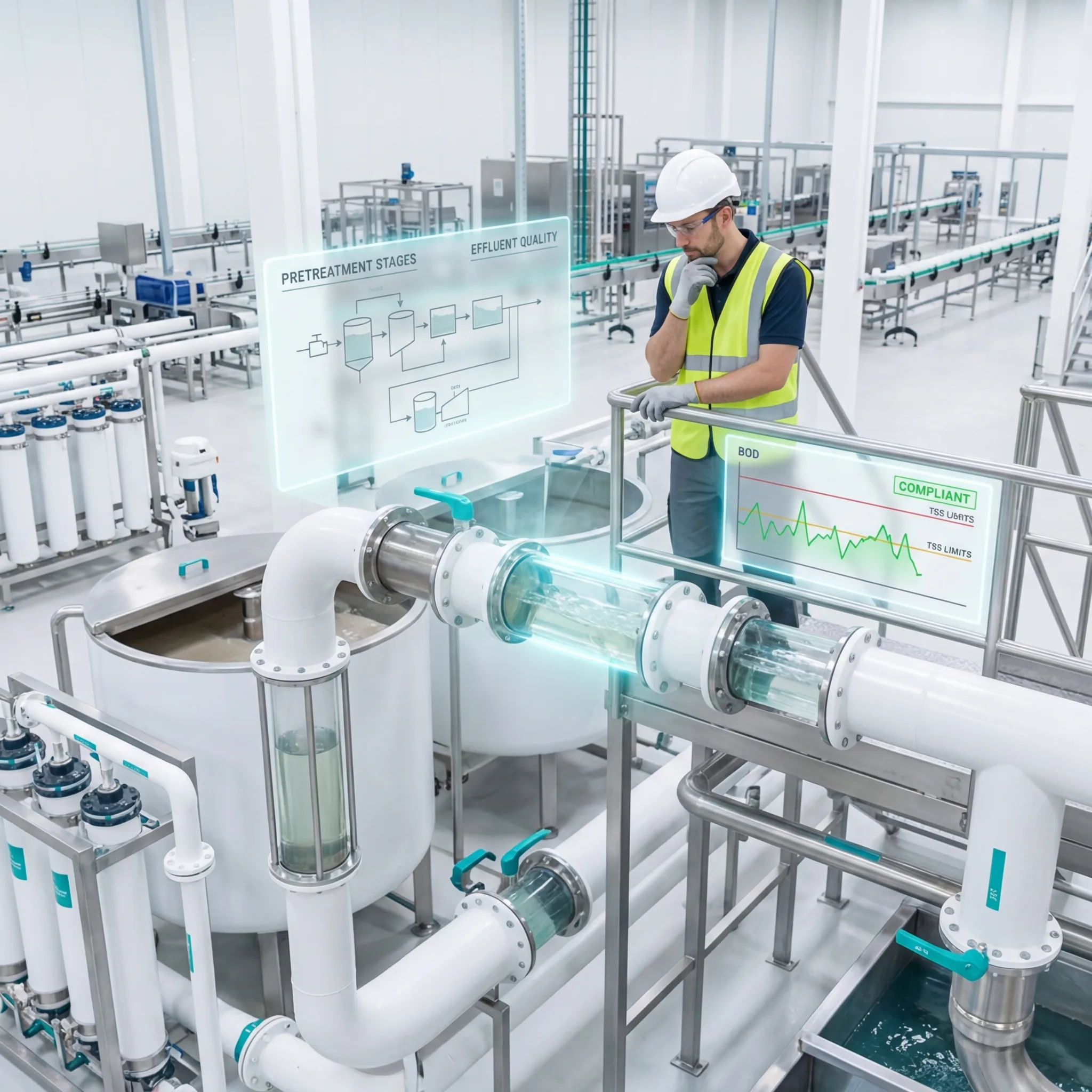
A juice processing plant discharges untreated wastewater to municipal system. Result: EPA violations, BOD/TSS exceed limits, fines accumulate, discharge permit revoked.
A compliant manufacturer installs pretreatment system: screening, fat separation, pH adjustment, settling. Wastewater meets discharge limits. Permit maintained. Regulatory compliance assured. Recycling of treated water reduces costs.
Wastewater treatment design is critical to environmental compliance and cost management.
The Wastewater System Framework
Key Design Elements:
- Waste stream characterization: BOD, TSS, oil/grease, pH
- Treatment stages: Physical, chemical, biological (as needed)
- Discharge limits: Local/federal regulations
- Monitoring: Regular testing and reporting
- Capacity: Design for peak flows (40-50% margin)
Wastewater Characterization
Food Processing Wastewater Typical Parameters:
| Parameter | Typical Range | Unit | Concern |
|---|---|---|---|
| BOD | 500-5000 | mg/L | Oxygen depletion |
| TSS | 300-2000 | mg/L | Solids settlement |
| Oil/Grease | 50-500 | mg/L | Clogs drains |
| pH | 3-9 | -- | Corrosion, aquatic impact |
| Temperature | 40-80 | degrees C | Thermal shock to microbes |
FDA Discharge Limits (typical municipal):
| Parameter | Limit | Measurement Frequency |
|---|---|---|
| BOD | 30-200 mg/L | 24-hour composite sample |
| TSS | 30-100 mg/L | Daily |
| Oil/Grease | under 10 mg/L | Weekly |
| pH | 6.5-8.5 | Daily |
| Temperature | under 38 degrees C | Daily |
Treatment Process Stages
Stage 1: Primary Treatment (Physical)
Purpose: Remove large solids, oils, fats
Methods:
- Screening: 6-25 mm mesh removes fiber, packaging
- Settling: Gravity sedimentation (1-3 hours retention)
- Fat separator: Oil/grease removal (floats to top, skimmed)
- Grit removal: Sand, gravel settle
Efficiency: BOD reduction 20-30%, TSS reduction 50-70%
Stage 2: Secondary Treatment (Biological)
Purpose: Decompose organic matter (BOD)
Biological process:
- Aerobic bacteria oxidize BOD into CO2 + biomass
- Time: 24-48 hours retention
- Aeration: Air diffusers supply oxygen
Common Methods:
- Activated Sludge: Most common, 85-95% BOD removal
- Lagoons: Simple, slower (3-7 days retention)
- Trickling Filter: Biofilm on media, moderate efficiency
Efficiency: BOD reduction 80-95%
Stage 3: Tertiary Treatment (Polish)
Purpose: Further purification if needed
Methods:
- Coagulation/flocculation: Chemical addition causes particle aggregation
- Sand filtration: Removes remaining TSS
- Activated carbon: Removes color, odor, residual organics
- UV/Ozonation: Disinfection if needed
Efficiency: TSS under 10 mg/L, BOD under 10 mg/L
Discharge Permit Requirements
Permit Types:
-
General Permit: Pre-approved for typical food processing
- Standard limits pre-determined
- Lower cost/complexity
- Limited customization
-
Individual Permit: Custom limits based on facility
- Site-specific analysis
- Longer approval (6-12 months)
- Higher cost
-
NPDES (National Pollutant Discharge Elimination System):
- Federal permit for surface water discharge
- Requires monitoring/reporting
- Annual renewal
Monitoring/Reporting:
- Frequency: Daily to monthly (depends on permit)
- Parameters: BOD, TSS, pH, flow rate
- Documentation: 3-year record retention required
- Reports: Monthly/quarterly submission to regulatory agency
On-Site Treatment Design Example
Facility: 100 kg/day juice processing
Wastewater generation: 200 L/day (2x product weight)
Treatment System Design:
-
Settling tank: 500 L capacity (2.5 days retention for sludge removal)
- BOD 2000 mg/L to 1400 mg/L (30% reduction)
- TSS 1000 mg/L to 300 mg/L (70% reduction)
-
Activated sludge tank: 1000 L, aerated
- Aeration: 10 hours retention
- BOD 1400 mg/L to 50 mg/L (96% reduction)
-
Settling clarifier: 500 L
- Separates treated water from sludge
- Final TSS: 10 mg/L
-
Discharge: 200 L/day of treated water to municipal system
- BOD: ~50 mg/L (below 200 mg/L limit)
- TSS: ~10 mg/L (below 100 mg/L limit)
Cost Considerations
| Component | Cost | Ongoing |
|---|---|---|
| Settling tank | Moderate | Labor (sludge removal) |
| Aeration system | Moderate | Power (10-15 kW) |
| Pumps/controls | Moderate | Maintenance |
| Permit/monitoring | High initial | Annual fees |
| Sludge disposal | Variable | ~10-20% of operating cost |
For food manufacturing companies, proper wastewater treatment ensures environmental compliance, reduces disposal costs, and improves community relations.