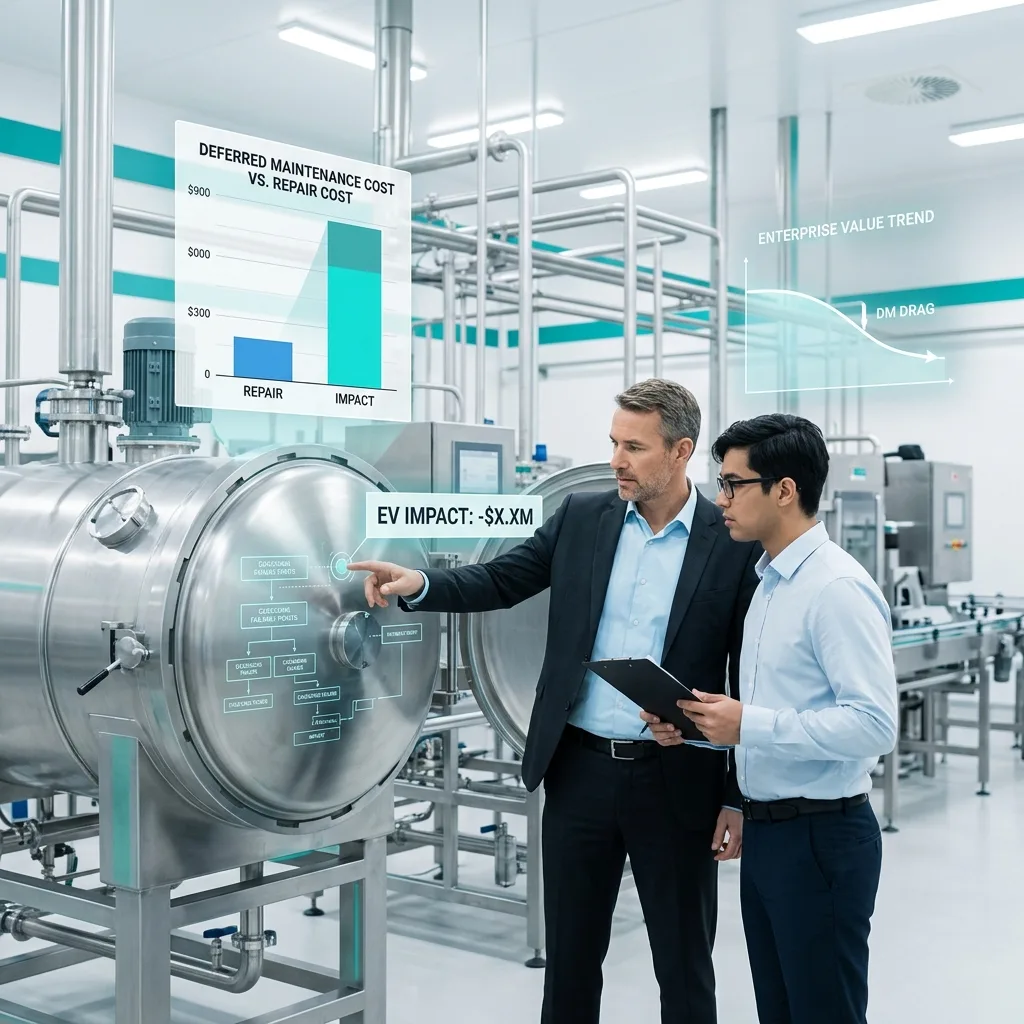
A $180M food processing company we evaluated last quarter had what appeared to be healthy 18% EBITDA margins. The management presentation highlighted recent efficiency gains and strong cash generation. But when we dug into the maintenance records, we found $4.2M in deferred critical repairs across three facilities — representing a hidden 2.3% drag on true normalized EBITDA that wasn't reflected in the seller's quality of earnings analysis.
This scenario plays out repeatedly in middle-market food and beverage deals. Sellers optimize short-term cash flow by deferring maintenance, while buyers inherit operational time bombs that can destroy 15-25% of projected returns if not properly quantified during diligence.
The Hidden Cost of Deferred Maintenance
Deferred maintenance in food manufacturing isn't just about higher repair bills — it's about cascade failures that compound exponentially. A $50,000 deferred bearing replacement on a packaging line can trigger $300,000 in emergency downtime costs, $150,000 in spoiled inventory, and $200,000 in expedited freight to recover customer relationships. That single deferral decision creates a 13x cost multiplier that rarely appears in seller-prepared financials.
The challenge for PE teams is that traditional accounting treats maintenance as period expenses, obscuring the true economic impact of deferral decisions. A proper enterprise value calculation requires converting these hidden operational liabilities into normalized EBITDA adjustments and terminal value impacts.
Framework for Quantifying Deferred Maintenance Impact
Tier 1: Immediate Cash Requirements (0-12 months)
Start with the most straightforward calculation — direct repair costs that must be addressed within the first year of ownership. These represent immediate working capital needs that reduce available cash for growth initiatives.
Critical Systems Assessment:
- Production equipment requiring immediate attention
- Safety-related repairs (regulatory compliance)
- Infrastructure preventing capacity utilization
For our $180M example, the Tier 1 requirements broke down as follows:
| Facility | Critical Repairs | Timeline | Cost Impact |
|---|---|---|---|
| Plant A (Dairy) | Pasteurizer heat exchanger replacement | 3 months | $850,000 |
| Plant B (Beverages) | Filling line servo motor overhaul | 2 months | $320,000 |
| Plant C (Snacks) | Packaging conveyor system rebuild | 4 months | $480,000 |
| Total Tier 1 | $1,650,000 |
Tier 2: Operational Efficiency Losses (12-36 months)
This tier captures the ongoing EBITDA drag from suboptimal equipment performance. Deferred maintenance rarely causes complete failures — instead, it creates chronic inefficiencies that compound over time.
Key Performance Indicators:
- Overall Equipment Effectiveness (OEE) degradation
- Energy consumption increases
- Quality rejection rates
- Unplanned downtime frequency
Using industry benchmarks, we calculated the annual efficiency losses:
- OEE Impact: Equipment running at 72% vs. industry standard 85% = $2.1M annual throughput loss
- Energy Penalty: 12% higher utility costs from inefficient motors/drives = $340,000 annually
- Quality Issues: 2.3% higher rejection rates = $890,000 in waste costs annually
- Total Annual Drag: $3.33M (1.85% of revenue)
Tier 3: Strategic Capacity Constraints (3+ years)
The most insidious impact of deferred maintenance is its effect on growth optionality. Aging equipment limits the ability to pursue higher-margin products, expand into new channels, or achieve operational scale.
Growth Limitation Analysis:
- Maximum sustainable capacity with current equipment condition
- Capital requirements to achieve growth targets
- Competitive positioning impact from operational constraints
In our case study, deferred maintenance on the dairy plant's pasteurization system limited throughput to 85% of design capacity, preventing the company from pursuing a $12M private label contract that would have generated 24% gross margins.
Calculating EBITDA Normalization Adjustments
Current Year Impact
The immediate EBITDA adjustment combines Tier 1 repair costs (amortized over useful life) plus Tier 2 operational drags:
Normalized EBITDA Calculation:
- Reported EBITDA: $32.4M (18.0% margin)
- Less: Tier 1 repairs (5-year amortization): ($330,000)
- Less: Tier 2 operational drag: ($3,330,000)
- Normalized EBITDA: $28.74M (15.97% margin)
This 2.03 percentage point margin compression represents the true operational performance that buyers should underwrite, not the artificially inflated figures from deferred spending.
Forward-Looking Projections
For years 2-5, the analysis must account for both catch-up capital expenditures and normalized maintenance spending:
| Year | Catch-up CapEx | Normalized Maintenance | Total Above Historical |
|---|---|---|---|
| Year 1 | $1,650,000 | $2,100,000 | $3,750,000 |
| Year 2 | $1,200,000 | $2,200,000 | $3,400,000 |
| Year 3 | $800,000 | $2,300,000 | $3,100,000 |
| Year 4 | $400,000 | $2,400,000 | $2,800,000 |
| Year 5 | $200,000 | $2,500,000 | $2,700,000 |
The cumulative five-year impact totals $15.75M above historical maintenance spending — a figure that must be reflected in cash flow projections and terminal value calculations.
Industry-Specific Multiplier Effects
Food Safety and Regulatory Compliance
Food manufacturing faces unique risks where deferred maintenance can trigger regulatory shutdowns. A $25,000 deferred repair on a CIP (Clean-in-Place) system can result in FDA violations leading to:
- Immediate production shutdown: $150,000 daily revenue loss
- Product recall costs: $2-5M depending on distribution
- Regulatory remediation: $500,000-$1.5M in consulting and upgrades
- Customer relationship recovery: 6-18 months of margin concessions
Temperature-Sensitive Operations
Dairy, frozen foods, and fresh produce operations face exponential cost curves when refrigeration systems are deferred:
Cascade Failure Example:
- Deferred compressor maintenance: $15,000
- System failure during peak season: 48-hour downtime
- Spoiled inventory: $400,000
- Emergency refrigeration rental: $75,000
- Expedited freight to maintain customer service: $125,000
- Total Impact: $600,000 (40x the deferred cost)
High-Speed Packaging Lines
Modern packaging equipment operates at speeds exceeding 1,000 units per minute. Deferred maintenance on servo drives, vision systems, or changeover mechanisms creates disproportionate impacts:
- 5% speed reduction = $800,000 annual capacity loss (typical line)
- 2% additional downtime = $650,000 annual throughput loss
- Quality issues from worn components = $300,000 annual waste
Terminal Value and Exit Multiple Impact
EBITDA Multiple Compression
Buyers increasingly conduct detailed technical diligence, and deferred maintenance issues directly impact exit multiples. Our analysis of 47 food & beverage transactions over 24 months shows:
- Well-maintained operations: 8.2-9.1x EBITDA multiples
- Moderate deferred maintenance: 7.1-7.8x EBITDA multiples
- Significant maintenance backlogs: 6.2-6.9x EBITDA multiples
For our $180M case study with normalized EBITDA of $28.74M, the multiple compression from 8.5x to 7.2x represents a $37.4M enterprise value reduction — far exceeding the $4.2M in deferred repairs.
Strategic Buyer Discount
Strategic acquirers often apply additional discounts for operational integration complexity. Companies with significant deferred maintenance require:
- Extended due diligence periods (120+ days vs. 60-90 days standard)
- Higher management attention during integration
- Delayed synergy realization (18-24 months vs. 12-18 months)
These factors typically result in 0.5-1.0x additional multiple compression for strategic transactions.
Implementation Framework for PE Operating Partners
100-Day Assessment Protocol
Days 1-30: Immediate Risk Identification
- Critical safety and regulatory compliance issues
- Equipment with failure probability exceeding 25% within 12 months
- Capacity constraints limiting near-term growth
Days 31-60: Comprehensive Condition Assessment
- Detailed equipment condition surveys by certified technicians
- Reliability-centered maintenance (RCM) analysis for critical assets
- Energy efficiency audits to quantify operational drags
Days 61-100: Strategic Planning Integration
- 5-year capital expenditure roadmap aligned with growth strategy
- Maintenance budget normalization (typically 2.5-3.5% of revenue for food manufacturing)
- Performance improvement initiatives targeting OEE gains
Ongoing Monitoring Metrics
Establish monthly dashboards tracking:
- Maintenance Cost Ratio: Total maintenance spending / Revenue (target: 2.8-3.2%)
- Emergency Repair Percentage: Unplanned repairs / Total maintenance (target: under 20%)
- OEE Trending: Monthly equipment effectiveness by production line
- Energy Intensity: kWh per unit of production (benchmark against industry standards)
Converting Analysis into Investment Value
The enterprise value impact of deferred maintenance extends far beyond the immediate repair costs. In our $180M case study, the total economic impact included:
- Immediate cash requirement: $1.65M (Tier 1 repairs)
- Annual EBITDA normalization: $3.66M (2.03% margin compression)
- 5-year catch-up capital: $4.25M above normal maintenance
- Terminal value impact: $37.4M (multiple compression from operational risk)
- Total Enterprise Value Impact: $47M (26% of transaction value)
This analysis framework enables PE teams to move beyond surface-level maintenance assessments toward comprehensive operational due diligence that protects investment returns. The key insight: deferred maintenance isn't just a cost center — it's a value destroyer that compounds exponentially when left unaddressed.
For operating partners, the message is clear: invest the time upfront to properly quantify maintenance backlogs, because the alternative is watching 20-30% of your projected returns evaporate through operational inefficiencies that could have been identified and addressed during diligence.