A soda manufacturer uses inconsistent carbonation. Result: Some bottles fizzy (perfect), some flat (low carbonation). Consumer complaints about inconsistency. Premium market positioning lost.
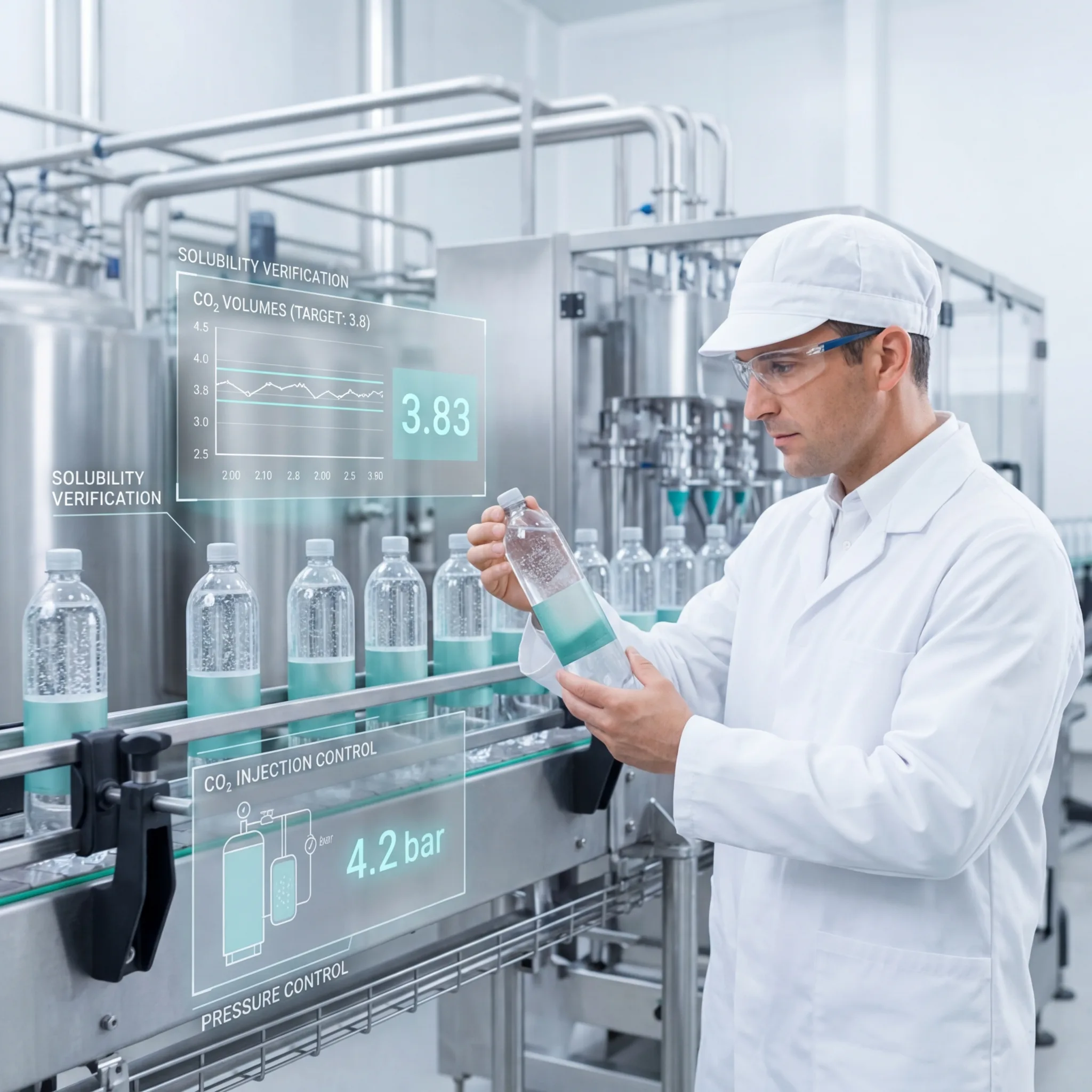
A modern facility uses precise carbonation control: Measure CO2 levels continuously, inject at exact pressure (2.5-4.0 volumes CO2), verify in every bottle. Result: Consistent carbonation (+/-0.2 volumes). Consumer satisfaction high. Premium market positioning maintained. Repeat purchase rate increases 40%.
Beverage carbonation precision directly impacts consumer satisfaction and brand loyalty.
The Carbonation Framework
CO2 Solubility (Henry's Law):
Amount of CO2 dissolved depends on:
- Pressure: Higher pressure = more CO2 dissolved
- Temperature: Colder = more CO2 dissolved
- Time: Longer contact = better saturation
Carbonation Levels (Volumes CO2):
Volumes = liters of CO2 gas at standard conditions per liter of liquid
| Beverage Type | Volumes CO2 | Characteristic | Examples |
|---|---|---|---|
| Still water | 0 | No carbonation | Water, juice |
| Lightly carbonated | 1.5-2.0 | Subtle fizz | Sparkling water |
| Moderately carbonated | 2.5-3.5 | Normal fizz | Most sodas, beer |
| Highly carbonated | 3.5-4.0 | Very fizzy | Premium sodas, champagne |
Carbonation Process
Step 1: Pre-cooling
Purpose: Cool beverage to optimal temperature for CO2 absorption
- Temperature target: 1-4 degrees C (cold maximizes solubility)
- Reason: Warm beverage (over 15 degrees C) releases CO2, won't absorb more
- Equipment: Plate heat exchanger or cold bath
- Time: 5-10 minutes typical
Step 2: CO2 Injection
Method: Inject pressurized CO2 gas into beverage
- Pressure: 2.5-4.0 bar typical (depends on target volumes)
- Equipment: Carbonator chamber (vessel with CO2 sparge pipe)
- Contact time: 1-3 minutes (allow dissolution)
- Agitation: Gentle stirring improves contact
Injection Types:
Batch Carbonation (Traditional):
- Load beverage in sealed tank
- Inject CO2 gas (bubbles rise through liquid)
- Time: 3-5 minutes
- Pressure monitoring: Gradual increase as CO2 dissolves
- Capacity: 50-1,000 L per batch
- Consistency: Moderate (depends on operator)
Continuous Carbonation (Modern):
- Beverage flows through carbonator continuously
- CO2 injected at entry point
- Pressure maintained constant (automated)
- Residence time: 30-60 seconds
- Capacity: 1,000-10,000 L/hour
- Consistency: Excellent (automated control)
Step 3: Pressure Verification
Purpose: Confirm target carbonation achieved
- Method: Pressure gauge (indicates CO2 in headspace)
- Or: Direct measurement (carbonometer analyzes CO2 content)
- Target: 2.5-4.0 bar (depending on target volumes)
- Tolerance: +/-0.1 bar acceptable
Step 4: Bottling
Equipment: Filler maintains pressure during bottling
- Pressure equalization: Pressure inside bottle = tank pressure
- Reason: Prevents CO2 loss during fill
- Speed: Maintains pressure until seal
- Capping: Hermetic seal essential (prevents escape)
Step 5: Capping/Sealing
Equipment: Capper under pressure
- Purpose: Seal bottle while pressurized
- Result: CO2 remains trapped (shelf-stable)
- Speed: 100-1,000 bottles/minute (automated)
Quality Control
Carbonation Measurement:
Method 1: Pressure gauge
- Fast, indirect measurement
- Correlates to CO2 content
Method 2: Carbonometer (Direct)
- Depressurizes sample, measures CO2 released
- Cost: $10-50K equipment
- Accuracy: +/-0.1 volumes
- Time: 1-2 minutes per sample
Validation Standard:
- Target: 3.0 +/- 0.3 volumes (example)
- Testing: Every batch or minimum hourly
- Action: If outside spec, adjust injection pressure
Shelf-Life Impact
CO2 Loss During Storage:
Sealed bottle at ambient:
- Week 1: 0-1% loss (minimal)
- Month 1: 2-5% loss (minor flatness noticeable)
- Month 3: 5-15% loss (significant flatness)
- Month 6: 15-30% loss (very flat)
Factors Affecting Loss:
- Seal integrity: Microleaks dramatically increase loss
- Temperature: Warm storage increases loss
- Light exposure: UV accelerates degradation
- Time: Longer = more loss
Extended Shelf-Life:
- High barrier bottle: Reduces permeation 50-70%
- Nitrogen flush: Replaces oxygen (preserves flavor)
- Refrigerated transport: Maintains carbonation
Cost-Benefit
| Factor | Cost/Impact |
|---|---|
| Continuous carbonator | $200-500K |
| Carbonometer equipment | $10-50K |
| Pressure monitoring | $5-20K |
| Total capital | $215-570K |
| Carbonation consistency | 70% to 98% on-spec |
| Consumer satisfaction | +40% repeat purchase |
| Waste reduction | 30-50% fewer rejects |
| Payback | 2-3 years |
For beverage manufacturers, precise carbonation control ensures consumer satisfaction and premium brand positioning.