A juice processor uses thermal pasteurization. Result: Vitamin C loss 20-30%, flavor degradation (cooked taste), premium juice positioning lost.
An innovative facility deploys UV-C treatment: 254 nm UV light inactivates pathogens without heat. Result: 4-5 log pathogen reduction, zero heat damage, vitamin C retained 95%+, fresh-pressed flavor preserved, premium pricing maintained (+$2-3/bottle).
UV treatment directly impacts nutrient preservation and fresh-squeezed positioning.
The UV Technology Framework
What is UV Light?
Ultraviolet light spectrum:
- Wavelength: 100-400 nm (beyond visible)
- UV-A: 315-400 nm (lowest energy)
- UV-B: 280-315 nm (moderate energy)
- UV-C: 100-280 nm (highest energy, germicidal)
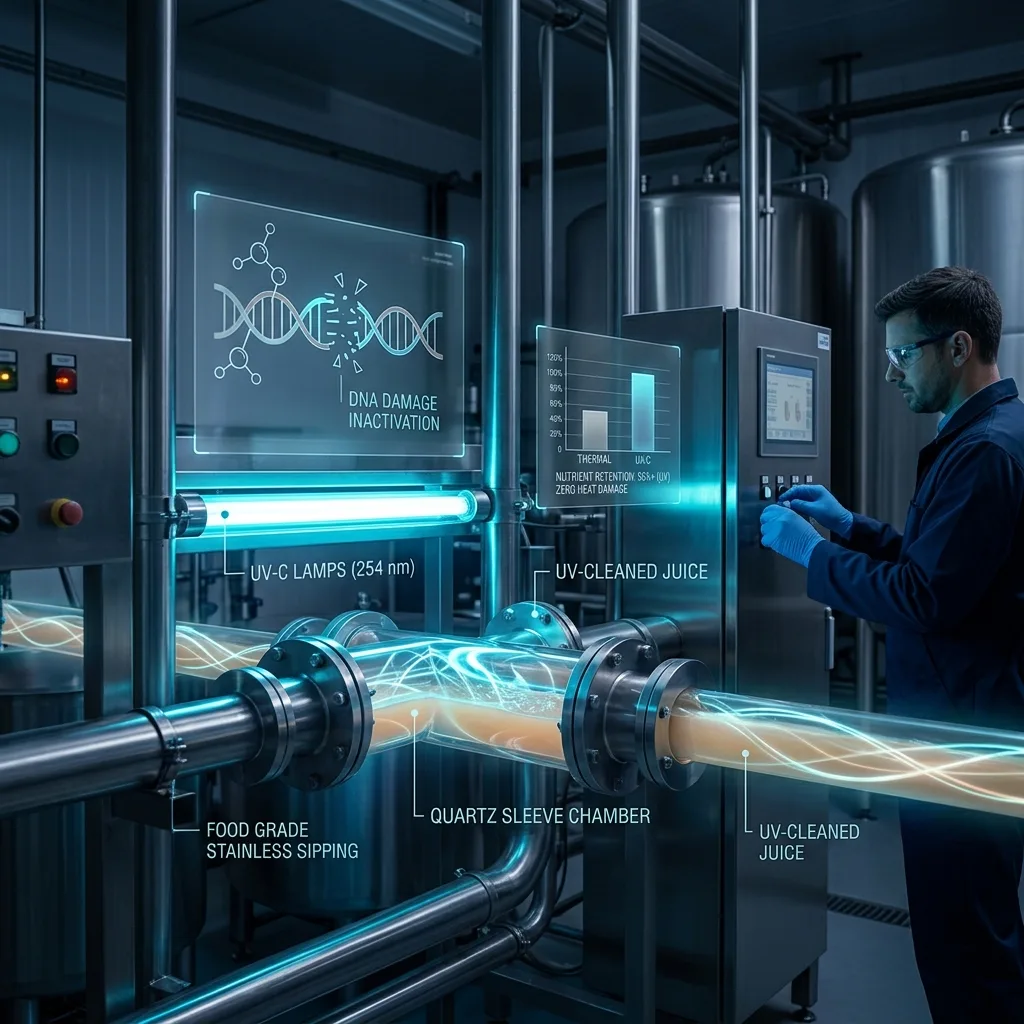
- Principle: Damages microorganism DNA (prevents replication)
vs. Other Pasteurization Methods:
| Method | Temperature | Time | Nutrients | Cost |
|---|---|---|---|---|
| Thermal (72 degrees C) | 72 degrees C | 15 sec | 70-80% retained | Low |
| HPP | Ambient | 3 min | 95%+ retained | High |
| UV-C | Ambient | under 1 sec | 95%+ retained | Medium |
UV-C Mechanism
How UV-C Kills Microorganisms:
- UV-C light penetrates microorganism cell
- Damages DNA/RNA (breaks nucleotide bonds)
- Replication prevented (cell dies)
- No viable offspring possible
- Result: Complete pathogen inactivation
Effectiveness:
| Organism | Log Reduction | UV Dose (mJ/cm2) |
|---|---|---|
| E. coli | 4-5 log | 20-40 mJ/cm2 |
| Salmonella | 4-5 log | 20-40 mJ/cm2 |
| Listeria | 3-4 log | 30-50 mJ/cm2 |
| Viruses | 3-4 log | 40-60 mJ/cm2 |
UV Treatment Process
System Components:
-
UV-C Lamp
- Wavelength: 254 nm (peak germicidal)
- Power: 20-100 watts typical
- Lifetime: 8,000-12,000 hours
- Cost: $100-500 per lamp
-
Reactor Chamber
- Design: Flows liquid past UV lamps
- Material: Quartz sleeves (UV-transparent)
- Mixing: Turbulent flow for uniform exposure
- Cost: $5-20K (scale-dependent)
-
Monitoring
- UV intensity sensor: Ensures adequate dose
- Validation: Continuous monitoring
- Control: Adjusts lamp intensity
- Cost: $1-5K
Treatment Parameters:
- UV dose needed: 20-40 mJ/cm2 (typical)
- Flow rate: 1-100 GPM (scale-dependent)
- Treatment time: under 1 second (very fast)
- Temperature rise: Minimal (under 1 degree C)
Applications
Application 1: Fresh Juice (Orange, Apple, Juice Blends)
Challenge: Pasteurization without heat damage
UV-C process:
- Fresh juice from press/extraction
- UV-C chamber: 254 nm light exposure
- Dose: 30 mJ/cm2 typical
- Result: 4-5 log pathogen reduction (E. coli, Salmonella)
- Outcome: Pasteurized, fresh taste, premium positioning
Shelf-life:
- Fresh (untreated): 2-7 days
- UV-C treated: 21-30 days refrigerated
- Advantages: No cooked taste, vitamins intact
Application 2: Beverage Water (Coconut Water, Aloe)
Challenge: Pathogen reduction in delicate beverages
UV-C advantage:
- No thermal stress
- No chemical residue
- Maintains original character
- Extends shelf-life 3-5x
Application 3: Liquid Egg
Challenge: Salmonella inactivation without texture damage
UV-C solution:
- Thermal: 60 degrees C x 3.5 min (affects texture)
- UV-C: under 1 sec, ambient temp (texture preserved)
- Result: Same safety, better quality
Advantages vs. Disadvantages
Advantages:
- Non-thermal: Flavor/nutrient preservation
- Fast: under 1 second treatment
- Clean: No chemical residue
- Energy-efficient: Moderate electricity use
- Premium positioning: "Flash-pasteurized"
Disadvantages:
- Clarity dependent: Turbid liquids reduce effectiveness
- Lamp maintenance: Replacement every 8K-12K hours
- Flow-dependent: Must achieve minimum UV dose
- Recirculation risk: Some organisms survive (less effective than HPP on pathogens)
Cost-Benefit Analysis
| Factor | Cost/Impact |
|---|---|
| UV-C chamber system | $20-100K |
| Lamps/replacement | $500-2K/year |
| Operating cost | $1-3K/month (electricity) |
| Shelf-life extension | 3-5x improvement |
| Nutrient retention | 95%+ (vs. 70% thermal) |
| Premium pricing | +$2-3/unit justified |
| Throughput | 10-100 GPM (scale) |
| ROI | 2-4 years (high-volume) |
For beverage processors, UV-C treatment enables premium fresh positioning.