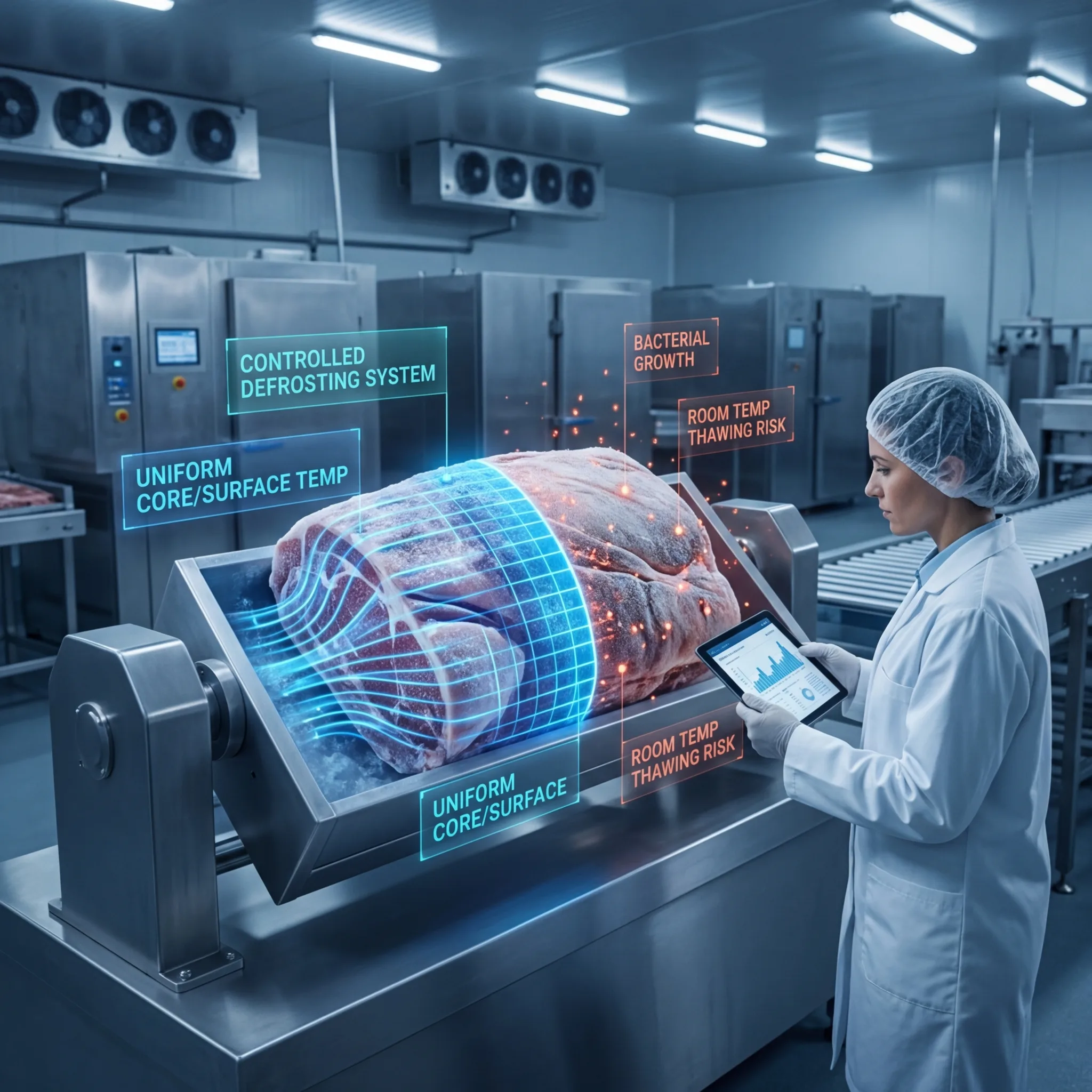
A food processor thaws frozen products at room temperature. Result: Surface reaches warm temps (15-20C) while core still frozen. Bacteria multiply on warm surface. Food safety risk. Inconsistent cooking results.
A modern facility uses controlled thawing: tempered air room (10-15C) with slow, uniform warming. Product thaws uniformly. Surface stays cool (prevents bacterial growth). Food safety assured. Product quality excellent.
Thawing equipment selection directly impacts food safety and product quality.
The Thawing Framework
Temperature Danger Zone:
Bacterial growth accelerates between 10-65C (50-149F)
- Most rapid: 30-37C (optimal pathogen temperature)
- Slow thawing risk: Surface in danger zone while core frozen
- FDA requirement: Keep surface under 10C during thawing
Uniform Thawing Objective:
Goal: Entire product reaches thawed state simultaneously
- Surface temperature = core temperature
- Minimize time in danger zone
- Preserve product texture and quality
Thawing Methods Comparison
Room Temperature Thawing (Uncontrolled):
Process: Product left at 20-25C ambient temperature
- Time: 2-4 hours for small items
- Surface temp: Reaches 15-20C (danger zone)
- Core temp: Remains frozen (0C) for extended period
- Risk: High bacterial growth on surface
Food Safety Risk:
- Surface in danger zone: 2-3 hours typical
- Bacterial doubling time: 20-30 minutes
- Potential multiplication: 16-64x in 2 hours
Conclusion: NOT RECOMMENDED
Water Immersion Thawing:
Process: Product submerged in cold water (10-15C)
- Time: 1-2 hours (faster than air)
- Temperature control: Water bath thermostat
- Circulation: Gentle water movement enhances uniformity
Advantages:
- Faster than air (water conducts heat 25x better)
- More uniform temperature distribution
- Moderate food safety risk
Disadvantages:
- Water absorption (weight gain, texture change)
- Microbial risk if water not sanitized
- Packaging must be waterproof
- Disposal of water
Application: Suitable for sealed products (vacuum-packed meat, seafood)
Tempered Air Room (Controlled):
Design: Refrigerated room with precise temperature control
- Temperature: 10-15C (above freezing, below danger zone)
- Humidity: 70-85% (prevents surface drying)
- Air circulation: Gentle fans (uniform temperature)
- Capacity: 1-10 tons product typical
Process:
- Frozen product loaded on racks
- Room temperature maintained at 10-15C
- Air circulation promotes uniform thawing
- Product monitored until core reaches 0-2C
- Transfer to processing or refrigerated storage
Time Requirements:
| Product | Thickness | Thaw Time |
|---|---|---|
| Ground meat | 5 cm | 3-4 hours |
| Chicken breast | 3 cm | 2-3 hours |
| Fish fillet | 2 cm | 1-2 hours |
| Turkey (whole) | 15 cm | 12-24 hours |
Advantages:
- Excellent food safety (surface under 10C throughout)
- Uniform thawing (minimal temp gradient)
- Product quality preserved
- No water absorption
Disadvantages:
- Slower than water immersion
- Capital cost ($10K-50K for room)
- Space requirement
Microwave Thawing:
Process: Electromagnetic radiation heats water molecules
- Time: 30-60 minutes (very fast)
- Temperature: Variable (hot spots possible)
- Application: Small items, individual portions
Advantages:
- Very rapid
- No water needed
- Compact equipment
Disadvantages:
- Uneven heating (cold and hot spots)
- Partial cooking possible (texture damage)
- Small capacity
- Quality degradation risk
Application: Emergency use only, not recommended for premium products
Thawing Method Selection Matrix
| Method | Time | Safety | Quality | Cost | Recommendation |
|---|---|---|---|---|---|
| Room temp | 2-4 hrs | Poor | Fair | Low | Not recommended |
| Water immersion | 1-2 hrs | Good | Good | Moderate | Acceptable |
| Tempered air | 3-6 hrs | Excellent | Excellent | Moderate-High | Best practice |
| Microwave | 30-60 min | Fair | Poor | Low | Emergency only |
Food Safety Validation
Time-Temperature Monitoring:
FDA recommendation:
- Surface temperature must stay under 10C during thawing
- Core temperature must reach 0-2C (thawed but cold)
- Transfer to processing within 2 hours of thawing completion
Validation Study:
- Place thermocouples: Surface and core
- Monitor temperature every 15 minutes
- Record when core reaches 0C (thawed)
- Verify surface never exceeded 10C
- Document total thawing time
Microbial Testing:
- Pre-thaw: Baseline microbial count
- Post-thaw: Verify no increase in pathogens
- Acceptance: Total plate count increase under 1 log
Equipment Design Considerations
Tempered Air Room Specifications:
- Insulation: R-30 minimum (energy efficiency)
- Refrigeration: 5-15 kW capacity (maintain 10-15C)
- Air circulation: 10-15 air changes per hour
- Humidity control: Dehumidifier (prevent condensation)
- Monitoring: Temperature sensors (multiple locations)
- Alarm: Out-of-range temperature alert
Cost Analysis:
| Item | Cost |
|---|---|
| Room construction | $20-40K |
| Refrigeration unit | $10-20K |
| Circulation fans | $2-5K |
| Controls/monitoring | $3-5K |
| Total capital | $35-70K |
| Operating cost | $50-100/day (energy) |
ROI Calculation:
Benefit: Food safety compliance, zero recalls Risk avoidance: $500K-2M (typical recall cost) Payback: under 1 year (through risk mitigation alone)
For food manufacturers, proper thawing equipment selection ensures food safety compliance and preserves product quality.