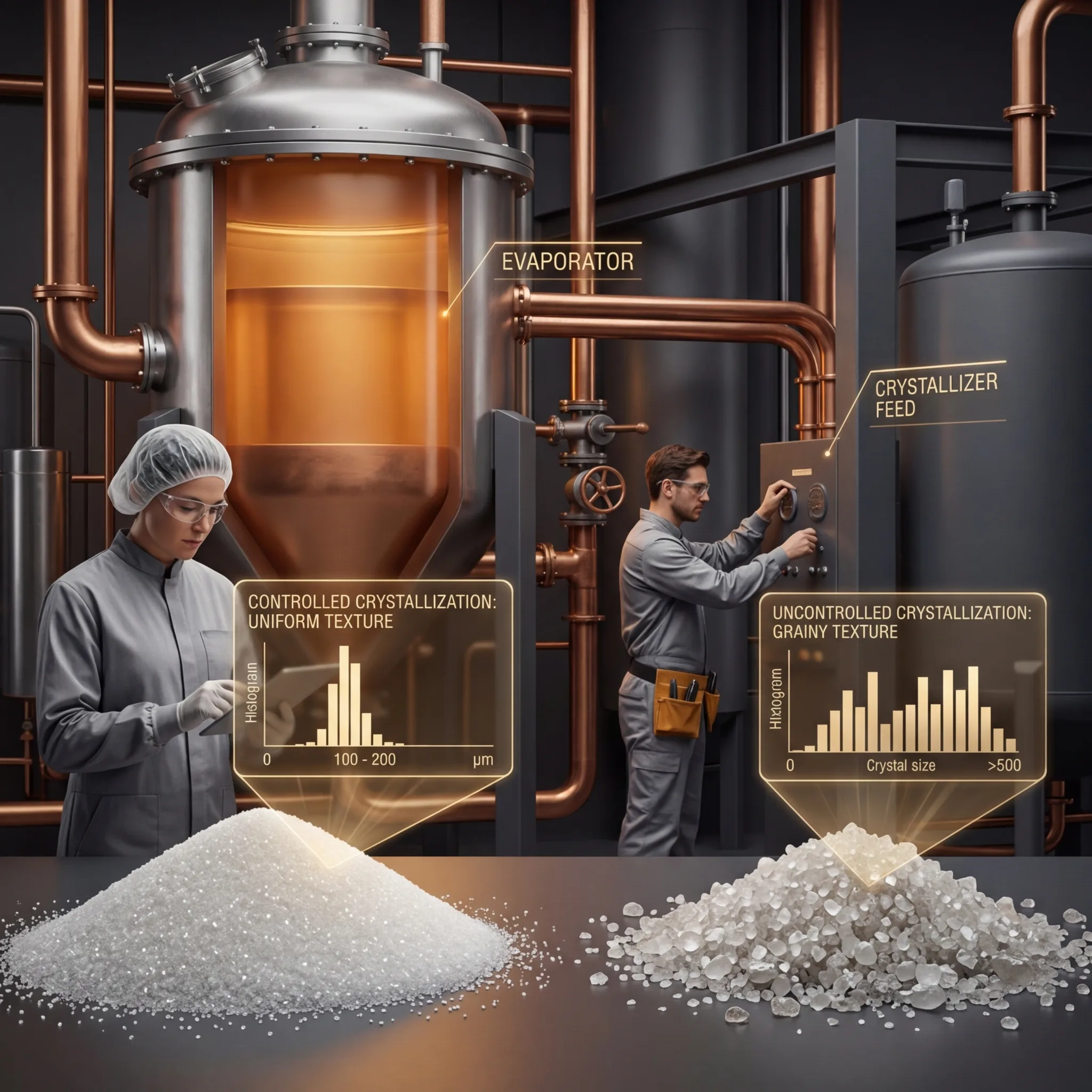
A candy manufacturer uses uncontrolled crystallization. Result: Crystal size inconsistent (some tiny, some large). Texture grainy/inconsistent. Consumer complaints. Product rejected for premium market.
A modern processor controls crystallization: Slow cooling, controlled nucleation, precision agitation. Result: Crystal size uniform (100-200 um). Texture smooth, glossy. Premium positioning achieved. 50% price premium realized.
Sugar crystallization control directly impacts candy texture and market positioning.
The Sugar Crystallization Framework
Crystallization Process:
Sucrose dissolved in water (supersaturated solution)
- Cooling reduces solubility
- Crystals form and grow
- Agitation/nucleation controls size
Crystal Size Effects:
| Crystal Size | Texture | Appearance | Application |
|---|---|---|---|
| under 50 um (fine) | Smooth, creamy | Glossy, translucent | Premium candies |
| 50-200 um (medium) | Slightly granular | Opaque/white | Standard candies |
| over 500 um (large) | Very granular | Chunky, dull | Rock candy, specialty |
Crystallization Control
Step 1: Evaporation (Create Supersaturation)
Equipment: Steam-jacketed evaporator
- Heat evaporates water
- Concentration increases
- Target: 90-95% sucrose (supersaturated)
- Temperature: Monitor to prevent browning (under 110 degrees C)
Step 2: Cooling (Initiate Crystallization)
Method: Controlled cooling
- Slow cooling: Large crystals (over 500 um)
- Rapid cooling: Small crystals (under 50 um)
- Optimal: Moderate cooling (50-200 um) = smooth texture
Cooling Profile Example:
- Hour 1: 110 degrees C to 80 degrees C (rapid, many nucleation sites form)
- Hour 2: 80 degrees C to 50 degrees C (moderate, crystals grow)
- Hour 3: 50 degrees C to 30 degrees C (slow, final size achieved)
Step 3: Nucleation (Start Crystal Formation)
Method: Introduce seed crystals
- Purpose: Control where crystals form
- Seed size: 10-50 um (small crystals as templates)
- Effect: Uniform crystal growth
Without seeds: Random nucleation (inconsistent size) With seeds: Uniform nucleation (consistent size)
Step 4: Agitation (Control Growth)
Equipment: Stirring paddle at controlled speed
- Purpose: Move crystals, promote uniform growth
- Stirring: Moderate (5-20 rpm typical)
- Too fast: Breaks forming crystals (fragments)
- Too slow: Uneven growth (size variation)
Step 5: Crystal Separation
Equipment: Centrifuge
- Spins at 1,000-3,000 rpm
- Separates crystals from remaining syrup (molasses)
- Recovery: 95%+ crystals separated
Molasses (Byproduct):
- Contains: 30-40% of original sugar
- Flavor: Very strong, bitter
- Application: Baked goods, dark rum, animal feed
- Value: $0.50-1.50 per lb (ingredient value)
Advanced Techniques
Continuous Crystallization (Modern):
Equipment: Crystallization vessel with programmable temperature/agitation
- Benefit: Consistent batch-to-batch (no variation)
- Control: Computer-monitored (precise parameters)
- Result: Uniform crystal size guaranteed
- Cost: $200K-500K equipment
Example Control:
- Temperature profile: Programmed hourly changes
- Agitation speed: Adjusted based on viscosity
- Time: Optimized (harvest crystals at peak quality)
Quality Testing
Particle Size Measurement:
Method: Laser diffraction analyzer
- Measures crystal size distribution
- Cost: $30-100K equipment
- Precision: +/-10 um accuracy
- Time: under 2 minutes per sample
Specification:
- Target: 100-200 um
- Tolerance: +/-25 um acceptable
- Testing: Every batch or minimum daily
Visual/Texture Assessment:
- Smoothness: Rubbed between fingers (feels smooth)
- Appearance: Uniform white (no browning)
- Shine: Glossy (not dull/matte)
Shelf-Life Impact
Crystalline Sugar (Shelf-Life):
- Ambient storage: 2+ years stable
- Moisture: under 0.5% (dry, stable)
- Storage: Sealed container, cool dry location
Syrup (Shelf-Life):
- Liquid/sticky: approximately 1 year (attracts moisture)
- Moisture: Can reach 10-15% (viscous)
- Storage: Requires higher barrier packaging
Crystalline over Syrup: Crystalline shelf-life 2-3x longer
Cost-Benefit
| Factor | Impact |
|---|---|
| Evaporator | $100-300K |
| Crystallization vessel | $100-300K |
| Particle analyzer | $30-100K |
| Total capital | $230-700K |
| Crystal consistency | 70% to 95% on-spec |
| Premium pricing | +$0.50-1.50/lb |
| Payback | 2-4 years |
For sugar processors, crystallization control enables premium candy positioning and extended shelf-life.