
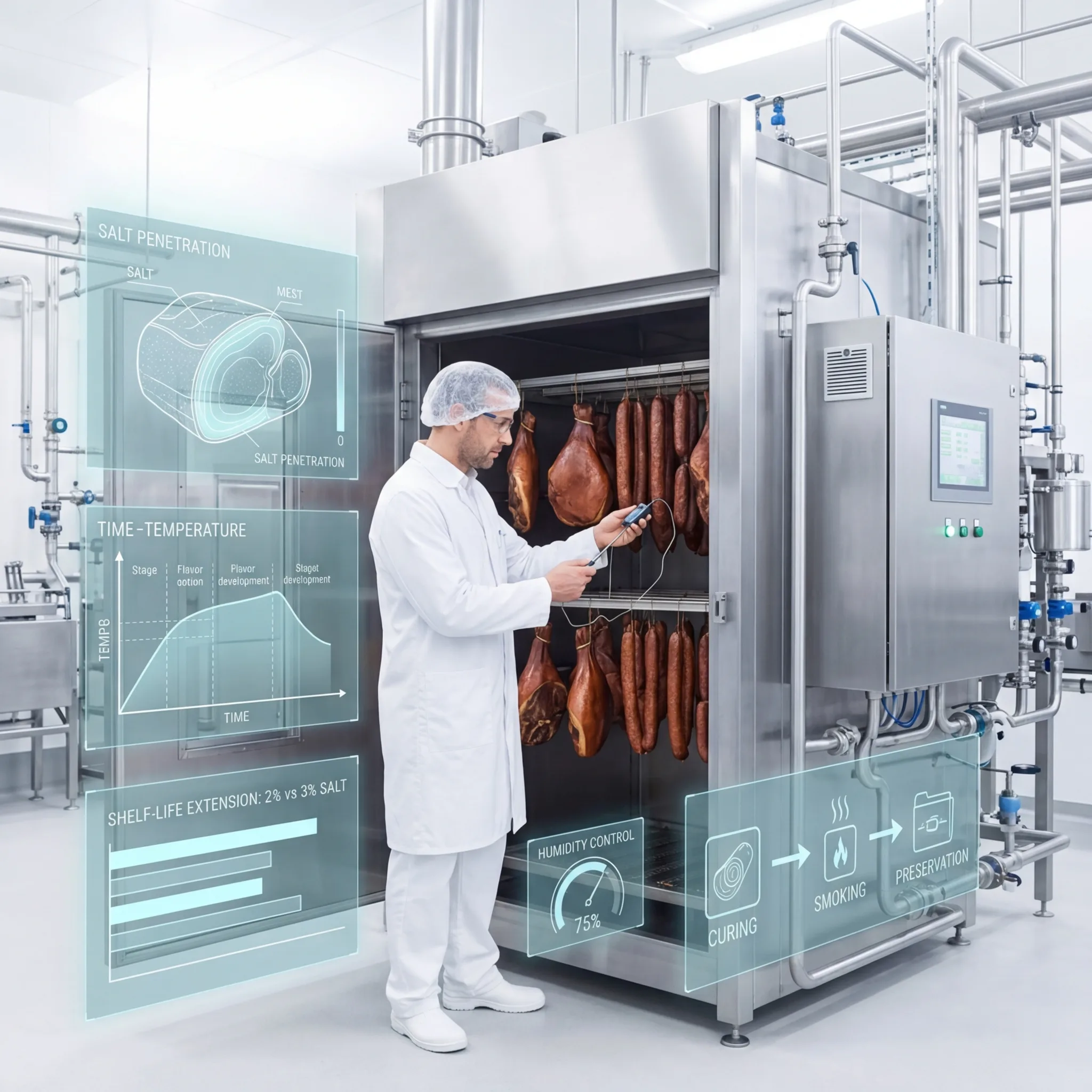
A meat processor uses traditional smoking with inconsistent temperature. Result: Smoke penetration varies. Some products under-smoked (weak flavor). Color inconsistent. Shelf-life variable due to uneven salt curing.
A modern facility installs temperature-controlled smokehouse with precise humidity and smoke density control. Flavor development consistent. Color uniform. Shelf-life extended through proper salt distribution.
Smoking and curing equipment selection directly impacts product flavor, shelf-life, and food safety.
The Smoking Framework
Curing Process (Pre-smoking):
Purpose: Remove moisture, develop flavor, preserve product
Methods:
-
Dry curing: Salt applied directly (12-48 hours)
- Salt penetrates 2-3 mm per 24 hours
- Water activity reduced (preservative effect)
- Flavor development significant
-
Wet brining: Salt dissolved in water (24-72 hours)
- More uniform salt distribution
- Faster penetration
- Moisture retention higher
Salt Impact:
| Salt Level | Effect | Food Safety | Shelf-Life |
|---|---|---|---|
| under 2% | Minimal preservation | under 7 days | Short |
| 2-3% | Adequate preservation | 2-3 weeks | Medium |
| 3-5% | Strong preservation | 1-3 months | Long |
| over 5% | Excessive (unpalatable) | over 3 months | Very Long |
Target: 2-3% salt (balances flavor and shelf-life)
Smoking Equipment Types
Batch Smokehouse (Chamber):
Design: Enclosed chamber with wood smoke and controlled environment
- Capacity: 100-500 kg per batch typical
- Temperature: 50-80C (cold smoking) or higher (hot smoking)
- Humidity: 70-85% (prevents case hardening)
- Smoke density: Visible smoke (subjective measurement)
- Time: 4-24 hours typical
Smoking Stages:
- Pellicle formation: 30-60 min at 50-60C (surface dries, accepts smoke)
- Smoke application: 4-12 hours (smoke penetration)
- Color development: Product to desired color (golden to dark)
- Cooling: 30-60 min to room temperature
Process Parameters:
- Wood type: Oak, hickory, apple (flavor profile)
- Smoke temperature: Must be under 80C (prevents cooking)
- Residence time: 4-12 hours typical
- Air circulation: Even exposure (fans help)
Advantages: Simple, batch traceability, artisanal control Disadvantages: Inconsistent results, long processing time, labor-intensive
Continuous Smokehouse (Conveyor):
Design: Product moves through smoke chamber on conveyor
- Capacity: 500-5,000 kg/hour (depending on speed)
- Temperature: Precisely controlled (+/-1C)
- Humidity: Automated control system
- Smoke density: Consistent (meters or sensors)
- Time: 30 min to 2 hours residence time
Advantages:
- High throughput
- Consistent product (exact time/temperature)
- Minimal labor
- Precise monitoring
Disadvantages:
- High capital cost ($100K-500K+)
- Complex operation
- Less artisanal control
Smoke Generation
Wood Smoke:
- Natural combustion of hardwood (oak, hickory, apple)
- Flavor compounds: Volatile aromatic compounds
- Temperature control: Essential (prevent cooking or cold spots)
Liquid Smoke:
- Concentrated smoke flavor (safer, more consistent)
- Application: Spray or immersion
- Flavor intensity: Controllable (dilution options)
- Advantage: No temperature concerns, consistent
Smoke House Temperature Management:
| Stage | Temperature | Duration | Purpose |
|---|---|---|---|
| Pellicle | 50-60C | 30-60 min | Surface drying |
| Cold smoke | 20-30C | 2-4 hours | Flavor without cooking |
| Warm smoke | 50-65C | 2-4 hours | Flavor + some cooking |
| Hot smoke | 70-85C | 1-2 hours | Cook + smoke |
Curing Validation
Salt Penetration Verification:
Cross-section analysis:
- Core samples taken at thickest point
- Salt concentration measured (chloride analysis)
- Target: Uniform distribution over 2% salt
Shelf-Life Testing:
- Accelerated shelf-life (elevated temperature storage)
- Microbial testing (no Listeria, Salmonella, pathogens)
- Sensory evaluation (flavor, color consistency)
- Moisture content measurement (food safety margin)
Food Safety Considerations
Critical Control Points (HACCP):
- Salt level: Minimum 2% (preservative effect)
- Temperature: Hot smoking 65C minimum or higher (pathogen reduction)
- Water activity: under 0.85 (inhibits pathogens)
- Cooling rate: under 1 hour from 65C to 10C (pathogen growth prevention)
Validation Required:
- Time-temperature studies (achieve target F-value or equivalent lethality)
- Salt distribution uniformity
- Shelf-life microbial testing
- Documentation for regulatory compliance
Equipment Selection Considerations
| Factor | Batch | Continuous |
|---|---|---|
| Capacity | Low (100-500 kg) | High (500-5,000+ kg/hr) |
| Consistency | Variable | Excellent |
| Control | Manual | Automated |
| Cost | Moderate | High |
| Artisanal | High | Lower |
| Labor | High | Low |
| Payback | -- | 3-5 years |
For meat and specialty food manufacturers, proper smoking equipment selection ensures consistent flavor development and food safety compliance.