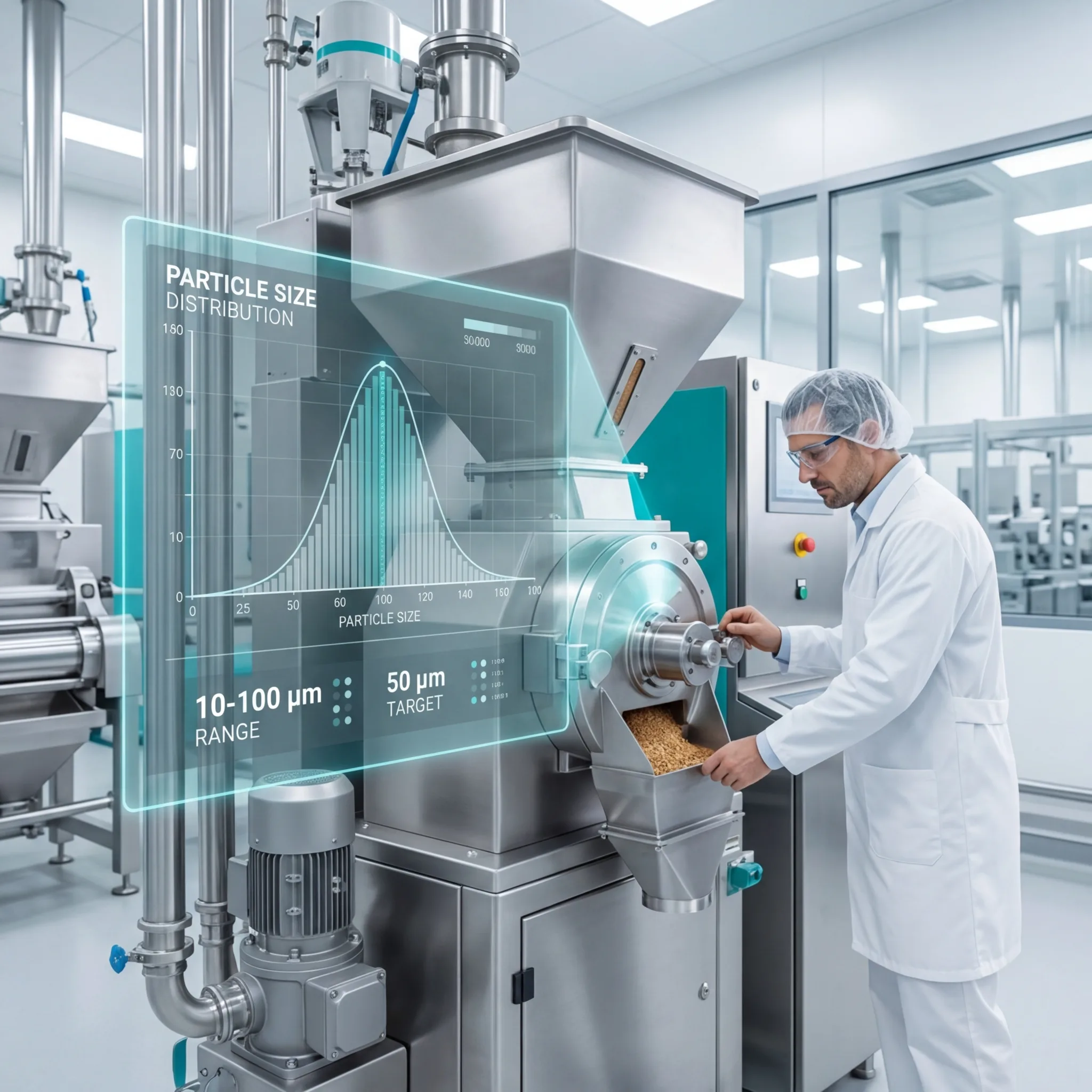
A spice manufacturer uses a laboratory grinder for production. Result: Inconsistent particle size (10-100 um range). Blending is difficult. Customer complaints on texture. Equipment wears rapidly.
A compliant manufacturer selects production-scale hammer mill with appropriate sieve selection (50 um target). Achieves 45-55 um particle size distribution (tight CV). Customer satisfaction improves. Equipment life doubles.
Size reduction equipment selection directly impacts product quality and consistency.
The Size Reduction Framework
Key Selection Criteria:
- Target particle size: um (microns)
- Particle size distribution: Range and consistency
- Feed material: Dry vs. moist, fiber content
- Production capacity: kg/hour
- Product sensitivity: Shear degradation, heat generation
- Maintenance: Blade wear, changeout frequency
- Sanitary design: NSF/ANSI compliance, cleanability
Grinding Equipment Types
Hammer Mill (Dry, Fibrous Materials):
Design: Rotating drum with swinging hammers, fixed sieve screen
Application: Spices, grains, dried fruit, coffee
- Feed size: under 50 mm
- Output size: 100 um - 2 mm (sieve dependent)
- Capacity: 50-500 kg/hour typical
- Power: 10-30 kW
Particle Size Control:
- Sieve opening size directly determines output size
- 50 um sieve results in ~40-60 um output
- 100 um sieve results in ~80-120 um output
- Smaller sieve = longer retention time = more passes = finer particles
Cost: Moderate capital, moderate operating
Pin Mill (Fine Grinding):
Design: Rotating disk with pins, stationary disk with pins, tight spacing
Application: Fine powders, spices needing texture
- Output size: 20-100 um (very fine)
- Capacity: 50-200 kg/hour
- Power: Higher (shear-intensive)
Advantages: Very fine, consistent particles Disadvantages: Heat generation, product degradation risk
Cost: Higher capital, higher operating cost
Ball Mill (Batch, Very Fine):
Design: Rotating drum with ceramic/steel balls
Application: Pigments, spices requiring ultra-fine texture
- Output size: 1-50 um (finest available)
- Capacity: Batch process (slower)
- Time: 30 minutes to several hours per batch
Advantages: Extremely fine, very consistent Disadvantages: Slow, expensive, heat generation
Cost: High capital, very high operating cost
Knife Cutter (Moist, Fresh Materials):
Design: Rotating blades against stationary blades
Application: Vegetables, herbs, cheese, meat
- Feed size: 10-50 mm chunks
- Output size: 1-10 mm diced (design-dependent)
- Capacity: 100-1000 kg/hour
Particle Consistency:
- Blade sharpness critical (dull blades = crushing, not cutting)
- Blade spacing determines size uniformity
- Speed (rpm) affects cutting efficiency
Cost: Moderate capital, lower operating cost
Shredder (Coarse Reduction):
Design: Rotating cylinder with blades on surface, food fed against
Application: Cheese, vegetables, nuts
- Output size: 2-5 mm
- Capacity: 100-500 kg/hour
- Power: Moderate
Cost: Low to moderate capital
Particle Size Distribution
Target Specification: "45-55 um average"
What does this mean?
- Average particle size: 50 um (0.050 mm)
- Range: Most particles between 40-60 um
- Coefficient of variation: under 15% (good uniformity)
Measurement Methods:
-
Sieve Analysis: Pass sample through progressively smaller sieves
- Results: % retained on each sieve
- Time: 30 minutes
-
Laser Diffraction: Light scattering by particles
- Results: Full distribution curve
- Time: 5 minutes
- Cost: Equipment expensive
-
Microscopy: Direct observation
- Manual counting (labor-intensive)
- Image analysis (automated, accurate)
Equipment Performance Trade-offs
| Equipment | Fineness | Consistency | Speed | Cost | Heat Risk |
|---|---|---|---|---|---|
| Hammer mill | Medium | Good | High | Low | Low |
| Pin mill | Fine | Excellent | Moderate | High | High |
| Ball mill | Very fine | Excellent | Low | Very high | High |
| Knife cutter | Coarse | Good | High | Low | Low |
Operational Considerations
Blade/Hammer Maintenance:
- Inspection: Every 40-80 hours operation
- Dullness check: Particle size increase over 10%
- Blade replacement cost: ~$500-1500 per set
- Wear rate: 100-200 hours per blade life
Heat Management:
Fine grinding generates heat (friction):
- Temperature rise: 20-50 degrees C possible
- Risk: Product degradation, texture change, flavor loss
- Solution: Batch grinding with cooling periods, or water-jacketed equipment
Cleanability:
- Disassemble for thorough cleaning
- Remove residues (hygiene/allergen control)
- Dry before next batch (moisture causes clogging)
For food manufacturing companies, proper size reduction equipment selection ensures consistent product quality and efficient operations.