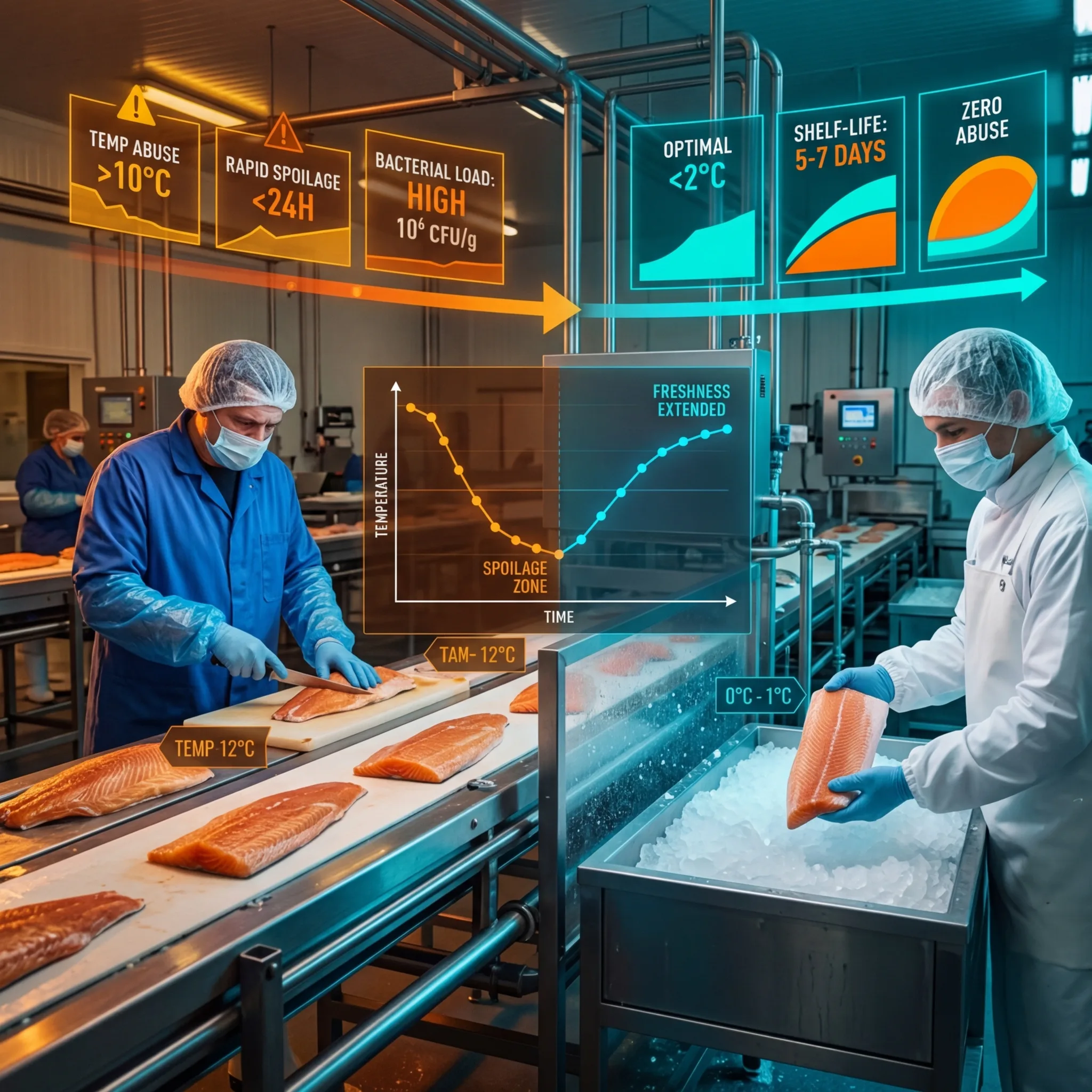
A fish processor receives fresh-caught salmon at 4 degrees C. Processing takes 8 hours (gutting, filleting, packaging). Result: Product arrives at customers at 12 degrees C (temperature abuse). Spoilage occurs within 24-36 hours. Returns and complaints. Consumer safety risk.
A modern processor ices fish immediately (maintains under 0 degrees C), processes within 2 hours, re-ices finished product. Product reaches customers at 1 degree C. Shelf-life extends to 5-7 days. Zero temperature abuse. Consumer satisfaction high.
Rapid seafood processing with precise temperature control directly impacts shelf-life and food safety.
The Seafood Processing Framework
Spoilage Speed Challenge:
Seafood spoils 5-7x faster than meat:
- Fresh meat: 7-14 days (if properly refrigerated)
- Fresh poultry: 3-7 days
- Fresh fish: 1-2 days (MUST be iced immediately)
Root Cause: Higher bacterial load in fish
- Seawater contains 10-100x more bacteria than air/soil
- Fish microbiota: 10^6-10^7 CFU/g initial load
- Meat microbiota: 10^2-10^3 CFU/g initial load
Temperature Control Critical:
| Temperature | Shelf-life |
|---|---|
| over 10 degrees C | 12-24 hours (spoils very fast) |
| 5-10 degrees C | 24-36 hours (spoils fast) |
| 0-5 degrees C (iced) | 3-5 days (acceptable) |
| under 0 degrees C (slurry ice) | 5-7 days (extended) |
Processing Steps
Step 1: Icing Immediately After Catch (CRITICAL)
Method: Pack in ice within 30 minutes of catch
- Purpose: Rapid cooling (stops bacterial growth)
- Temperature: Aim for 0-2 degrees C within 1 hour
- Ratio: 1 part fish : 3 parts ice minimum
- Monitoring: Verify temperature under 0 degrees C
Alternative: Slurry Ice
Mixture: Water + ice (-2 to -1 degrees C effective temperature)
- Advantage: Better contact than solid ice (faster cooling)
- Cost: Higher (specialized equipment needed)
- Result: Extended shelf-life (5-7 days vs. 3-5 days)
Step 2: Gutting (Remove Intestines)
Purpose: Remove contamination source (intestinal pathogens)
- Timing: Within 2-4 hours of catch (before spoilage)
- Method: Mechanical or manual knife cut
- Risk: Bile rupture (off-flavors), fecal contamination
- Precision: Must not cut into other organs
Equipment: Mechanical gutting machine
- Opens belly precisely
- Removes organs without rupture
- Efficiency: 95%+ success rate
- Hygiene: Better than manual (less contamination)
Step 3: Filleting
Yield varies by species:
- Salmon: 60-70% fillet (high meat content)
- Cod: 40-50% fillet
- Shrimp: 80% usable (after peeling)
- Halibut: 50-60% fillet
Manual Filleting:
- Skilled labor required (training 3-6 months)
- Variable quality (depends on operator)
- Yield: 85-90% fillet recovery
- Cost: High labor
Mechanical Filleting:
- Consistent quality
- Yield: 90-95% fillet recovery
- Speed: 2-4 fish per minute
- Capital cost: $100K-500K
Step 4: Trimming (Remove Dark Flesh)
Purpose: Remove strong-flavored tissues
- Dark flesh: Myoglobin-rich, strong "fishy" taste
- Location: Along lateral line (side of fillet)
- Removal: Knife or mechanical trimmer
- Yield impact: 2-3% loss
Step 5: Ice Again (Re-icing)
Purpose: Cool finished product back to under 0 degrees C
- Required: Yes (filleting generates frictional heat)
- Time: Must re-ice within 15 minutes
- Temperature: Confirm under 0 degrees C before packaging
Step 6: Packaging & Storage
- Vacuum seal or modified atmosphere packaging
- Temperature: Maintain under 0 degrees C during distribution
- Labeling: "Use by" date based on shelf-life
- Monitoring: Temperature monitoring devices recommended
Byproduct Valorization
Fish Frames (Bones, Head, Skin):
- Yield: 30-40% of total fish weight
- Application: Fish meal (animal feed)
- Value: $0.20-0.40/lb
- Market: Animal feed, aquaculture, fertilizer
Fish Oil:
- Yield: 5-15% of body weight (depends on species)
- Value: $2-5/lb (omega-3 premium)
- Market: Supplements, cosmetics, pharmaceuticals
Total Byproduct Value:
- Example: 100 lb salmon = 60 lb fillet, 40 lb frames
- Fillet: 60 x $8/lb = $480
- Frames: 40 x $0.30/lb = $12
- Oil (if recovered): 5 x $3/lb = $15
- Total value: $507 (+5% from byproducts)
Food Safety
HACCP Application:
CCP #1: Icing (maintain cold chain)
- Monitor: Temperature under 0 degrees C continuously
- Action: If temperature rises, ice again
CCP #2: Gutting (prevent contamination)
- Monitor: Visual inspection (no bile/feces)
- Action: Reject contaminated fish
CCP #3: Shelf-life control
- Monitor: Date coding, temperature maintenance
- Action: Use "First In, First Out" (FIFO) rotation
Microbial Testing:
- Pre-process: Baseline microbial count
- Post-process: Verify microbial load under 1 million CFU/g
- Pathogen testing: Listeria, Vibrio (species-dependent)
Cost-Benefit
| Factor | Impact |
|---|---|
| Ice equipment | $10-30K |
| Mechanical filleting | $200-500K |
| Re-icing system | $5-15K |
| Temperature monitoring | $5-10K |
| Total capital | $220-555K |
| Shelf-life improvement | 1-2 days to 5-7 days (3-5x extension) |
| Waste reduction | 40-50% spoilage reduction |
| Distribution reach | Regional to National possible |
| Payback | 2-3 years |
For seafood processors, rapid processing with precise temperature control enables extended shelf-life and expanded market reach.