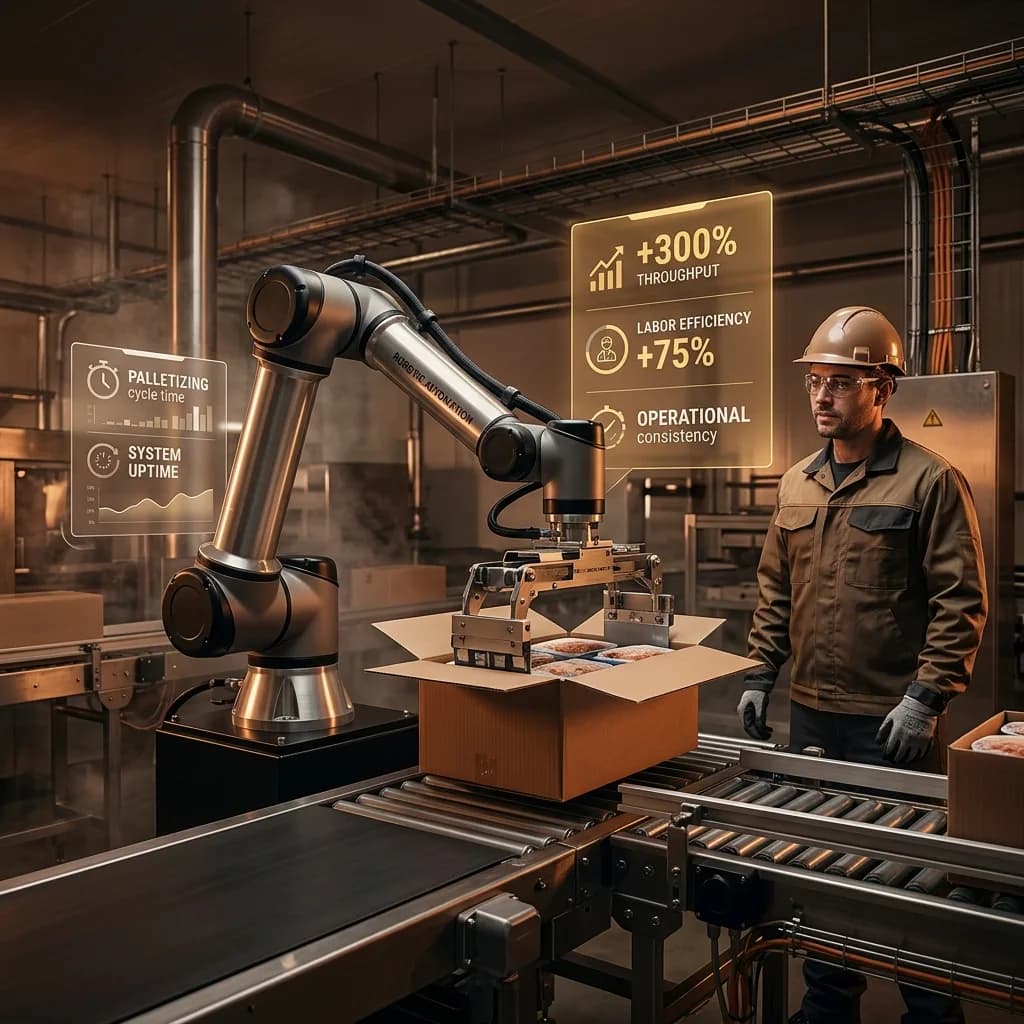
A frozen food facility employs 20 workers (palletizing, sorting, packaging manually). Result: High labor cost ($400K/year), inconsistent quality, low throughput (500 cases/shift), labor turnover 40%/year (backfill challenge).
An automated facility deploys 5 collaborative robots (palletizers, sorters, packagers). Result: 15 workers replaced (labor cost reduced $300K/year), 100% consistency, throughput 2,000 cases/shift (+300%), 24/7 operation possible, labor turnover eliminated (remaining workers retrained to supervision/maintenance).
Robotic systems directly impact labor efficiency and production throughput.
The Robotic Automation Framework
Labor Crisis Context (Post-2020):
Food industry challenges:
- Vacancy rate: 15-30% unfilled positions
- Wage pressure: +20-40% annual inflation
- Retention: 40-50% turnover typical
- Burnout: Repetitive work, physical strain
Robotic Solution:
Automation addresses labor shortage:
- Labor replacement: 1 robot replaces 2-5 workers
- 24/7 operation: No shift limits
- Consistency: Identical quality every time
- Safety: Reduces repetitive strain injury
Robotic Applications
Application 1: Palletizing (Most Common)
Task: Stack product cases onto pallets
Traditional (manual):
- Workers: 2-4 per shift
- Speed: 40-60 cases/hour per worker
- Cost: $30-40/hour x 8 hours = $240-320/shift
- Quality: Variable stacking, occasional damage
Robotic system:
- Equipment: 1 collaborative robot arm
- Speed: 200-400 cases/hour (3-5x faster)
- Cost: Operating cost $50-100/shift (electricity, maintenance)
- Quality: Perfect consistency, minimal damage
Economics (Single Robot):
- Equipment: $300-500K
- Annual labor replacement: 2-3 FTE = $80-120K
- Annual savings: $80-120K labor - $20K maintenance = $60-100K
- Payback: 3-5 years
Application 2: Sorting (Pick and Place)
Task: Sort products by size, color, weight (quality control)
Traditional (manual):
- Workers: 5-10 per line
- Speed: 20-40 units/minute
- Accuracy: 95-97% (human error)
- Cost: $40-50/hour labor
Robotic system:
- Equipment: 2-3 robot arms + vision system
- Speed: 60-120 units/minute (2-3x faster)
- Accuracy: 98-99%+ (AI-guided)
- Cost: Operating cost $100-150/shift
Economics (Complete sorting line):
- Equipment: $400-800K
- Annual labor replacement: 5-8 FTE = $200-320K
- Annual savings: $180-300K labor - $40K maintenance = $140-260K
- Payback: 2-3 years
Application 3: Portioning (Cutting, Weighing)
Task: Cut meat, portion portions (steaks, ground meat)
Traditional (manual):
- Skilled workers: 3-5 per line
- Speed: 80-150 portions/hour
- Accuracy: +/-10-20g variation
- Cost: $35-45/hour (skilled labor premium)
Robotic system:
- Equipment: 1-2 articulated robots + scales
- Speed: 300-500 portions/hour (3-4x faster)
- Accuracy: +/-2-5g (excellent consistency)
- Cost: Operating $80-120/shift
Economics:
- Equipment: $400-600K
- Annual labor replacement: 3-5 FTE = $120-200K
- Annual savings: $100-180K labor - $30K maintenance = $70-150K
- Payback: 3-5 years
Application 4: Packaging (Box Filling, Sealing)
Task: Fill boxes, apply labels, seal packages
Traditional (manual):
- Workers: 3-8 per line
- Speed: 40-80 packages/minute
- Accuracy: 98% (occasional errors)
- Cost: $30-40/hour
Robotic system:
- Equipment: 2-3 robot arms + vision
- Speed: 100-200 packages/minute (2.5-5x faster)
- Accuracy: 99.5%+ (consistent)
- Cost: Operating $100-150/shift
Cost-Benefit Summary
| Application | Equipment | Labor Replacement | Annual Savings | Payback |
|---|---|---|---|---|
| Palletizing | $300-500K | 2-3 FTE | $60-100K | 3-5 years |
| Sorting | $400-800K | 5-8 FTE | $140-260K | 2-3 years |
| Portioning | $400-600K | 3-5 FTE | $70-150K | 3-5 years |
| Packaging | $350-600K | 4-6 FTE | $80-150K | 3-5 years |
Collaborative Robots (Cobots)
Advantages over traditional industrial robots:
- Safety: Work alongside humans (no cages needed)
- Flexibility: Easy reprogramming for new tasks
- Cost: Lower initial investment ($50-150K vs. $300-500K traditional)
- Space: Smaller footprint
Ideal for: Mid-size facilities, product variation, smaller budgets
Implementation Considerations
Challenges:
- Capital investment: $300-800K upfront
- Programming: Requires technical expertise
- Integration: Must work with existing equipment
- Staff retraining: Shift workers to maintenance/supervision
Success factors:
- High-volume production (justifies ROI)
- Repetitive tasks (robots excel)
- Sufficient capital budget
- Management commitment to automation
For food manufacturers, robotic automation dramatically improves efficiency and addresses labor shortages.