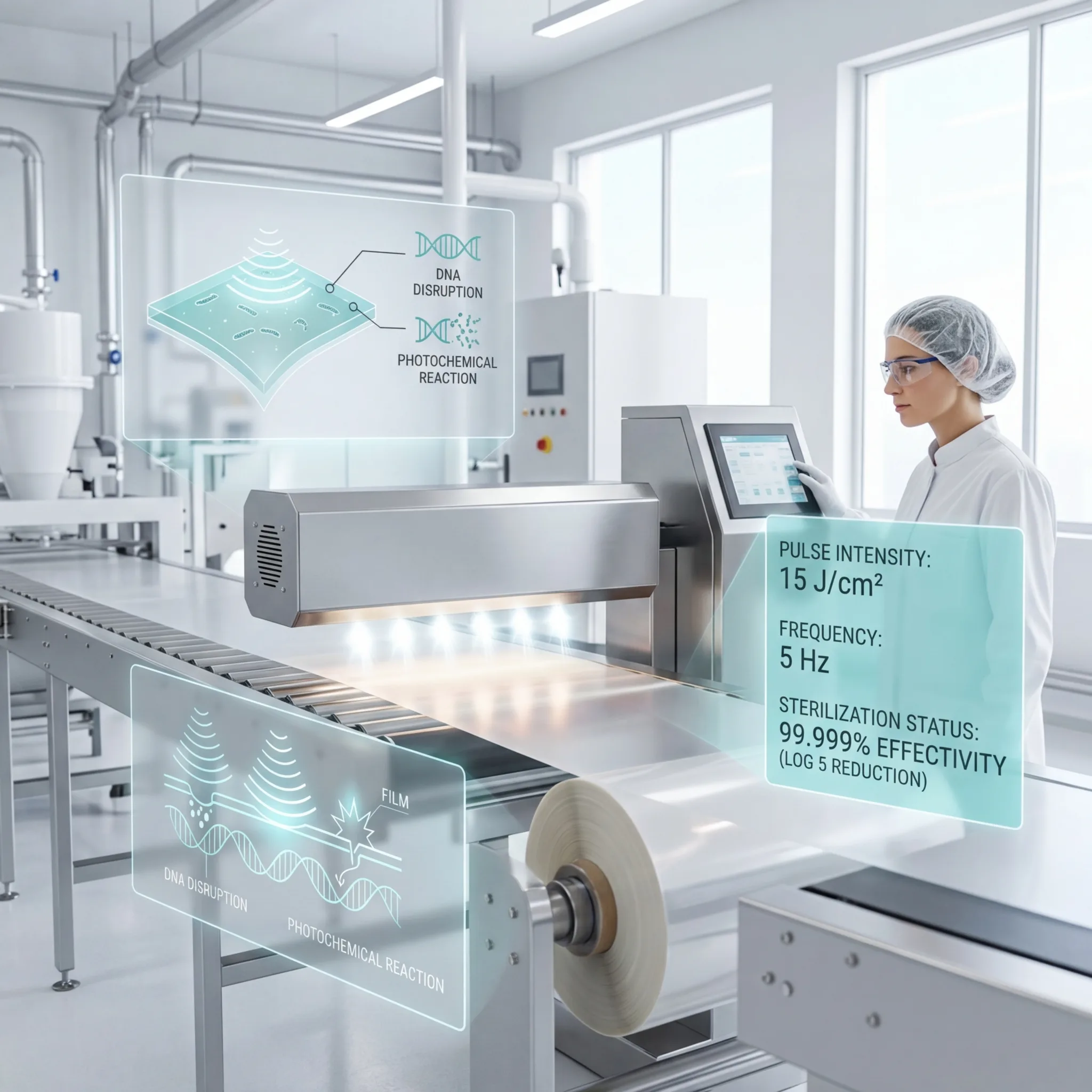
A food manufacturer must sterilize packaging film before filling (prevent product contamination). Result: Uses traditional methods (heat, chemicals). High energy cost. Chemical residues possible. Film degradation risk.
A modern facility installs pulsed light system. High-intensity light pulses sterilize film surface in seconds. No heat, no chemicals, no residue. Film integrity maintained. Product safety assured. Energy cost minimal. Sustainability advantage gained.
Pulsed light technology enables chemical-free surface sterilization.
The Pulsed Light Framework
Principle:
High-intensity light pulses (UV + visible spectrum) destroy microbes
- Wavelength: 170-2,600 nm (UV to near-infrared)
- Intensity: 0.1-20 J/cm2 per pulse
- Pulse duration: Microseconds
- Frequency: 1-10 pulses per second
Microbial Destruction Mechanism:
Light energy damages microbial DNA/RNA:
- UV-A (320-400 nm): Free radical formation
- UV-B (280-320 nm): DNA direct damage
- UV-C (200-280 nm): Most effective (DNA absorption peak at 254-265 nm)
- Visible (400-700 nm): Photochemical reactions
Result: Microbial death without heat or chemicals
Microbial Inactivation Effectiveness
Log Reduction by Microbe Type:
| Microbe | Log Reduction | Resistance Level |
|---|---|---|
| Vegetative bacteria | 2-3 log | Low (susceptible) |
| Viruses | 1-2 log | Moderate |
| Fungi/yeasts | 1-2 log | Moderate |
| Bacterial spores | under 1 log | High (resistant) |
Target Applications: Vegetative bacteria, yeasts, molds (surface contamination)
Applications
1. Packaging Film Sterilization
Purpose: Eliminate microbes on film surface before filling
- Process: Film passes under pulsed light system
- Effect: Reduces surface contamination 2-3 log
- Benefit: Improves product shelf-life
- Cost: Low (seconds of treatment)
2. Equipment Surface Decontamination
Purpose: Reduce microbes on processing equipment between products
- Process: Light pulses over equipment surfaces
- Effect: Reduces biofilm and surface microbes
- Benefit: Reduces chemical cleaning needs
- Frequency: Between product runs
3. Water Surface Treatment
Purpose: Decontaminate water for cleaning or product use
- Process: Water flows through pulsed light zone
- Effect: UV inactivates pathogens
- Benefit: No chemical disinfection residue
- Limitation: Only surface (not bulk water penetration)
Equipment Design
Pulsed Light System Components:
- Lamp: Xenon flash lamp or LED array
- Optics: Lens to focus/distribute light
- Pulse generator: Creates high-voltage pulses
- Cooling system: Manages heat from electronics
- Control system: Adjusts intensity/frequency
System Specifications:
- Treatment area: 10-100 cm2 typical
- Pulse intensity: 0.1-20 J/cm2
- Pulse duration: 1-10 microseconds
- Frequency: 1-10 Hz
- Treatment time: Seconds
Advantages vs. Traditional Methods
| Factor | Heat | Chemicals | Pulsed Light |
|---|---|---|---|
| Treatment time | Minutes-hours | Minutes | Seconds |
| Temperature change | Significant | Room temp | None |
| Chemical residue | None | Possible | None |
| Environmental impact | Energy use | Chemical disposal | Minimal |
| Film/surface integrity | Risk | Risk | No risk |
| Cost per treatment | Moderate | Moderate | Low |
Limitations
Surface-Only Treatment:
Pulsed light only sterilizes exposed surfaces
- Penetration: under 0.1 mm into product
- Application: NOT suitable for bulk product pasteurization
- Limitation: Must have line-of-sight to microbes
Shadowing Issue:
Microbes hidden in surface crevices may escape
- Solution: Ensure smooth, clean surfaces
- Pre-cleaning: Removes biofilm, debris
Resistant Microbes:
Bacterial spores less susceptible
- Spore reduction: under 1 log (insufficient for sterilization)
- Application: Supplements other methods
Regulatory Status
FDA Status:
- 21 CFR 179.41: Pulsed light treatment approved
- Approved for: Food surfaces, food packaging
- Not approved for: Direct food product treatment (surface-only)
- Limitation: Must be nontoxic light source
GRAS Status:
Some pulsed light systems recognized as GRAS (Generally Recognized As Safe)
Cost-Benefit Analysis
| Item | Cost |
|---|---|
| Equipment | $100-300K (system installation) |
| Operating cost | $0.01-0.05 per treatment cycle |
| Chemical savings | -$20-50K annually (reduced sanitizers) |
| Water savings | -$10-20K annually (less rinsing) |
| Energy | $5-10K annually |
| Payback | 2-4 years (chemical/water savings) |
Non-Financial Benefits:
- Reduced chemical use (sustainability)
- Improved product shelf-life
- No chemical residues (clean label advantage)
- Worker safety improvement (no chemical handling)
For food manufacturers, pulsed light technology enables chemical-free surface sterilization with sustainability and safety advantages.