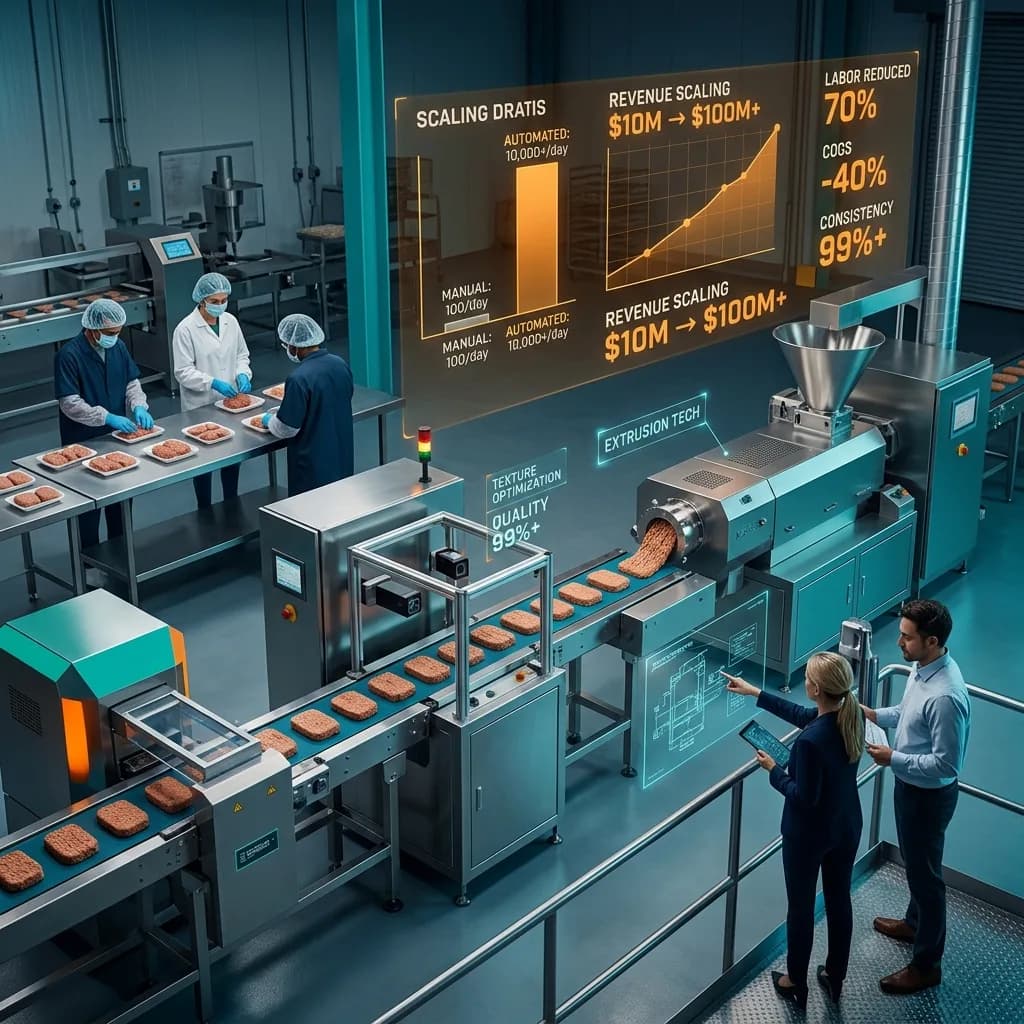
A plant-based startup produces hand-crafted products (100 units/day). Result: High labor cost, inconsistent quality, limited production capacity, scaling impossible.
An optimized facility implements automated plant-based production line: Extrusion technology, texture optimization, quality control automation. Result: 10,000+ units/day capacity, labor reduced 70%, consistency 99%+, COGS reduced 40%, premium market positioning maintained, revenue scaling $10M to $100M+ possible.
Production optimization directly impacts plant-based scaling economics.
The Plant-Based Scaling Framework
Market Context:
Plant-based market growth:
- Growth rate: 27% annually (vs. 2% conventional meat)
- Market size: $10B+ USA (2024)
- Consumer adoption: 39% US households buy plant-based
- Premium positioning: +30-100% pricing possible (early stage)
Scaling Challenge:
- Manual production: Labor-intensive, slow
- Inconsistent quality: Variable texture, taste
- High COGS: Labor cost limits profitability
- Capital intensive: Scaling requires major investment
Plant-Based Protein Sources
Common Plant Proteins:
| Source | Protein % | Taste | Texture | Cost |
|---|---|---|---|---|
| Pea | 25% | Neutral-mild | Mild | $1-2/lb |
| Soy | 35% | Neutral | Firm | $0.50-1.50/lb |
| Wheat gluten | 75% | Neutral | Very firm | $2-4/lb |
| Legume blend | 20-25% | Neutral | Mild | $1-2.50/lb |
Key Challenge: Replicating meat texture (fibrous, juicy)
Production Technologies
Technology 1: Extrusion
Process:
- Mix: Combine plant proteins, water, binders
- Heat: Apply controlled heat (60-80 degrees C)
- Pressure: Force through shaped die (creates fiber alignment)
- Cool: Rapidly cool for texture
- Result: Fibrous texture mimics meat
Advantages:
- Fast: Hundreds of units/minute
- Consistent: Uniform texture batch-to-batch
- Scalable: High throughput
- Texture: Closely mimics meat fiber
Equipment: $500K-5M (scale-dependent)
Technology 2: Fermentation
Process:
- Substrate: Plant protein-rich base
- Culture: Beneficial microorganisms (similar to cheese making)
- Fermentation: 7-14 days (develops umami, complexity)
- Result: Complex flavor, improved digestibility
Advantages:
- Flavor: Developed umami/complexity
- Nutrition: Fermented proteins more bioavailable
- Premium: Health perception (fermented foods valued)
- Sustainability: Lower inputs than fermentation
Equipment: $1-10M (fermentation tanks, controls)
Technology 3: 3D Printing
Emerging technology:
- Precision: Layer-by-layer building (controls structure)
- Customization: Different textures in single product
- Speed: Rapid production (industrial scale developing)
- Positioning: Premium, precision manufacturing perception
Equipment: $2-20M+ (high-end technology)
Quality Optimization
Texture Control:
Parameter optimization:
- Protein ratio: 70/30 pea/soy blend optimal
- Hydration: 45-55% water content (juiciness)
- Binders: 2-3% optimum (prevents crumbling)
- Extrusion pressure: 100-200 bar (fiber alignment)
- Temperature: 70-75 degrees C (optimal texture, nutrient retention)
Flavor Enhancement:
- Umami agents: Natural yeast extract, mushroom powder
- Browning: Maillard reaction development (roasting)
- Fat content: Coconut oil/MCT for mouthfeel
- Seasoning: Matches meat product category
Cost Dynamics
Production Cost Breakdown (per unit):
| Component | Manual | Automated |
|---|---|---|
| Raw materials | $2.00 | $2.00 |
| Labor | $3.00 | $0.30 |
| Equipment depreciation | $0.50 | $1.00 |
| Packaging | $0.50 | $0.50 |
| Overhead | $1.00 | $0.50 |
| Total COGS | $7.00 | $4.30 |
Result: Automation reduces COGS 40%, increases margins significantly
Cost-Benefit Analysis
| Factor | Cost/Impact |
|---|---|
| Automated production line | $2-10M |
| Installation/integration | $500K-2M |
| Staff retraining | $50-200K |
| Production capacity | 100 to 10,000+ units/day |
| COGS reduction | 40% improvement |
| Margin improvement | +25-40% |
| Payback period | 18-36 months |
| Revenue scaling | 10-100x potential |
For plant-based manufacturers, production optimization enables scaling and profitability.