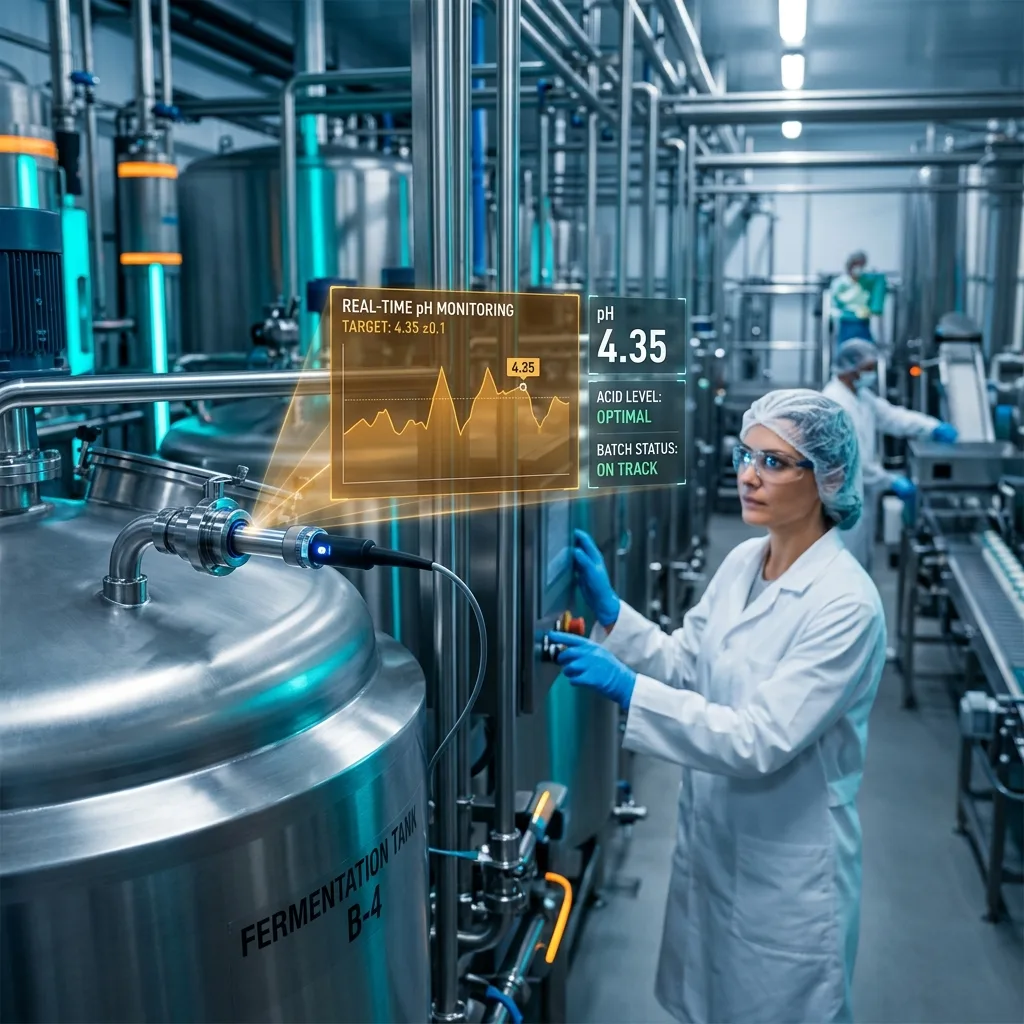
A yogurt facility relies on end-of-batch pH testing. Result: Batch variability (pH 4.2-4.6 range), inconsistent texture, rework needed, production delays.
An optimized facility installs inline pH sensors. Result: Real-time pH monitoring, automated fermentation control (target pH 4.35 +/-0.1), consistent yogurt texture, zero rework, throughput +25%, consistent product quality.
pH sensors directly impact fermentation consistency and production efficiency.
The pH Sensor Framework
What is pH?
Measure of acidity/alkalinity:
- Scale: 0-14 (7 = neutral)
- Food range: Typically 2-8 (acidic)
- Precision critical: +/-0.2 pH units affects taste, texture, safety
Importance in Food:
- Fermentation: Lactic acid bacteria lower pH (yogurt, cheese, kimchi)
- Preservation: Low pH (4.6 or under) prevents Clostridium botulinum
- Texture: pH affects protein gel formation (yogurt)
- Flavor: pH influences taste perception
pH Sensor Technology
Sensor Types:
-
Glass Electrode Sensors
- Principle: Ion-selective electrode
- Accuracy: +/-0.05 pH units
- Response time: 30-60 seconds
- Cost: $100-500 per sensor
-
Ion-Selective Electrode (ISE)
- Principle: Selective ion measurement
- Accuracy: +/-0.1 pH units
- Response time: 10-30 seconds
- Cost: $200-800 per sensor
-
Optical pH Sensors
- Principle: Fluorescence-based measurement
- Accuracy: +/-0.05 pH units
- Response time: 1-5 seconds (fast)
- Cost: $500-2K per sensor
Sensor Components:
| Component | Function |
|---|---|
| Electrode | Measures ion concentration (pH) |
| Reference electrode | Provides voltage reference |
| Amplifier | Converts electrode signal to pH |
| Transmitter | Sends pH data to controller |
| Housing | Protects sensor (stainless steel typical) |
Fermentation Monitoring Applications
Application 1: Yogurt Production
Challenge: Achieve target fermentation pH consistently
Process:
- Start: Fresh milk (pH ~6.8)
- Addition: Lactic acid bacteria (LAB) culture
- Fermentation: LAB consume lactose, produce lactic acid
- Target pH: 4.35 (optimal flavor, texture)
- Detection: Real-time pH sensor monitors
- End point: Automatically detected, fermentation stops (cooling)
Traditional approach:
- End-of-batch lab testing
- Result: Batch variability (pH 4.2-4.6 range)
- Texture inconsistency
Sensor approach:
- Real-time monitoring
- Automated end-point detection (+/-0.1 pH tolerance)
- Consistent target pH (4.35 +/-0.05)
- Texture consistency +95%
Result:
- Quality: Consistent
- Rework: Eliminated
- Throughput: +20-30%
Application 2: Kimchi Fermentation
Challenge: Control fermentation rate (product stability)
Monitoring:
- Start: pH ~5.5 (vegetables + seasonings)
- Fermentation: Lactobacillus reduce pH daily
- Target: pH 4.0-4.5 (traditional taste)
- Day 1: pH 5.2-5.3
- Day 2: pH 4.8-4.9
- Day 3: pH 4.4-4.5 (ready)
- End point: Verified by pH sensor
Real-time benefit:
- Early end detection: Avoid over-fermentation
- Consistency: Same taste batch-to-batch
- Process optimization: Adjust temperature if pH drifts
Application 3: Beverages (Kombucha, Kefir)
Challenge: Monitor acid production (taste control)
Process:
- Start: Sweetened tea (pH ~5.5)
- Addition: Starter culture (SCOBY/kefir grains)
- Fermentation: Bacteria/yeast produce acids
- Target: pH 2.8-3.5 (desired tartness)
- Monitoring: Real-time pH sensors prevent over-fermentation
Benefit:
- Taste consistency: Predictable tartness
- Safety: Confirmed pH under 4.6 (prevents pathogens)
- Process time: Reduces guesswork
Sensor Maintenance and Calibration
Calibration:
Perform weekly (or as needed):
- Buffer solution pH 7.0: Verify neutral point
- Buffer solution pH 4.0: Verify acid point
- Adjustment: If drift detected, recalibrate
- Documentation: Record calibration date/time
Storage:
- Between use: Store in pH 7.0 buffer solution
- Never dry: Drying damages electrode
- Temperature: Room temperature storage
Replacement:
- Glass electrodes: Every 6-12 months (typical lifetime)
- ISE sensors: Every 12-24 months
- Optical sensors: Every 24-36 months (longer)
Cost-Benefit Analysis
| Factor | Cost/Impact |
|---|---|
| pH sensor (each) | $100-2K |
| Transmitter/controller | $1-5K |
| Installation | $2-5K |
| Total investment | $3-12K per line |
| Rework reduction | 5-10% to under 1% |
| Consistency improvement | +90-95% |
| Throughput increase | +20-30% |
| Maintenance/calibration | $500-1K/year |
| ROI | 12-24 months |
For fermentation-based manufacturers, pH sensors enable consistency and efficiency.