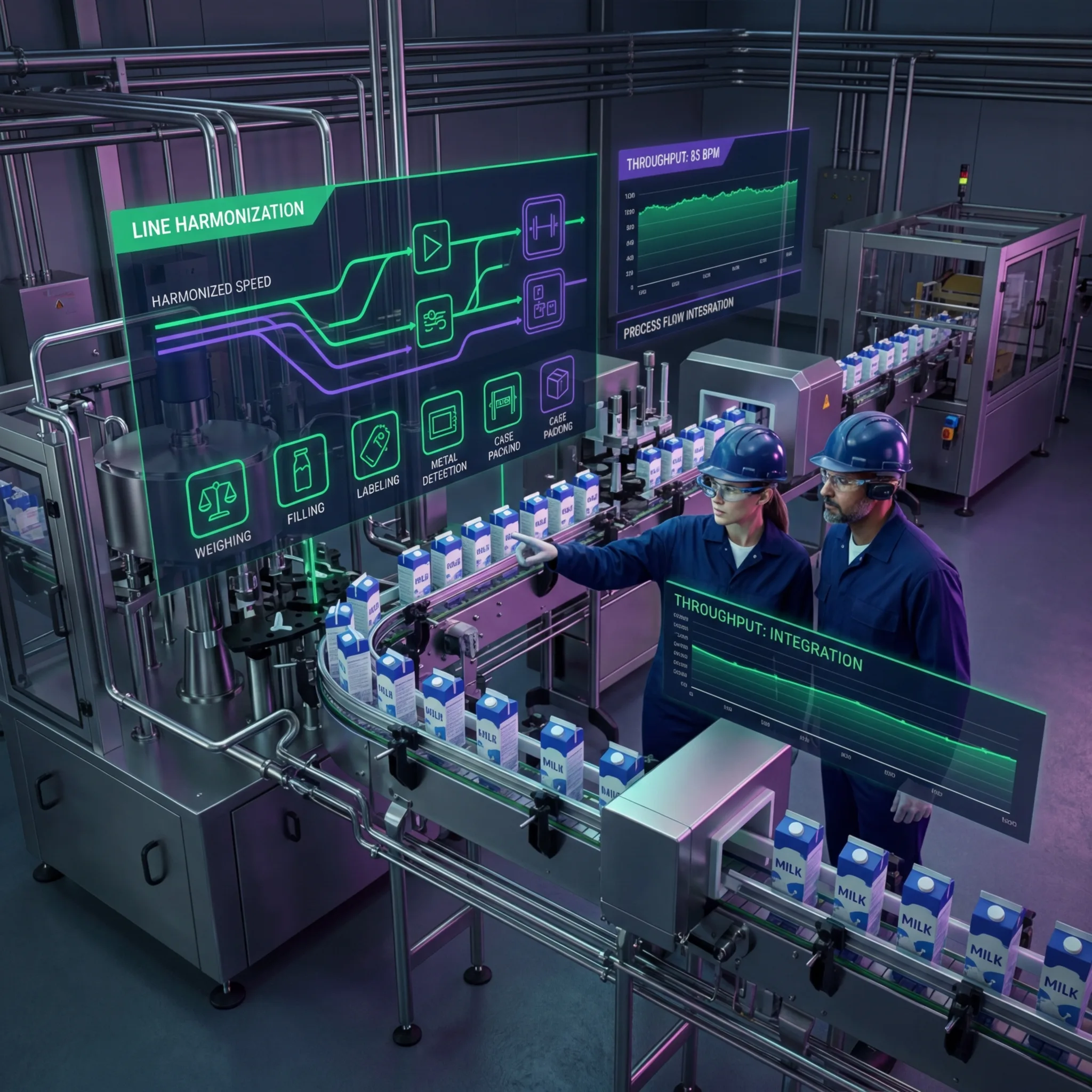
A dairy manufacturer adds new packaging equipment piece-by-piece without planning integration. Result: Speed mismatches cause bottlenecks, product backup at weighers, rejected packages, labor costs increase 35%.
A planned manufacturer designs complete line with harmonized speeds: filler, capper, labeler, metal detector, and case packer all synchronized. Throughput 85 cases/minute with no bottlenecks. Labor efficiency maximized.
Packaging line integration directly impacts productivity, waste, and ROI.
The Packaging Line Framework
Critical Integration Principle: Line Harmonization
All equipment must operate at compatible speeds (or intentional buffers for asynchronous operation):
Speed harmony = (Upstream throughput approximately equals Downstream throughput)
If filler produces 200 units/min but labeler handles only 150 units/min, backup occurs. Solution: Install buffer or choose compatible labeler.
Packaging Equipment Types and Speeds
| Equipment | Throughput | Key Parameter | Selection Criteria |
|---|---|---|---|
| Infeed/Weighing | 50-300 units/min | Accuracy (+/-2-5g) | Product type, weight range |
| Filler | 50-200 units/min | Portion accuracy | Volume/weight, viscosity |
| Capper/Sealer | 50-300 units/min | Seal quality | Container type, torque |
| Labeler | 50-150 units/min | Label precision | Size, orientation, adhesion |
| Metal Detector | 50-200 units/min | Sensitivity | Product type (magnetic field) |
| Case Packer | 10-40 cases/min | Pattern, stability | Pack size, automation level |
| Palletizer | 5-20 pallets/hour | Load stability | Robot vs. mechanical |
Packaging Line Integration Design
Step 1: Establish Throughput Target
Required output: 100,000 units/day
- Shift length: 16 hours (one shift operation)
- Throughput: 100,000 / (16 x 60 min) = 104 units/minute
Design capacity: Add 20% buffer = 125 units/minute
Step 2: Select Primary Equipment (Bottleneck Prevention)
Filler is typically bottleneck (most complex equipment). Select filler at 125+ units/min, then match other equipment speeds.
Step 3: Design Infeed System
Feeding must supply consistent product flow without jamming. Options:
- Gravity feed (simplest, requires proper slope)
- Vibrating tray feeder (orientation)
- Robotic pick-and-place (flexible, expensive)
Step 4: Integrate Weight Verification
Checkweigher must:
- Operate at line speed (125 units/min example)
- Reject under/overweight units (+/-3% specification)
- Accumulate for end-of-shift reporting
- Integrate with PLC for lot tracking
Step 5: Metal Detection
Position AFTER filling (detect any metal contamination). Options:
- Inline metal detector (high-speed)
- X-ray inspection (detects metal AND glass AND bone)
- Integration: Automatic reject (air blast or pusher)
Step 6: Labeling
Ensure:
- Label placement accuracy (+/-5 mm)
- Speed matching to line speed
- Changeover procedure for label size/graphics
Step 7: Case Packing
Integration considerations:
- Pattern selection (arrangement in case)
- Surge capacity buffer (protects labeler if case packer momentarily slower)
- Case erection and closing automation
Step 8: Palletizing and Storage
- Load pattern optimization (stability, weight distribution)
- Pallet position tracking
- Storage orientation for efficient retrieval
Buffer Capacity Strategy
Zero Buffer (Synchronous):
- Advantage: No space required, low cost
- Disadvantage: Any slowdown stops entire line
- Application: High-speed, well-tuned lines
Modest Buffer (5-10 seconds storage):
- Advantage: Absorbs minor speed variations
- Disadvantage: Minimal space usage
- Application: Most food lines
Large Buffer (30+ seconds):
- Advantage: Absorbs equipment problems, allows maintenance
- Disadvantage: Space requirement, product hold time
- Application: Complex, multi-product lines
Changeover Planning
For lines handling multiple products:
- Define changeover time (product A to product B)
- Quick-disconnect filler nozzles
- Modular weigher platters
- Label roll changing
- Target: under 15 minute changeover
Speed Calculation Example
Target: 10,000 filled containers daily
- 2-shift operation: 16 hours available
- Per shift: 5,000 containers
- Throughput: 5,000 / (8 hours x 60 min) = 10.4 containers/min
- Design capacity (20% buffer): 12.5 containers/min
- Equipment selection: Choose filler rated 15+ containers/min
For food manufacturing companies, proper packaging line integration optimizes throughput, reduces costs, and improves efficiency.