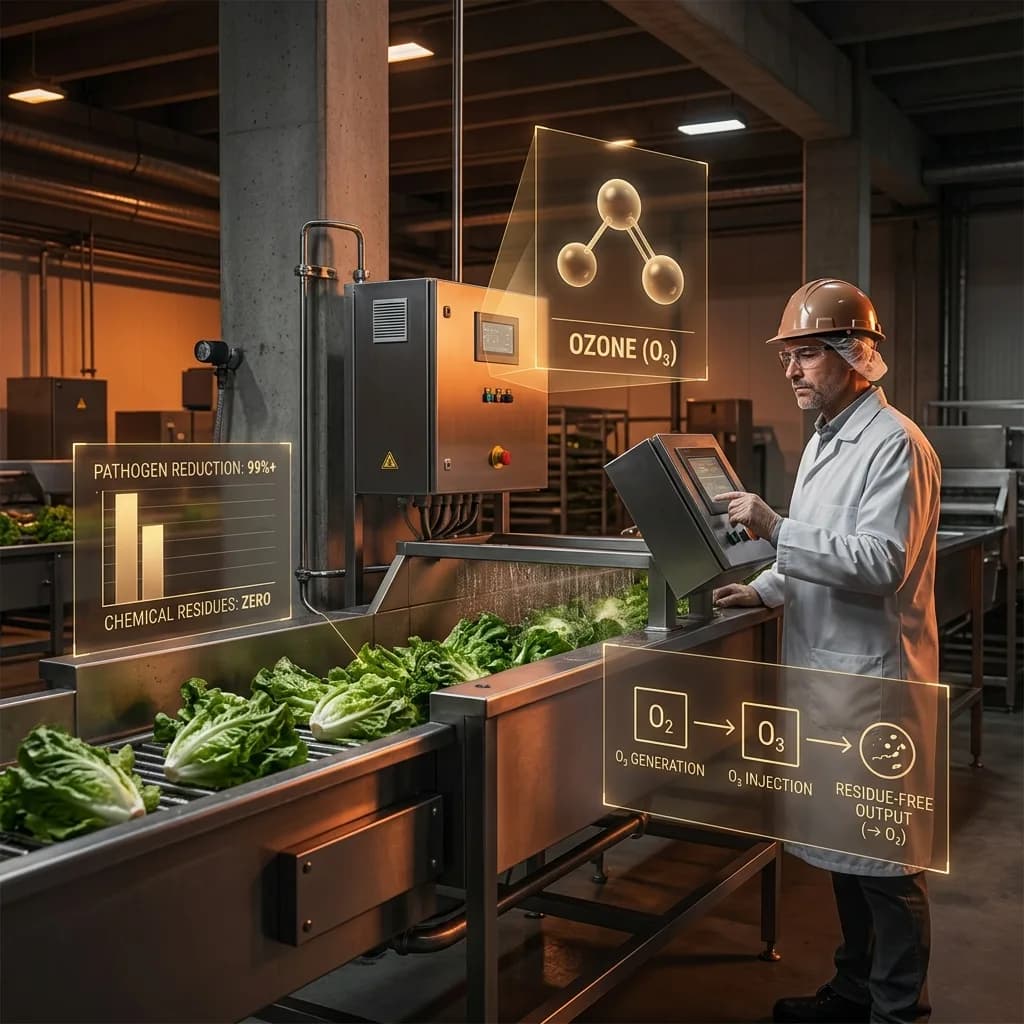
A produce washing facility uses chlorine-based sanitizer (200-500 ppm). Result: Chemical residues potential, consumer concern ("chemicals"), organic certification precluded, premium market lost.
An eco-conscious facility deploys ozone treatment: O3 gas injected in wash water, no chemical residues, organic-compliant. Result: 99%+ pathogen reduction (equivalent to chlorine), zero chemical residues, organic certification achieved, premium positioning, +30-50% market premium sustained.
Ozone treatment directly impacts food safety and clean-label positioning.
The Ozone Technology Framework
What is Ozone?
Powerful oxidizing gas:
- Formula: O3 (three oxygen atoms)
- Source: Generated on-site (from O2)
- Mechanism: Oxidation (breaks down microorganism membranes)
- Byproduct: Oxygen (O2) - no chemical residue
- Regulation: FDA-approved (Generally Recognized as Safe)
vs. Chemical Sanitizers:
| Method | Residue | Effectiveness | Organic OK | Cost |
|---|---|---|---|---|
| Chlorine | Yes (chemical) | 99%+ | No | Low |
| Chlorine dioxide | Yes (chemical) | 99%+ | No | Medium |
| Ozone | No (reverts to O2) | 99%+ | Yes | Medium |
| UV light | None | 90-95% | Yes | Medium |
Ozone Generation
Technology:
Ozone generated on-site from oxygen:
- Input: Oxygen (O2) from air or oxygen tank
- UV generation: UV light splits O2 into O3
- Or corona discharge: High-voltage electrical discharge
- Output: Ozone-enriched water or gas
- Advantage: No chemical purchase/storage/disposal
Equipment:
- Ozone generator: $5-50K (scale-dependent)
- Integration: Injection into wash water
- Monitoring: Ozone level sensors
- Safety: Ozone doesn't accumulate (reverts to O2 quickly)
Ozone Treatment Mechanism
How Ozone Disinfects:
- Ozone encounters microorganism cell membrane
- Oxidation: O3 breaks down lipids/proteins
- Cell rupture: Microorganism dies
- Decomposition: O3 reverts to O2
- Result: Pathogen eliminated, no residue
Effectiveness:
| Organism | Reduction | Time |
|---|---|---|
| Bacteria (E. coli, Salmonella) | 99-99.9% (4-5 log) | 5-10 seconds |
| Viruses | 99% (3-4 log) | 10-30 seconds |
| Protozoa | 99% (3-4 log) | 30-60 seconds |
| Mold spores | 95-99% (2-3 log) | 60-120 seconds |
Applications
Application 1: Produce Washing (Lettuce, Spinach, Salad Mix)
Challenge: Reduce pathogens without chemical residue
Ozone process:
- Harvest produce
- Wash in ozone-treated water (2-3 ppm ozone)
- Contact time: 5-10 minutes
- Result: 99%+ pathogen reduction (E. coli, Salmonella, Listeria)
- Rinse: Removes ozone (reverts to O2)
- Outcome: Pathogen-free, no chemical residue, organic-compliant
Advantages:
- No chemical residue
- Organic certification possible
- Consumer appeal: "Chemical-free sanitized"
- Premium pricing: +20-40% justified
Application 2: Fruit Surface Disinfection (Berries, Apples)
Challenge: Reduce surface mold/pathogens
Ozone treatment:
- Ozone gas chamber (vs. water treatment)
- Exposure: 10-20 minutes in ozone atmosphere
- Ozone level: 10-50 ppm (safe for produce)
- Result: Surface mold spores eliminated, shelf-life extended
Example (Blueberries):
- Untreated: Mold growth visible by day 5-7
- Ozone treated: Shelf-life extended to 14-21 days
- Result: Extended distribution possible, premium market access
Application 3: Water Recycling (CIP Systems)
Challenge: Reuse wash water without contamination
Ozone treatment:
- Wash water collected
- Ozone treatment: 2-3 ppm, 30-60 minutes
- Result: Pathogen elimination, water reusable
- Benefit: Water conservation, cost savings
Safety Considerations
Worker Safety:
- Ozone exposure limit: under 0.1 ppm (OSHA)
- System design: Enclosed chambers, ventilation
- Monitoring: Ozone detectors (alarm if over 0.1 ppm)
- Handling: Safe on-site generation (no transport)
Residue:
- Advantage: Ozone reverts to oxygen naturally
- Timeline: Half-life ~20 minutes in water
- No chemical accumulation risk
- No disposal issues
Cost-Benefit Analysis
| Factor | Cost/Impact |
|---|---|
| Ozone generator | $5-50K |
| Installation/integration | $5-20K |
| Operational cost | $100-500/month (electricity) |
| No chemical purchase | Savings $1-5K/month |
| Pathogen reduction | 99%+ (equivalent to chlorine) |
| Organic certification | Enables premium market |
| Premium pricing | +20-40% justified |
| Water conservation | 20-50% reduction (recycling) |
| ROI | 12-24 months |
For produce processors, ozone treatment enables organic certification and premium positioning.