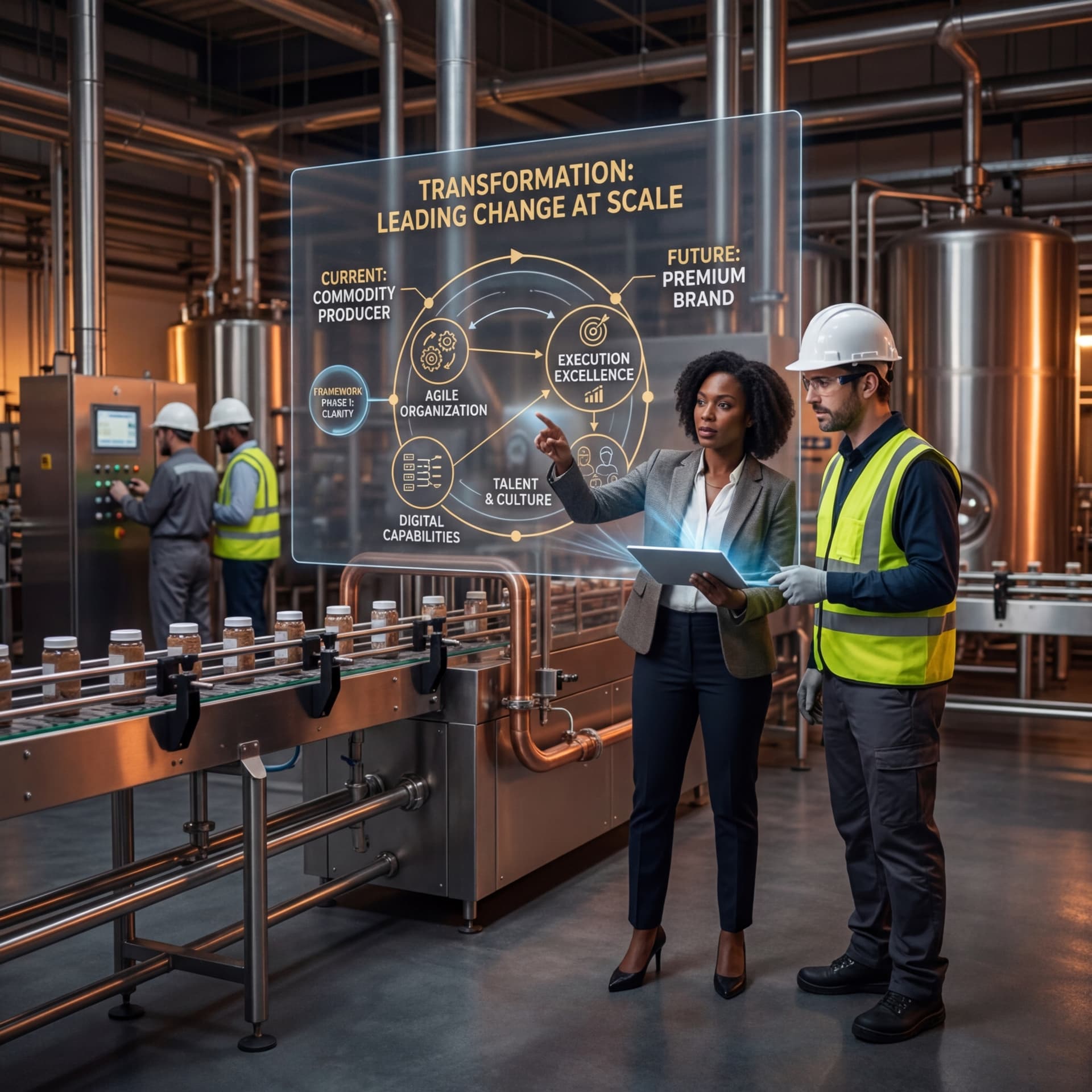
Food manufacturer tries to transform from commodity producer to premium brand. New strategy requires: product innovation, sustainability commitment, digital capabilities, customer relationships, lean operations.
Without organizational transformation, strategy fails. Old culture doesn't support innovation. Systems don't enable agility. Talent lacks required capabilities.
Systematic organizational transformation aligns structure, processes, people, and culture to execute new strategy.
The Transformation Framework
Phase 1: Clarity (Months 1-3)
Define future state:
- What capabilities needed?
- What organizational structure enables them?
- What culture/behaviors required?
- What talent gaps exist?
- What processes/systems must change?
Example: Premium brand transformation requires:
- Product development capability (new function)
- Sustainability/ESG focus (new role)
- Digital/e-commerce capability (new teams)
- Customer intimacy (reorganized sales)
- Agile operations (new processes)
Phase 2: Prepare (Months 3-6)
Build foundation:
- Recruit new leadership (Head of Innovation, Sustainability Officer)
- Create transition plan (what changes, when, how)
- Communicate vision and roadmap
- Identify quick wins to build momentum
- Build change management team
Phase 3: Implement (Months 6-18)
Execute transformation:
- Reorganize (new structure, roles, reporting)
- Implement new processes and systems
- Launch talent development programs
- Execute key initiatives (new products, sustainability program)
- Monitor progress and adjust
Phase 4: Embed (Months 18-24)
Make change stick:
- New behaviors become norms
- Performance management aligned to new expectations
- Celebrate wins and acknowledge progress
- Identify and address resistance
- Continuous improvement mindset
Organizational Structure Changes
Commodity Producer Structure:
- Plant Manager
- Operations Manager
- Quality Manager
- Maintenance Manager
- Sales Manager
- Finance Manager
Premium Brand Structure:
- Chief Operating Officer
- Plant Manager (Operations)
- Head of Quality and Safety
- Head of Innovation and Product Development
- Head of Sustainability
- Chief Commercial Officer
- VP Sales and Customer Management
- Head of Marketing and Brand
- VP Digital and E-commerce
- CFO (Finance)
- Head of Talent and Culture
Key Transformation Initiatives
Initiative 1: Capability Development
- External hiring (innovation, digital, sustainability expertise)
- Internal talent development (leadership programs)
- Cross-functional teams (break silos)
- Investment: $500K-$1M annually
Initiative 2: Technology Enablement
- ERP implementation (integrated systems)
- Analytics and BI platforms
- Digital/e-commerce capabilities
- Supply chain visibility
- Investment: $1-2M
Initiative 3: Process Transformation
- New product development process
- Agile operations (lean, continuous improvement)
- Customer-centric sales process
- Sustainability measurement and reporting
- Investment: $200K-$500K
Initiative 4: Culture Change
- Define new values and behaviors
- Leadership modeling
- Recognition and celebration
- Performance management alignment
- Investment: $300K-$500K
Change Resistance Management
Common Resistance Sources:
- Fear: "I'll lose my job" or "I can't learn new skills"
- Identity: "We're a commodity producer, not premium"
- Inertia: "We've always done it this way"
- Skepticism: "This won't work"
Mitigation Strategies:
- Communicate vision clearly (why, what, how)
- Involve people in change (builds ownership)
- Provide training and support
- Early wins (build confidence)
- Transparent about difficult changes
- Address concerns respectfully
Transformation Outcomes (18-Month)
Structural Changes:
- New organization optimized for strategy
- Appropriate talent in place
- Leadership bench strengthened
Capability Improvements:
- Product innovation rate: 5+ new SKUs/year
- Sustainability progress: Carbon reduction targets
- Digital channels: 10%+ DTC revenue
- Customer satisfaction: NPS 50+
Financial Impact:
- Revenue growth: 10%+ vs. baseline 5%
- Margin improvement: 18% vs. baseline 15%
- ROIC improvement: 15% vs. baseline 12%
For food manufacturing companies, systematic organizational transformation aligning structure, processes, talent, and culture to new strategy enables successful execution and competitive advantage.