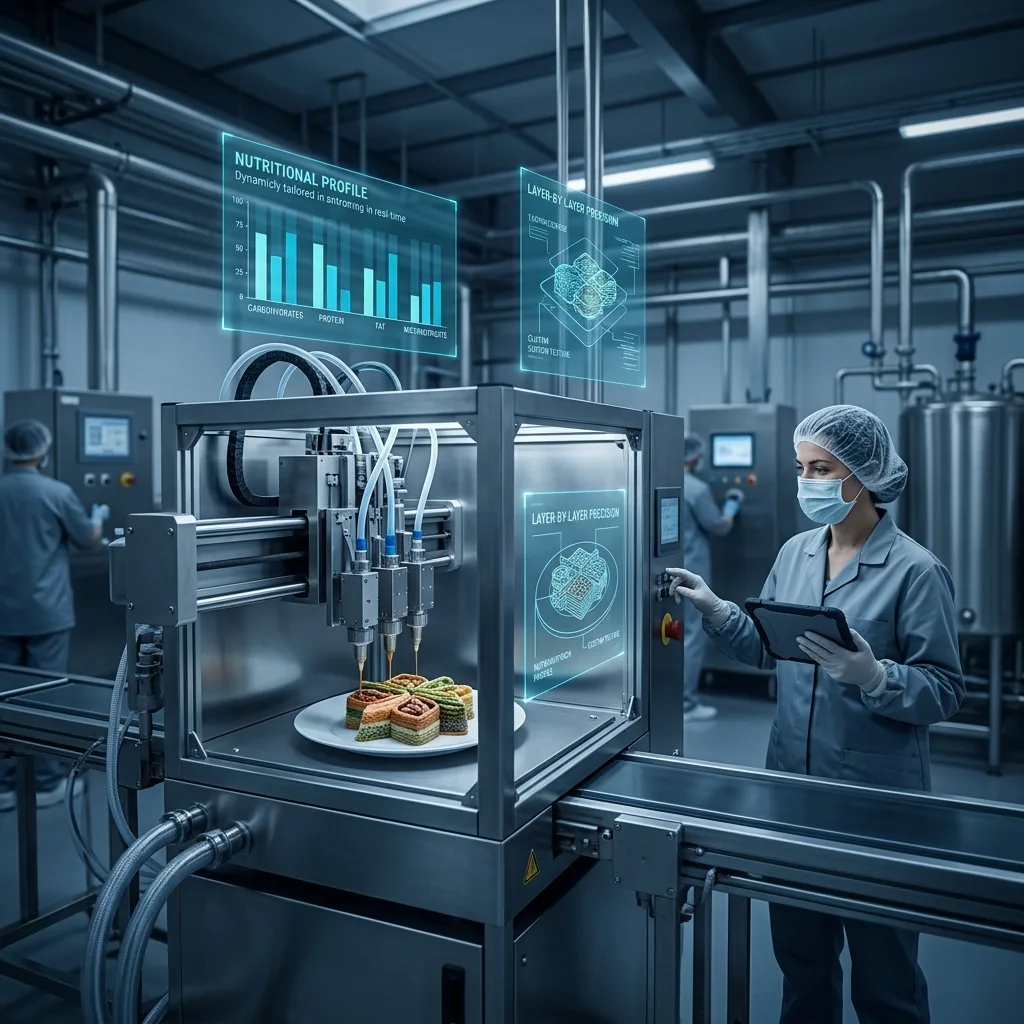
A hospital's elderly patients struggle with standard meals (too tough to chew, unappealing). Nutrition intake poor. Health outcomes compromised.
A food technology company implements 3D food printing: Custom-formulated meals printed to exact texture, macro balance, caloric content per patient. Result: Therapeutic nutrition accepted, consumed, absorbed. Patient outcomes improve. Hospital operating costs reduced (less waste, better nutrition).
3D food printing enables personalization impossible with traditional manufacturing.
The 3D Food Printing Framework
Technology Overview:
3D food printers work like plastic 3D printers:
- Dispense: Food "inks" (pastes, gels) instead of plastic
- Layer: Build food item layer by layer
- Precision: under 1mm accuracy achievable
- Customization: Each item unique per person
Printing Technologies:
| Type | Mechanism | Advantage |
|---|---|---|
| Extrusion | Pushes paste through nozzles | Food-friendly, proven |
| Inkjet | Sprays droplets | High precision, fast |
| Selective laser | Laser sinters powder | Complex geometry |
| Acoustic | Sound waves eject droplets | Non-contact, delicate foods |
Food Ink Development
Requirements for Printable Food:
- Viscosity: Appropriate flow (not too thin, not too thick)
- Shear-thinning: Flows under pressure, stays put when static
- Stability: Maintains shape during printing
- Food-safety: Safe ingredients, no toxins
- Taste/nutrition: Flavor, macro profile correct
Common Food Inks:
| Ink Type | Composition | Application |
|---|---|---|
| Protein paste | Ground plant/animal protein | Meat alternative, high-protein |
| Vegetable puree | Ground vegetables | Nutrient density, color |
| Grain paste | Grains (rice, wheat) | Carbohydrate source |
| Fruit gel | Fruit + pectin/gelatin | Flavor, natural sweetness |
| Fat binder | Oils/fats | Mouthfeel, caloric density |
Formulation:
Printer 1 (Protein): Soy protein isolate + binder (xanthan) + water Printer 2 (Vegetables): Broccoli puree + thickener + salt Printer 3 (Grains): Quinoa paste + oil + herbs
Result: Multi-layer food with precise composition
Applications
Application 1: Hospital Nutrition
Use Case: Dysphagia (Swallowing Difficulty)
Traditional: Puree all food (mushy, unappetizing) 3D Printed: Custom texture, layered design, attractive presentation
Printed Meal Example:
- Layer 1: Soft protein layer (ground chicken texture, but safe to swallow)
- Layer 2: Vegetable layer (broccoli, mashed texture)
- Layer 3: Grain layer (quinoa, soft)
- Layer 4: Binding sauce (gravy texture)
- Result: Looks like real food, safety guaranteed
Benefits:
- Patient acceptance: Looks appealing, tastes better
- Nutrition: Higher intake, better outcomes
- Safety: Controlled texture prevents aspiration
- Dignity: Meal looks normal, not "invalid food"
Application 2: Sports Nutrition
Personalization per Athlete:
- Macro balance: Custom protein/carb/fat ratio
- Caloric content: Exact amount per athlete
- Ingredient specifics: Allergies accommodated
- Timing: Pre/post-workout formulation
- Delivery: Immediately printable
Example: Basketball player needs 500 calories, 40g protein, 60g carbs
- Traditional: Multiple items from cafeteria (approximation)
- 3D Printed: Single meal, exact specification
Application 3: Allergen Management
Problem: Cross-contamination risk with allergens
Solution: 3D print from pure ingredients
- No peanut factory contact: Printed fresh
- No sesame cross-contact: Dedicated printer
- No shellfish residue: Clean system
- Result: Safe for severe allergies
Current Status and Challenges
Proof-of-Concept Stage:
- Demonstrations: Various universities, startups
- Prototypes: Working but slow (10-30 min per meal)
- Cost: High ($5,000-50,000 per printer)
- Commercialization: Emerging
Challenges:
- Speed: Too slow for large-scale production (currently)
- Cost: Equipment expensive, consumables high
- Scalability: Lab success does not equal production ready
- Taste: Still needs work vs. traditional cooking
- Texture: Limited variety (improving rapidly)
Near-term (2024-2025):
- Hospital/senior care facilities: First adopters
- Specialized nutrition market: Premium pricing justified
- Research: Universities, food innovation labs
Medium-term (2025-2030):
- Speed improvements: Faster printing (5-10 min)
- Cost reduction: 50%+ price decline expected
- Wider adoption: More healthcare facilities
- Consumer market: Emerging (high-end market)
Cost-Benefit Analysis
| Factor | Impact |
|---|---|
| Printer cost | $10-50K |
| Ink/consumables | $5-15 per meal |
| Labor | 10-30 min design + printing |
| Food cost | $3-8/meal (similar to traditional) |
| Premium positioning | Therapeutic, personalized |
| Hospital benefit | Better nutrition leads to better outcomes |
| ROI | 2-3 years (specialized facilities) |
For food innovators, 3D printing enables personalization and therapeutic applications.