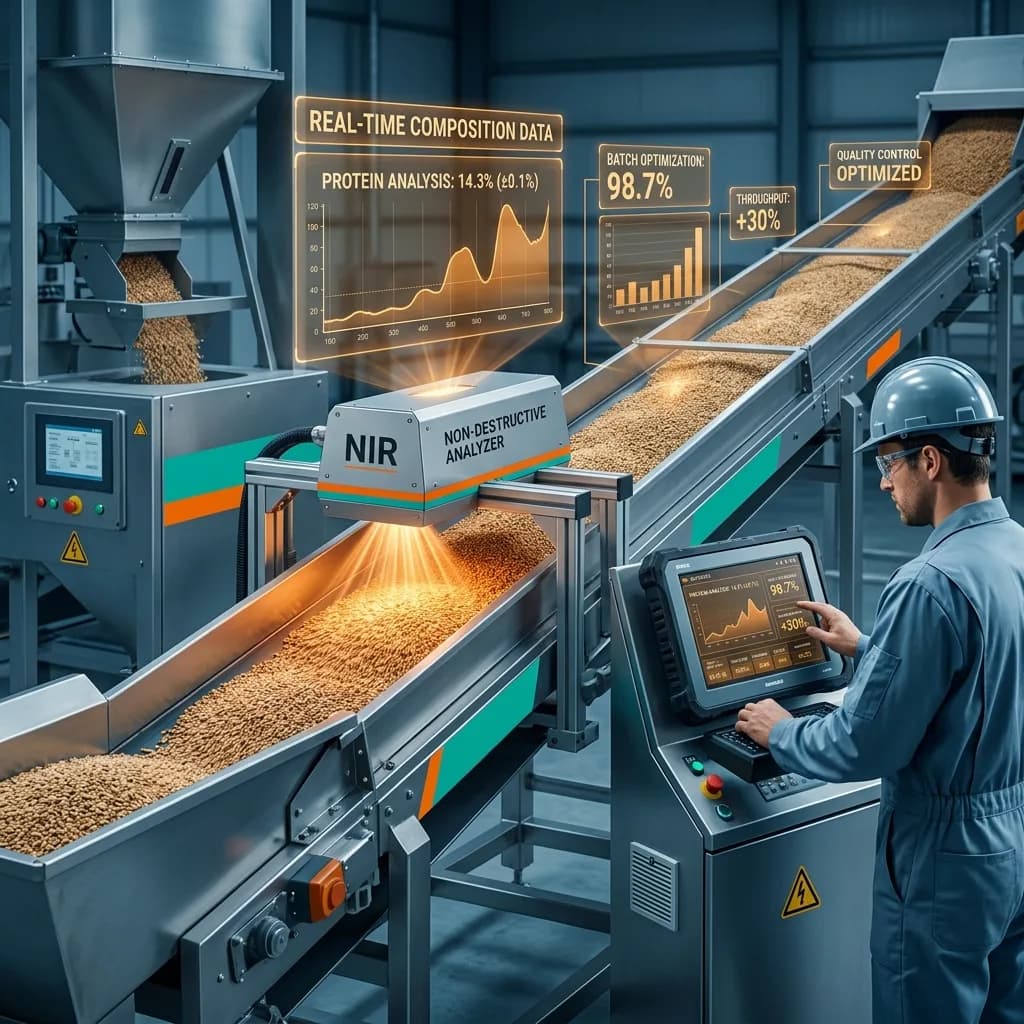
A grain processor waits 2-3 days for lab protein analysis. Result: Production delays, batch holds, batch-to-batch variation undetected, quality inconsistency.
A process-focused facility installs NIR spectroscopy system: Real-time inline measurement, 5-second analysis per sample, non-destructive. Result: Immediate protein verification, batch decisions same-shift, protein consistency +/-2%, throughput increased 30%, quality premium justified.
NIR spectroscopy directly impacts quality decisions and production speed.
The NIR Framework
What is NIR?
Non-destructive analysis using near-infrared light:
- Wavelength: 780-2,500 nanometers (near-infrared spectrum)
- Principle: Different compounds absorb different wavelengths
- Result: Composition predictable from absorption pattern
- Speed: under 1 minute per sample (vs. 1-2 days lab)
vs. Traditional Lab Analysis:
| Metric | Lab Analysis | NIR |
|---|---|---|
| Speed | 1-2 days | under 1 minute |
| Cost | $50-200/test | $5-20/test |
| Destructive | Yes (sample destroyed) | No (non-destructive) |
| Automation | Batch (labor-intensive) | Inline possible (automated) |
| Accuracy | 95-99% | 85-95% (varies by compound) |
NIR Technology
Principle:
Light absorption by chemical bonds:
- C-H bond: Absorbs specific wavelength
- O-H bond: Absorbs different wavelength
- N-H bond: Absorbs unique wavelength
- Result: Absorption pattern = "fingerprint" of composition
Equipment Components:
-
NIR Spectrometer
- Light source: Tungsten halogen lamp (780-2,500 nm)
- Detector: Sensitive photodiode array
- Fiber optics: Flexible light delivery
- Cost: $20-50K
-
Sampling Interface
- Transmission cell: For liquids
- Diffuse reflectance: For powders/solids
- Inline probe: For continuous production
- Cost: $2-10K per interface
-
Software and Calibration
- Algorithm: Machine learning model (trained on lab data)
- Calibration: Reference samples establish accuracy
- Cost: $5-20K development (or purchased pre-calibrated)
Measurable Parameters
Common Measurements:
| Parameter | Detection | Accuracy | Application |
|---|---|---|---|
| Moisture | Yes | 95%+ | Grain, flour, nuts |
| Protein | Yes | 92%+ | Grain, meat, dairy |
| Fat/Oil | Yes | 90%+ | Seeds, meat, chocolate |
| Carbohydrates | Yes | 88%+ | Grain, sugar |
| Fiber | Yes | 85%+ | Grain, vegetables |
| Sugar (Brix) | Yes | 95%+ | Juice, beverages |
Applications by Industry
Application 1: Grain Processing (Wheat, Corn, Oats)
Use: Protein and moisture verification
Traditional:
- Lab analysis: 1-2 days
- Cost: $50-100 per test
- Batch release: Delayed
NIR:
- Result: 5 seconds
- Cost: $5-10 per test
- Batch release: Same-day
Example (Wheat Flour):
- Target protein: 14.5% +/- 1%
- NIR measurement: 14.3% (within tolerance)
- Decision: Approve batch immediately
Application 2: Meat Processing (Ground Meat, Cuts)
Use: Fat percentage verification
Traditional:
- Lab (Soxhlet extraction): 6-8 hours
- Cost: $75-150 per test
NIR:
- Result: 30 seconds
- Cost: $10-20 per test
- Real-time feedback: Adjust process if off-spec
Application 3: Beverage (Juice, Wine, Beer)
Use: Sugar (Brix) verification
Traditional:
- Refractometer: Manual, subjective
- Lab: Time-consuming
NIR:
- Inline probe: Automated measurement
- Result: Continuous monitoring
- Adjustment: Immediate correction if needed
Calibration and Accuracy
Calibration Process:
- Collect 30-100 representative samples
- Measure with lab reference method (destructive)
- Record NIR spectra for each sample
- Train machine learning model
- Validate accuracy on blind test set
- Result: Calibration model ready for production
Accuracy Factors:
- Sample preparation: Consistent grinding/mixing
- Calibration scope: Model trained on expected range
- Outliers: Unusual samples may have lower accuracy
- Maintenance: Regular recalibration (quarterly typical)
Cost-Benefit Analysis
| Factor | Cost/Impact |
|---|---|
| Equipment | $20-50K |
| Sampling interface | $2-10K |
| Software/calibration | $5-20K |
| Total investment | $27-80K |
| Lab analysis saved | $50-100K/year (50 tests/week) |
| Time savings | 1-2 days to under 1 minute |
| Batch throughput | +20-30% improvement |
| Quality consistency | Significantly improved |
| ROI | 6-18 months typical |
For food manufacturers, NIR spectroscopy enables real-time quality decisions and production speed.