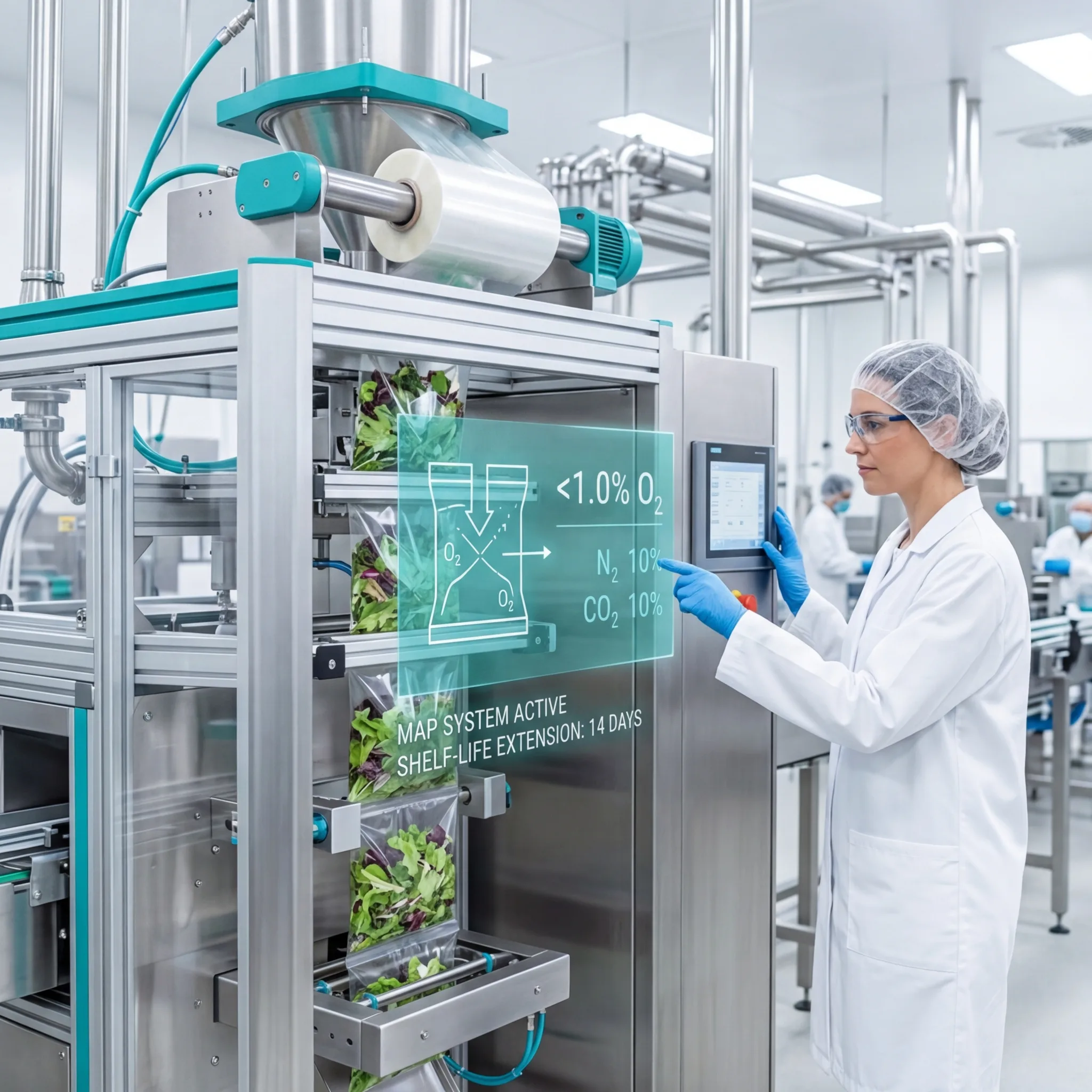
A prepared salad manufacturer packages in regular air. Result: Oxidation causes browning within 24 hours. Flavor degradation noticeable. Off-odors develop. Shelf-life only 5 days. Limited distribution radius.
A modern facility installs MAP system with nitrogen flushing. Oxygen reduced to under 1%. Browning prevented. Flavor stable for 10+ days. Off-odors eliminated. Shelf-life extends to 14 days. Distribution to national retailers enabled.
Modified Atmosphere Packaging directly impacts fresh-cut product shelf-life and market reach.
The MAP Framework
Principle:
Remove oxygen, replace with protective gas mixture
- Oxygen causes: Oxidation, browning, off-flavors, spoilage
- Protective gases: Nitrogen (N2), Carbon dioxide (CO2)
- Result: Extended shelf-life, maintained quality
Gas Functions:
- Nitrogen (N2): Inert filler gas (displaces oxygen)
- Carbon dioxide (CO2): Antimicrobial (inhibits bacteria, molds)
- Oxygen (O2): Sometimes included at low levels (prevent anaerobic pathogens)
Typical Gas Mixtures by Product
| Product | N2 | CO2 | O2 | Shelf-Life |
|---|---|---|---|---|
| Fresh salad | 90% | 5% | 5% | 10-14 days |
| Fresh meat | 40% | 30% | 30% | 21-30 days |
| Cooked meat | 70% | 30% | 0% | 21-28 days |
| Cheese | 70% | 30% | 0% | 30-60 days |
| Bakery | 60% | 40% | 0% | 14-21 days |
| Fresh pasta | 70% | 30% | 0% | 21-30 days |
Gas Selection Logic:
High O2 (20-30%): Fresh meat (maintain red color) Moderate CO2 (30-40%): Antimicrobial benefit Zero O2: Prevent oxidation (browning, rancidity) Low O2 (3-5%): Balance (prevent anaerobic risk)
Oxygen Level Impact
Oxygen and Shelf-Life:
| O2 Level | Effect | Shelf-Life |
|---|---|---|
| 21% (air) | Rapid oxidation | 3-5 days |
| 5-10% | Moderate oxidation | 7-10 days |
| 1-3% | Minimal oxidation | 10-14 days |
| under 1% | Anaerobic conditions | Risk of C. botulinum |
Target: 1-5% O2 for most fresh products (balance safety and quality)
MAP Equipment
MAP Machine Design:
-
Vacuum stage: Remove air from package
- Vacuum level: 90-99% air removal
- Time: 1-3 seconds
-
Gas injection: Fill with protective gas mixture
- Pressure: Slightly positive (prevent collapse)
- Flow rate: Programmable (ratio control)
-
Sealing: Heat seal or ultrasonic seal
- Hermetic seal essential (prevent oxygen ingress)
- Seal integrity testing required
Equipment Types:
Vertical Form-Fill-Seal (VFFS):
- Capacity: 50-200 packs per minute
- Application: Salads, snacks, produce
- Process: Form bag, fill, gas flush, seal
Tray Sealer:
- Capacity: 20-60 trays per minute
- Application: Meat, prepared meals, deli items
- Process: Fill tray, gas flush, film seal
Thermoformer:
- Capacity: 50-100 packs per minute
- Application: Sliced meat, cheese
- Process: Form tray from film, fill, gas, seal
Gas Mixture Control
Precision Requirements:
Target: 70% N2, 30% CO2 (+/-2%)
- Gas analyzer: Inline measurement
- Adjustment: Automatic proportional valves
- Verification: Sample testing (daily)
Residual Oxygen Testing:
Headspace analyzer measures O2 in sealed package
- Target: under 1-5% (product dependent)
- Frequency: Every 30 minutes or per batch
- Acceptance: Within specification range
Film Selection
Oxygen Transmission Rate (OTR):
Critical parameter: How much O2 permeates through film
- Low OTR: Better shelf-life (less oxygen ingress)
- High OTR: Shorter shelf-life
Film Requirements:
| Product | OTR Target | Film Type |
|---|---|---|
| Salad | under 50 cc/m2/day | High barrier (EVOH, Nylon) |
| Meat | under 100 cc/m2/day | Moderate barrier |
| Bakery | under 200 cc/m2/day | Standard film |
Cost vs. Performance:
High barrier film: $0.05-0.15 per pack (more expensive) Standard film: $0.01-0.03 per pack
- Decision: Balance shelf-life need vs. cost
Limitations
MAP is NOT a Replacement for Refrigeration:
MAP + ambient temperature: Pathogen growth still possible
- MAP + refrigeration (2-4C): Shelf-life extended
- Temperature abuse: MAP cannot prevent spoilage
Anaerobic Pathogen Risk:
Zero oxygen + temperature abuse = C. botulinum risk
- Mitigation: Include 3-5% O2, maintain refrigeration, use hurdle technology
Cost-Benefit Analysis
| Item | Cost/Benefit |
|---|---|
| MAP machine | $50-200K |
| Gas cost | $0.01-0.05 per pack |
| Film cost | +$0.02-0.10 per pack (high barrier) |
| Shelf-life extension | 5 days to 14 days (2.8x) |
| Distribution reach | Regional to National |
| Waste reduction | 20-30% less spoilage |
| Payback | 1-3 years |
For fresh and prepared food manufacturers, MAP technology enables extended shelf-life and expanded distribution reach.