A berry producer uses conventional blast freezing (30 minutes). Result: Large ice crystals form (10-50 micrometers). Thawed berries mushy, drip loss 15-18%. Quality degraded. Retail price limited to commodity levels.
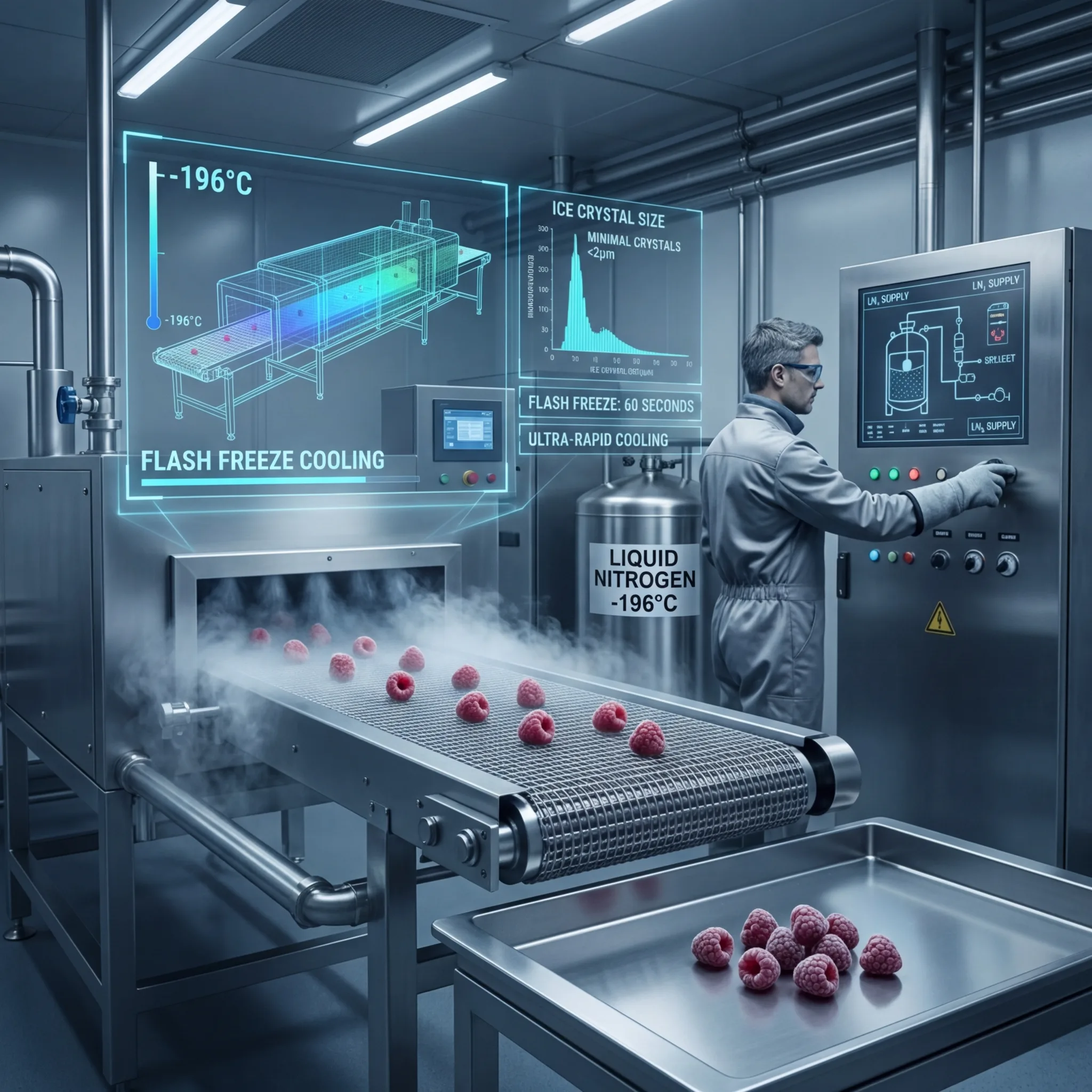
A premium producer installs liquid nitrogen freezing system. Freezing completes in 60 seconds (-196C). Ice crystals minimal (under 2 micrometers). Thawed berries perfect texture, drip loss under 1%. Ultra-premium positioning achieved ($25/lb vs. $8/lb commodity).
Liquid nitrogen freezing directly impacts premium product positioning through superior quality preservation.
The Cryogenic Freezing Framework
Principle:
Liquid nitrogen at -196C provides extreme cold
- Direct contact: Product immersed in or sprayed with liquid nitrogen
- Rapid heat transfer: Very high temperature gradient
- Flash freezing: Ice crystal formation minimized
- No mechanical cooling: Passive energy from phase change
Phase Change Physics:
Liquid nitrogen absorbs heat when it evaporates (boils)
- Boiling point: -196C (at 1 atm pressure)
- Energy released: 199 kJ/kg (latent heat of vaporization)
- Result: Extreme rapid cooling possible
Ice Crystal Formation
Freezing Rate Impact:
| Method | Freezing Rate | Crystal Size | Drip Loss | Quality |
|---|---|---|---|---|
| Slow (-18C) | 0.1C/min | 50-200 micrometers | 15-20% | Processing only |
| Blast (-40C) | 1-3C/min | 10-30 micrometers | 5-10% | Good |
| Liquid N2 (-196C) | 15-50C/min | under 2 micrometers | under 1% | Ultra-premium |
Why Ultra-Rapid Matters:
Freezing rate is inversely proportional to crystal size
- Rapid freezing: Ice crystals form too fast to grow large
- Extracellular ice: Crystals form outside cells (not rupturing)
- Cell structure preserved: Perfect texture after thawing
Liquid Nitrogen Freezing Equipment
Design Types:
Immersion System:
- Product placed in insulated chamber
- Liquid nitrogen sprayed or immersed
- Time: 30-60 seconds typical
- Capacity: 100-500 kg per batch
- Automation: Conveyor-based for continuous operation
Spray System:
- Liquid nitrogen sprayed onto moving conveyor
- Tunnel design: Product travels through -196C spray zone
- Residence time: 60-120 seconds
- Capacity: 500-5,000 kg/hour (high throughput)
- Application: Continuous production
Characteristics:
- Temperature: -196C (colder than any mechanical freezer)
- Heat transfer: Extremely rapid
- No moving parts in freezing zone (simple, reliable)
- Safety: Requires specialized equipment and training
Freezing Time Comparison
Product: 20mm diameter berry
| Method | Temperature | Time to Freeze | Energy |
|---|---|---|---|
| Slow freezer | -18C | 8-12 hours | Ambient |
| Blast freezer | -40C | 30-60 minutes | Compressor |
| Liquid N2 | -196C | 60-120 seconds | Cryogenic |
Improvement: 1,000x faster than slow freezing
Quality Preservation
Texture After Thawing:
Slow-frozen berries:
- Large ice crystals rupture cell walls
- Cell contents leak out (drip loss 15-20%)
- Texture: Mushy, collapsed
- Appearance: Collapsed, unappealing
Liquid N2 frozen berries:
- Minimal crystal formation
- Cells largely intact
- Texture: Firm, fresh-like
- Appearance: Bright, appealing
- Drip loss: under 1%
Sensory Evaluation:
Taste test: Liquid N2 vs. conventional blast-frozen vs. fresh
- Flavor: Nearly identical to fresh (minimal degradation)
- Texture: Indistinguishable from fresh when properly thawed
- Color: Bright, natural (no browning)
Applications
Ideal for Liquid N2:
- Berries (premium retail products)
- Specialty fruits (mango, passion fruit, etc.)
- Seafood (shrimp, scallops)
- Premium desserts (ice cream components)
- Specialty foods (pizza toppings, prepared meals)
Economics:
Premium positioning possible:
- Commodity berries: $8/lb
- Blast-frozen berries: $10-12/lb
- Liquid N2 frozen: $20-30/lb
- Fresh premium: $18-25/lb
Market Advantage: Frozen product at fresh prices
Cost Analysis
| Item | Cost |
|---|---|
| Equipment | $200-500K (spray tunnel) |
| Liquid N2 cost | $0.50-1.00 per kg product |
| Operating labor | Minimal (automated) |
| Maintenance | Low (no moving parts in freezing) |
| Total cost per unit | $0.60-1.20 per kg |
ROI Calculation:
Example: Berry producer (500 kg/day, 250 working days)
- Annual volume: 125,000 kg
- Price premium: +$12/lb ($26/lb vs. $14/lb)
- Premium gain: +$3.3M annual revenue
- Liquid N2 cost: -$125K annual
- Equipment payback: Under 1 month
Payback: Very rapid (high premium justifies high cost)
Safety and Regulatory
Safety Considerations:
- Liquid nitrogen: Extremely cold (burns skin instantly)
- Personal protective equipment: Essential (insulated gloves, face shield)
- Ventilation: Required (nitrogen displacement risk)
- Containment: Specialized insulated tanks/equipment
- Training: Critical for operator safety
Regulatory Status:
- FDA: No specific restrictions on liquid nitrogen freezing
- USDA: Approved for meat/poultry
- EFSA: Approved in Europe
- GRAS: Generally recognized as safe
Limitations
Cost: Highest per-unit cost of any freezing method Requirement: Premium positioning needed to justify cost Applicability: Best for high-value products
For premium food manufacturers, liquid nitrogen freezing enables ultra-premium market positioning through superior quality preservation.