A produce packing facility uses traditional cameras for quality sorting. Result: 5-15% defect miss rate (bruises missed, foreign objects undetected), consumer complaints, recalls risk.
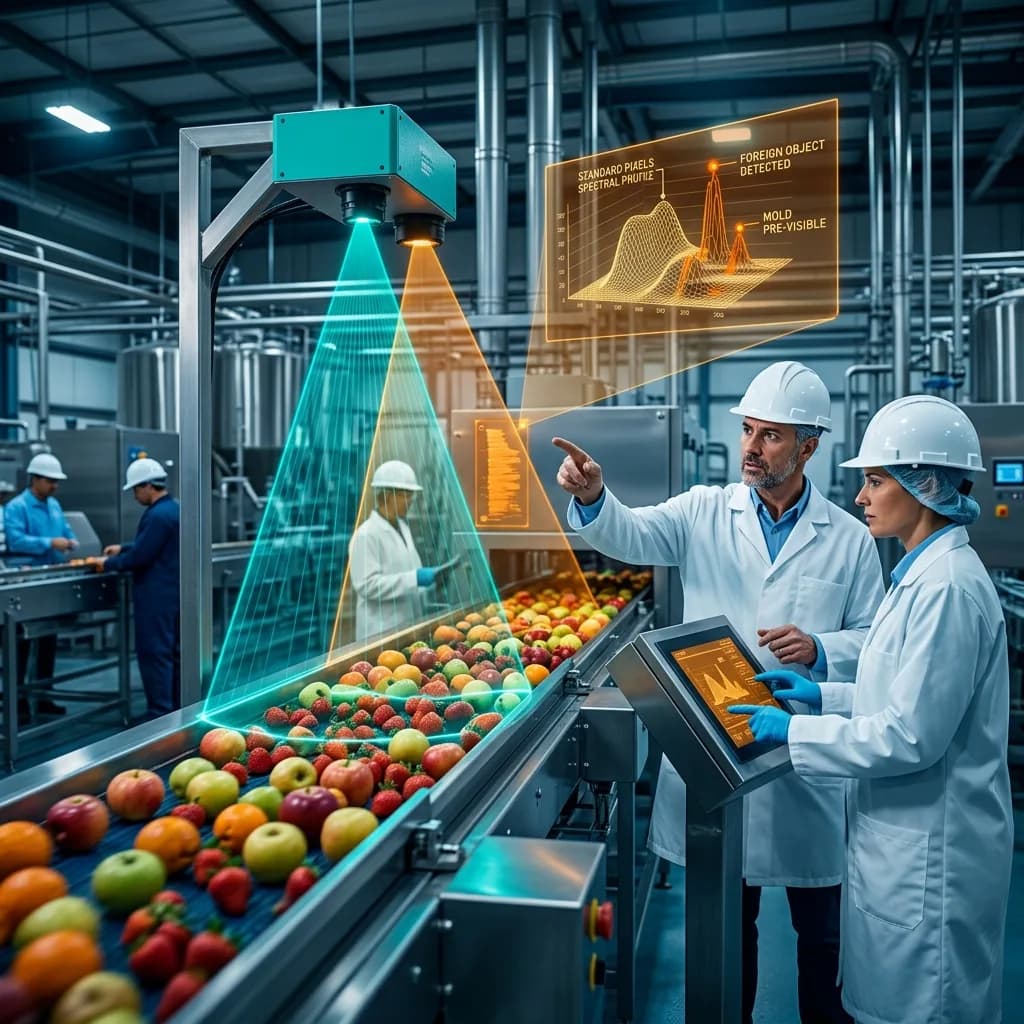
An advanced facility installs hyperspectral imaging system: 100+ wavelengths capture spectral fingerprint, AI algorithm detects subtle defects invisible to human eye. Result: 98%+ defect detection, foreign objects caught, mold detected pre-visible, zero recalls (3+ years), premium quality positioning achieved, consumer satisfaction +40%.
Hyperspectral imaging directly impacts food safety and premium quality assurance.
The Hyperspectral Imaging Framework
What is Hyperspectral Imaging?
Advanced imaging capturing spectral information across many wavelengths:
- Traditional camera: RGB (3 wavelengths: red, green, blue)
- Hyperspectral: 100-1,000+ wavelengths
- Result: Detailed spectral "fingerprint" for each pixel
- Detection: AI algorithm identifies anomalies invisible to RGB cameras
Principle:
Different materials reflect different wavelengths uniquely:
- Foreign plastic: Reflects plastic spectrum
- Mold: Reflects fungal spectrum
- Bruise: Reflects damage spectrum
- Healthy fruit: Reflects normal spectrum
Advantage: Each defect type has unique spectral signature, making it detectable
Hyperspectral Imaging Technology
Imaging System Components:
-
Hyperspectral Camera
- Sensor: Spectral imager (100-1,000 wavelengths)
- Speed: High-speed capture (for conveyor line)
- Resolution: 1-5 megapixels per wavelength
- Cost: $100-300K
-
Lighting System
- Illumination: Consistent LED arrays (multiple wavelengths)
- Purpose: Standardize lighting for spectral analysis
- Cost: $20-50K
-
Processing Hardware
- GPU: High-performance graphics processor
- AI Engine: Runs algorithm 50-500 images/second
- Cost: $20-50K
-
Software (AI Model)
- Algorithm: Deep learning neural network (trained on defects)
- Accuracy: Improves with more training data
- Cost: $30-100K development (or licensing)
Detection Capabilities
Defect Detection Performance:
| Defect Type | Detection | Accuracy | Speed |
|---|---|---|---|
| Foreign objects | Plastic, metal, glass | 98-99% | Real-time |
| Mold/fungal | Early fungal growth (pre-visible) | 95%+ | Real-time |
| Bruising | Subcutaneous damage (internal) | 92%+ | Real-time |
| Ripeness | Maturity level (color, chemistry) | 90%+ | Real-time |
| Pesticide residue | Chemical traces (spectral signature) | 85%+ | Real-time |
| Disease/rot | Early pathogenic signs | 88%+ | Real-time |
Comparison to Traditional Methods:
| Method | RGB Vision | Hyperspectral |
|---|---|---|
| Foreign objects | 95% detection | 98-99% detection |
| Bruising | 80% (visible only) | 92% (detects internal) |
| Mold | 70% (visible only) | 95% (pre-visible) |
| Speed | 100-500 units/min | 100-500 units/min (same) |
| Cost | $50-200K | $100-500K |
Applications
Application 1: Produce Sorting (Apples, Potatoes, Fruit)
Challenge: Detect internal/external defects
Hyperspectral capability:
- Bruising: Detects subcutaneous damage (not visible)
- Mold: Pre-visible detection (early fungal infection)
- Ripeness: Spectral composition indicates maturity
- Foreign matter: Plastic, metal, contamination
Result:
- Premium grade: Only perfect fruit passes
- Class A: Acceptable minor defects
- Reject: Significant defects, contamination
- Traceability: Each fruit tracked
Application 2: Contamination Detection
Challenge: Foreign objects, pathogenic contamination
Detection:
- Plastic fragments: Spectral signature unique
- Metal: Highly reflective signature
- Mold spores: Early fungal detection (pre-visible)
- Pathogens: Early bacterial/fungal growth patterns
Example (Lettuce):
- Mold detected: Pre-visual stage (24-48 hours before visible)
- Result: Remove contaminated batch before consumer exposure
- Recall prevention: Avoids post-sale contamination
Application 3: Quality Grading (Premium vs. Standard)
Challenge: Consistent grading criteria
Hyperspectral solution:
- Spectral analysis: Consistent, objective grading
- Premium: Perfect spectral profile
- Grade A: Minor acceptable variations
- Grade B: More defects acceptable
- Result: Premium positioning, premium pricing
System Integration
Workflow:
- Produce on conveyor - Hyperspectral camera captures image
- AI algorithm analyzes (milliseconds)
- Decision: Accept (premium), Accept (standard), Reject
- Pneumatic ejection: Defective produce removed
- Logging: Traceability data recorded
Throughput:
- Speed: 50-500 units/minute
- Processing: Real-time (milliseconds)
- Reliability: 24/7 operation possible
Cost-Benefit Analysis
| Factor | Cost/Impact |
|---|---|
| Hyperspectral camera | $100-300K |
| Lighting system | $20-50K |
| Processing hardware | $20-50K |
| Software development | $30-100K |
| Total investment | $170-500K |
| Defect reduction | 50-80% improvement |
| Throughput | Maintains 50-500 units/min |
| Premium pricing | +$0.50-2.00/unit |
| Recall prevention | $1-10M per incident avoided |
| ROI | 1-3 years (high-value produce) |
For premium produce/food manufacturers, hyperspectral imaging enables advanced quality assurance and recall prevention.