
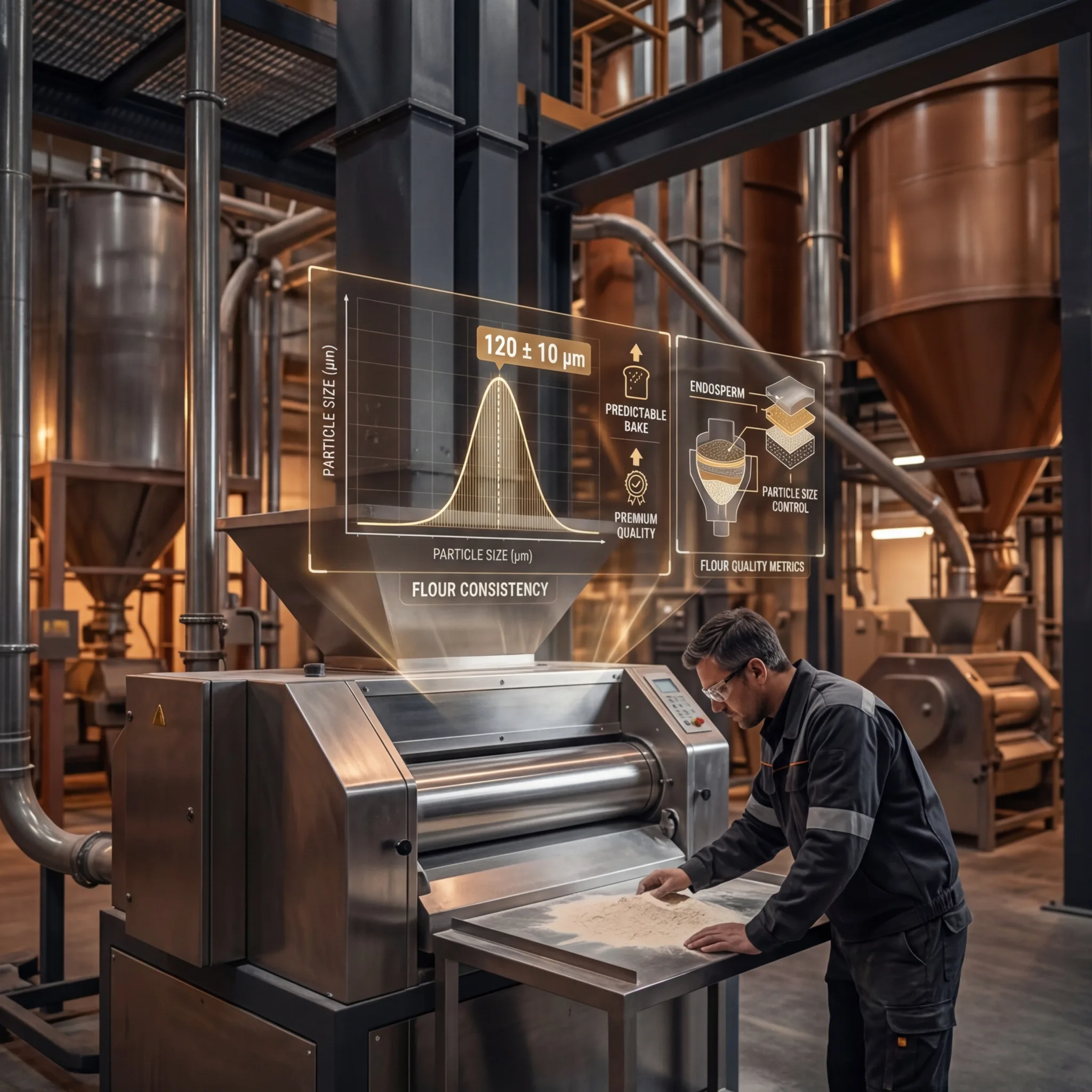
A flour mill grinds wheat to inconsistent particle sizes (100-500 um range). Result: Bakers report variable bread rise (some dense, some airy). Flour consistency complaint. Loss of premium bakery accounts.
A modern mill controls particle size to 120 +/- 10 um (tight specification). Delivered flour consistent batch-to-batch. Bakers achieve predictable rise every bake. Premium account contract renewed. Market premium maintained.
Grain milling precision directly impacts final product quality and baker satisfaction.
The Grain Milling Framework
Grain Composition:
Wheat kernel contains:
- Endosperm (85%): Starch + protein (makes flour)
- Bran (14%): Fiber + minerals (darker, strong flavor)
- Germ (1%): Oils + nutrients (can turn rancid)
Flour Types (Particle Size):
| Flour Type | Particle Size | Application | Properties |
|---|---|---|---|
| Bread flour | 100-150 um | Yeast breads | Strong gluten development, good rise |
| Cake flour | 80-120 um | Cakes, pastries | Fine, tender crumb, soft |
| All-purpose | 120-150 um | General baking | Balanced properties |
| Whole wheat | 150-250 um | Healthy bread | Coarser, denser |
| Cornmeal | 200-400 um | Polenta, cornbread | Gritty texture desired |
Milling Equipment
Hammer Mill:
Design: Rotating hammer blades impact grain
- Adjustable screen size (determines final particle size)
- Cost: Lower ($50-150K)
- Throughput: 500-2,000 kg/hour
- Consistency: Moderate (screen size may vary during operation)
- Application: General-purpose milling
Roller Mill:
Design: Two rollers crushing grain between them
- Precise size control
- Cost: Higher ($100-300K)
- Throughput: 1,000-5,000 kg/hour
- Consistency: Excellent (same size every batch)
- Application: Flour mills (wheat, specialty grains)
Micronizer (Pin Mill):
Design: High-speed rotating pins disintegrate particles
- Ultra-fine particles: under 20 um possible
- Cost: Very high ($200-500K)
- Throughput: 100-500 kg/hour (slower)
- Consistency: Very tight (uniform particles)
- Application: Specialty powders, spices
Process Control
Particle Size Control (Critical):
-
Screen Selection: Choose screen opening size
- Bread flour: 120 um screen
- Cake flour: 100 um screen
- Cornmeal: 300 um screen
-
Throughput Speed: Affects final size
- Faster through: Coarser particles
- Slower through: Finer particles
-
Temperature Monitoring: Grinding generates heat
- Temperature rise: Raises starch gelatinization risk
- Control: Monitor, reduce speed if overheating
- Target: Keep flour under 50 degrees C
-
Screen Maintenance: Screen clogs reduce efficiency
- Clean between batches
- Replace when worn (holes enlarge)
- Impact: Worn screens = coarser flour
Quality Impact on Baking
Bread Flour (120 um optimal):
- Particle size: 120 +/- 10 um
- Result: Fast water absorption, strong dough
- Rise: Consistent, predictable
- Crust: Crisp exterior
- Crumb: Open structure (good aeration)
Too Coarse (over 150 um):
- Result: Slow water absorption
- Rise: Poor (less development time)
- Texture: Dense, heavy
Too Fine (under 100 um):
- Result: Over-hydration (sticky dough)
- Rise: Excessive (over-proofing risk)
- Texture: Gummy interior
Cake Flour (100 um optimal):
- Particle size: 100 +/- 5 um (very tight spec)
- Result: Fine, tender crumb
- Texture: Soft, moist
- Quality: Premium essential
Flour Quality Testing
Particle Size Measurement:
Method: Laser diffraction analyzer
- Measures exact particle size distribution
- Cost: $30-100K equipment
- Precision: +/-5 um accuracy
- Time: under 1 minute per sample
Standards:
- Specification: Written target range (e.g., 120 +/- 10 um)
- Testing: Every batch or daily verification
- Documentation: Required by bakers
- Tolerance: under 5% outside specification acceptable
Cost-Benefit
| Factor | Impact |
|---|---|
| Roller mill | $150-300K |
| Particle size analyzer | $30-100K |
| Total investment | $180-400K |
| Flour quality | Consistency improved 300% |
| Premium pricing | +$0.10-0.20/lb possible |
| Baker retention | High (consistency appreciated) |
| Payback | 2-3 years |
For grain millers, precise particle size control ensures baking consistency and premium market positioning.