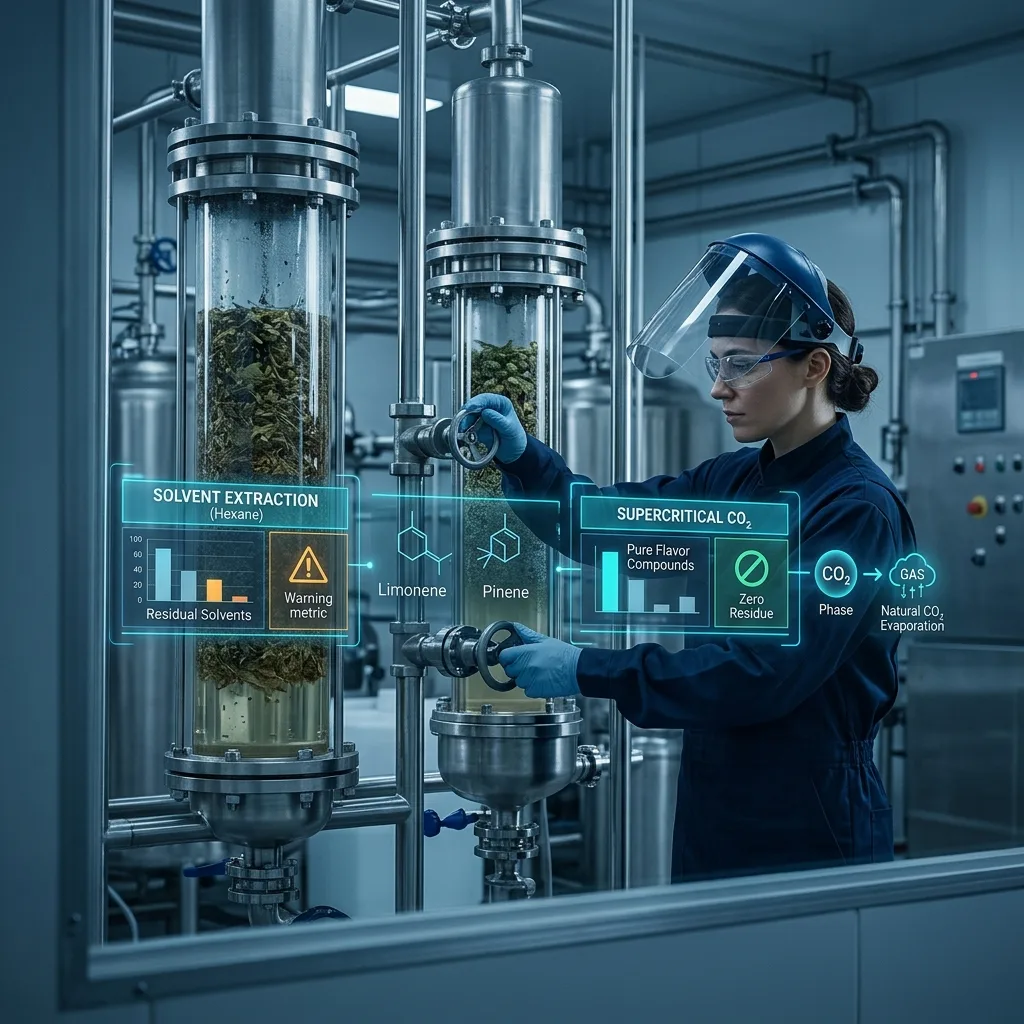
A flavor house uses traditional solvent extraction (hexane). Result: Residual solvent traces remain (regulatory concern), flavor contaminated, clean-label market lost.
A modern facility uses supercritical CO2 extraction. Result: No solvent residue (CO2 evaporates naturally), pure flavor extracted, premium "natural, solvent-free" positioning achieved. Market premium +50%.
Flavor extraction technology directly impacts purity and market positioning.
The Flavor Extraction Framework
Flavor Compounds (Volatiles):
Essential oils contain:
- Terpenes: Pinene (pine), limonene (citrus)
- Aldehydes: Cinnamic aldehyde (cinnamon)
- Alcohols: Geraniol (rose), eugenol (clove)
- Esters: Complex aromas
- Ketones: Sharp, pungent notes
Target: Extract maximum flavor with minimum solvent residue
Extraction Methods
Method 1: Solvent Extraction (Traditional)
Process: Soak plant material in organic solvent
- Solvents: Hexane, ethanol, acetone
- Temperature: Ambient to 60 degrees C
- Time: 30 minutes - 2 hours
- Result: Flavor compounds dissolve, removed with solvent
Problems:
- Solvent residue: Difficult to remove completely
- Toxicity: Hexane health concerns
- Regulatory: FDA limits on residues (10 ppm typically)
- Cost: Solvent recovery/waste disposal
Method 2: Supercritical CO2 Extraction (Modern)
Process: CO2 at high pressure/temperature behaves as solvent
- Pressure: 200-600 bar (high)
- Temperature: 40-60 degrees C (moderate)
- Time: 1-4 hours
- Result: Flavor extracted, CO2 evaporates naturally
Supercritical State (Above Critical Point):
| Parameter | Value | Effect |
|---|---|---|
| Pressure | 73.8 bar (critical) | CO2 becomes liquid-like |
| Temperature | 31.1 degrees C (critical) | Solvent power increases |
| Above critical | 100-600 bar | Selective solvent |
| Density | 0.4-0.8 g/cm3 | Adjustable selectivity |
Advantage: Pressure increases/decreases selectivity (tune extraction)
Process Stages:
- Extraction: CO2 + plant material (high pressure)
- Separation: Reduce pressure, CO2 gas escapes
- Recovery: Flavor extract remains, pure (no solvent)
- CO2 recycling: Reuse CO2 (economical)
Extraction Yield Comparison
| Method | Yield | Purity | Residue | Cost |
|---|---|---|---|---|
| Solvent (hexane) | 95-98% | Fair (75-80%) | 5-10 ppm | Low |
| Solvent (ethanol) | 90-95% | Good (85-90%) | under 1 ppm | Medium |
| Supercritical CO2 | 85-95% | Excellent (98%+) | 0 ppm | High |
Quality Impact
Solvent Extraction Residue:
Hexane residue (10 ppm limit per FDA):
- Health: Neurotoxin (nervous system impact)
- Regulatory: Must test and document removal
- Cost: Additional purification steps needed
- Market: Not "clean label" (if residue present)
Supercritical CO2 (No Residue):
- Health: Safe (CO2 food-grade)
- Regulatory: Automatic compliance (no residue)
- Cost: Extraction cost only (no purification)
- Market: "Naturally extracted, solvent-free" (premium)
Cost-Benefit Analysis
| Factor | Solvent | Supercritical CO2 |
|---|---|---|
| Equipment cost | $50-150K | $300-800K |
| Operating cost/kg | $2-5 | $5-8 |
| Yield | 95% | 90% |
| Solvent waste | High | None (CO2 recycled) |
| Residue testing | Required | Not needed |
| Market premium | Minimal | +30-50% |
| Payback | Immediate | 3-5 years |
Total Cost per kg Extract:
Solvent: $3-8/kg + residue testing + waste Supercritical: $8-15/kg (all-in, premium positioning)
Selectivity Advantage (Supercritical)
Different pressures extract different compounds:
| Pressure (bar) | Compounds | Application |
|---|---|---|
| 150-200 | Light volatiles | Citrus, floral |
| 300-400 | Medium compounds | Spice, herb |
| 500-600 | Heavy, waxy | Complete extract |
Benefit: Customize extraction (tune flavor profile)
Regulatory Status
FDA GRAS:
- Supercritical CO2 extraction: Approved (GRAS status)
- Labeling: Can declare "CO2-extracted" (preferred)
- No residue testing required
Solvent Extraction:
- Approved but residue limits apply
- Testing required (verification needed)
- "Natural" label restricted (if residue present)
For flavor manufacturers, supercritical CO2 extraction enables clean-label premium positioning with zero residue risk.