A botanical extract company uses manual steeping in large tanks. Result: 3-week process, inconsistent potency, expensive labor. Product quality variable.
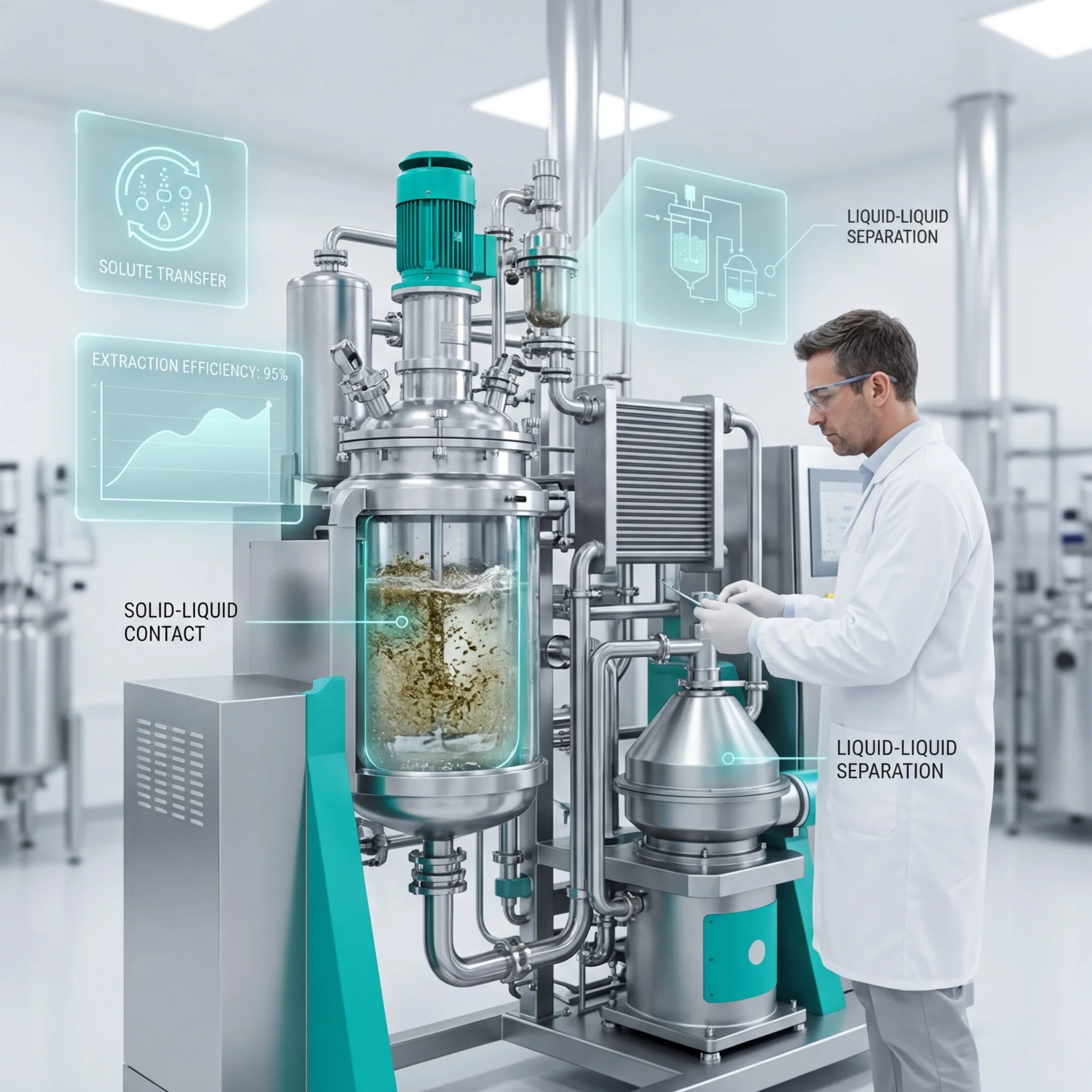
A modern facility installs continuous counter-current extractor with precise temperature and solvent control. Process time reduced to 2 hours. Extraction efficiency improves to 95%. Product consistency excellent.
Extraction equipment selection directly impacts process time, product quality, and production efficiency.
The Extraction Framework
Core Principle: Concentration Gradient
Solute transfers from solid to solvent when solvent concentration is lower. Transfer continues until equilibrium (saturation).
Key Parameters:
- Solvent type: Ethanol, water, hexane, supercritical CO2
- Temperature: Affects diffusion rate and component solubility
- Solvent-to-solid ratio: Impacts extraction efficiency
- Contact time: Longer contact = more complete extraction
- Agitation: Enhances mass transfer
Batch Extraction (Solid-Liquid)
Simple Steeping Process:
- Load solid material into tank
- Add solvent
- Heat to target temperature
- Stir for hours/days
- Drain liquid (extract)
- Optional: Multiple extractions (re-extract solids)
Batch Parameters:
- Temperature: 40-80 degrees C (heat-sensitive products)
- Time: 2-24 hours typical
- Solvent ratio: 2:1 to 10:1 (solvent:solid)
- Recovery: 60-80% extraction efficiency
Capacity Example (Herbal Extract):
- Batch size: 100 kg dried herb
- Solvent used: 400 L ethanol (4:1 ratio)
- Process time: 8 hours
- Extract recovered: 20 kg (20% yield)
- Batches/day: 2
- Daily production: 40 kg extract
Advantages: Simple, low cost, batch traceability Disadvantages: Long process time, labor-intensive, inconsistent
Continuous Counter-Current Extraction
Design Process:
- Solids move downward through column
- Solvent enters at bottom, moves upward
- Fresh solvent meets partially extracted solids (better extraction)
- Fully extracted solids exit bottom
- Rich extract exits top
Efficiency Improvement:
Batch extraction (8 hours): ~70% efficiency Continuous counter-current (2 hours): ~95% efficiency
Why? Fresh solvent continuously contacts new material
Capacity Example:
- Throughput: 100 kg/hour (vs. 25 kg/hour batch)
- Extraction efficiency: 95% (vs. 70% batch)
- Process time: 2 hours residence time (vs. 8 hours batch)
- Improvement: 4x capacity, 25% better efficiency
Supercritical CO2 Extraction
Advanced Technology:
CO2 at supercritical conditions (over 31.1 degrees C, over 73.8 bar):
- Liquid-like density (dissolves compounds)
- Gas-like diffusivity (fast mass transfer)
- Selective extraction (tunable selectivity by pressure)
Advantages:
- No solvent residue (CO2 evaporates naturally)
- Temperature control (preserves heat-sensitive compounds)
- Selective extraction (target specific components)
- FDA approved for food use
Disadvantages:
- High capital cost ($200K-1M+)
- Complex operation
- Regulatory approval needed
Application Examples:
- Hop extraction (beer)
- Coffee decaffeination
- Herb extraction (medicinal)
- Spice oleoresins
Liquid-Liquid Extraction
Principle: Solute transfers between immiscible liquids based on partition coefficient.
Equipment: Mixer-settler or centrifugal extractor
Application:
- Separating acids/bases by pH adjustment
- Removing unwanted color/flavor components
- Concentrating target compounds
Example - Citric Acid Recovery:
- Input: Acidic fermentation broth (5% citric acid, 95% water)
- Solvent: Tributyl phosphate in organic phase
- Process: Mix, settle (phases separate)
- Output: Concentrated citric acid in organic phase
- Recovery: ~90% of citric acid
Solvent Selection Criteria
| Solvent | Selectivity | Cost | Safety | Residue |
|---|---|---|---|---|
| Water | Low | Low | Excellent | None |
| Ethanol | Moderate | Moderate | Good | Requires removal |
| Hexane | High | Low | Poor | Health concern |
| Supercritical CO2 | Tunable | High | Excellent | None |
FDA Approved Solvents:
- Water (most common)
- Ethanol (approved with residue limits)
- Supercritical CO2 (no residue limits)
Process Control and Optimization
Key Monitoring Parameters:
- Temperature (+/-2 degrees C precision)
- Solvent flow rate
- Residence time
- Extract concentration (refractometer, chromatography)
- Recovery efficiency (mass balance)
Typical Extraction Equation:
Efficiency (%) = (Extract weight / Theoretical maximum) x 100
Example: 15 kg extract from 100 kg material (theoretical max: 20 kg) Efficiency = (15/20) x 100 = 75%
For specialty food and botanical manufacturers, proper extraction equipment selection optimizes efficiency, quality, and production throughput.