A meat processor sells tough cuts at commodity prices (e.g., chuck steak). Result: Low margin. Limited market appeal. Product degraded if overcooked.
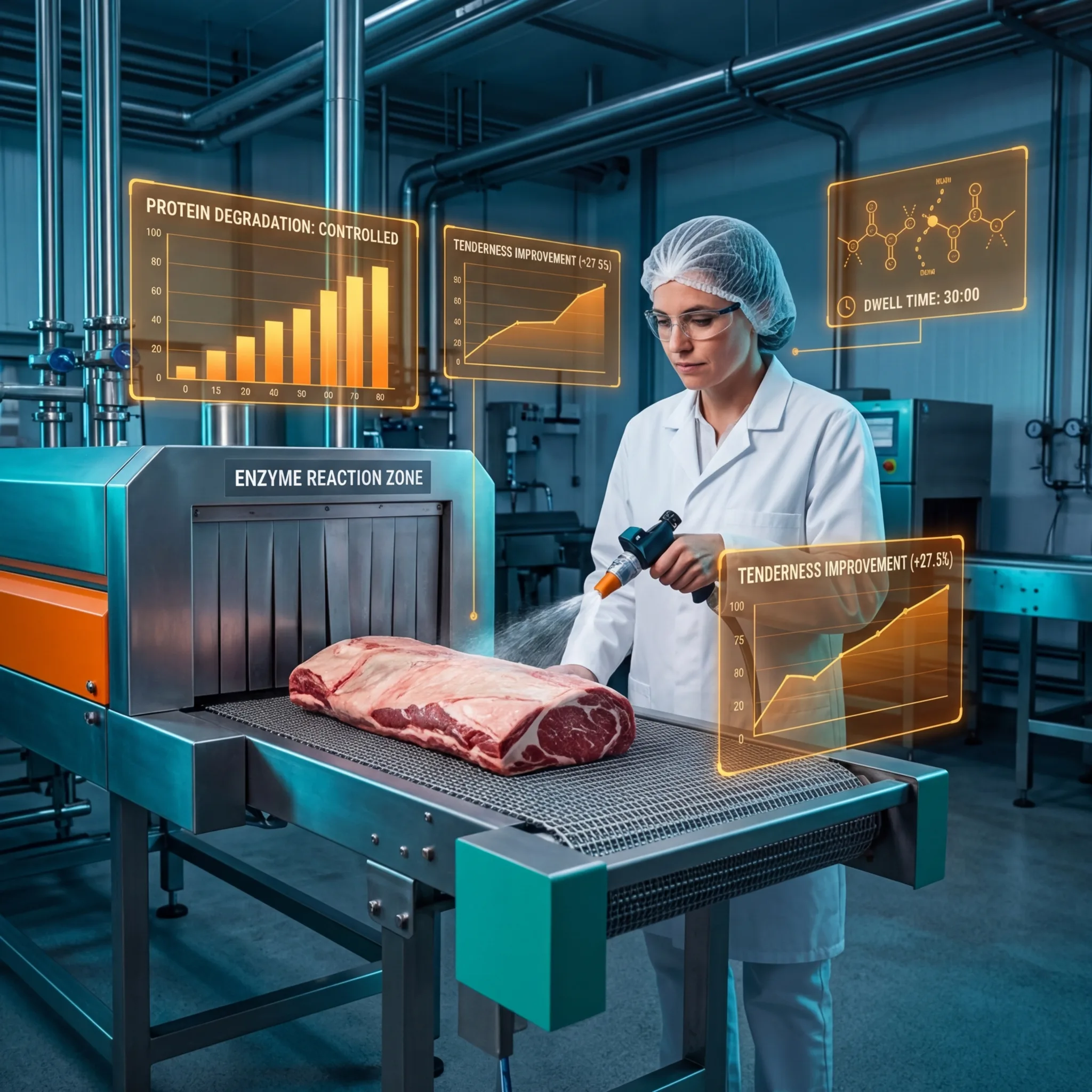
An innovative processor applies proteases (meat tenderizing enzymes) in controlled manner. Applies enzyme, allows specific dwell time (30 minutes), then inactivates enzyme (heat or pH adjustment). Result: Tough cuts become tender (+25-30% tenderness improvement). Premium quality tier pricing achieved. Waste eliminated (tough cuts become premium products).
Enzymatic treatment enables value-add processing with controlled quality outcomes.
The Enzymatic Treatment Framework
Principle:
Add specific enzyme, allow controlled reaction time, inactivate enzyme, controlled modification achieved
Key Advantage:
Enzyme action stops at exact point (can be controlled precisely)
- Unlike traditional cooking (continuous degradation)
- Unlike mechanical tenderization (uneven, inconsistent)
Common Food Enzymes
1. Proteases (Meat Tenderization)
Source: Papaya (papain), pineapple (bromelain), ginger (zingibain)
Action: Break peptide bonds (protein degradation)
- Effect: Breaks down muscle protein, producing tender meat
- Degree: Controlled by:
- Enzyme concentration (more enzyme = more tenderization)
- Temperature (warmer = faster reaction)
- Time (longer = more tenderization)
- pH (optimal pH varies by enzyme)
Tenderization Results:
| Treatment | Tenderness Improvement |
|---|---|
| None (control) | 0% |
| Papain 0.1% / 1 hour | +15% |
| Papain 0.5% / 2 hours | +30% |
| Papain 1.0% / 4 hours | +50% (over-tenderized, mushy) |
Optimal: 0.5% papain, 1-2 hours, 50C
2. Amylases (Starch Modification)
Source: Barley malt, fungal enzymes
Action: Break starch polymers into glucose, maltose
- Effect: Sweetness increase, texture change
- Application: Bread making (flavor enhancement), sauce modification
3. Pectinases (Juice Clarification)
Source: Fungal or bacterial enzymes
Action: Break pectin (cell wall component)
- Effect: Clarifies juice (removes cloudiness from suspended pectin)
- Application: Juice clarification (clear vs. pulpy juice)
- Efficiency: 90%+ clarity improvement possible
4. Lipases (Flavor Development)
Source: Fungal enzymes
Action: Break down fats into fatty acids, glycerol
- Effect: Develops flavor compounds (particularly in dairy)
- Application: Cheese flavor development, butter fat modification
Enzyme Inactivation Strategies
Strategy 1: Heat Inactivation
Method: Heat product to 70-80C for 5-10 minutes
- Effect: Denatures enzyme (stops reaction)
- Advantage: Simple, no additional chemicals
- Disadvantage: Heat affects product (some browning, texture change possible)
Strategy 2: pH Adjustment
Method: Lower or raise pH to enzyme optimum +/- 2 units
- Example: Protease optimal pH 7.5, add acid to reach pH 5.0
- Effect: Enzyme unfolds, stops working
- Advantage: No heat
- Disadvantage: pH change affects product flavor
Strategy 3: Removal
Method: Remove excess enzyme (filtration, washing)
- Effect: Enzyme still present but diluted (slows further reaction)
- Advantage: Enzyme eventually deactivates naturally
- Disadvantage: Slower approach, less control
Application Examples
Beef Tenderization:
- Inject papain solution (0.5%) into chuck steak
- Hold at 50C for 2 hours (enzyme acts)
- Heat to 70C for 10 minutes (inactivate enzyme)
- Cook normally
- Result: Chuck steak tenderness equals ribeye steak
Cost-Benefit:
- Chuck steak: $3-4/lb
- With papain: Sells as premium at $8-10/lb
- Enzyme cost: $0.20-0.30/lb
- Profit increase: 100-150%
Juice Clarification:
- Crush fruit (apples, pears)
- Add pectinase (0.1%)
- Hold 4 hours at 20C (enzyme breaks pectin)
- Filter to remove suspended particles
- Heat to 80C to stop enzyme
- Result: Crystal clear juice (vs. cloudy without enzyme)
Regulatory Considerations
FDA Status:
- Most food enzymes GRAS (Generally Recognized As Safe)
- Papain: Approved for meat tenderization
- Bromelain: Approved
- Amylases: Approved for baking
- Pectinases: Approved for juice processing
Labeling:
- Must declare enzyme addition if retained in final product
- "Enzymatically modified" or specific enzyme name required
- Consumer acceptance growing (natural processing method)
Cost-Benefit Analysis
| Factor | Cost/Benefit |
|---|---|
| Enzyme cost | $0.20-0.50 per unit product |
| Value improvement | +$2-5 per unit (premium pricing) |
| Equipment | Minimal (can use existing tanks) |
| Labor | Minimal (automated dwell time) |
| Net benefit | +$1.50-4.50 per unit |
| ROI | Very high (direct margin improvement) |
For meat and specialty food processors, enzymatic treatment enables value-add processing through controlled quality improvement.