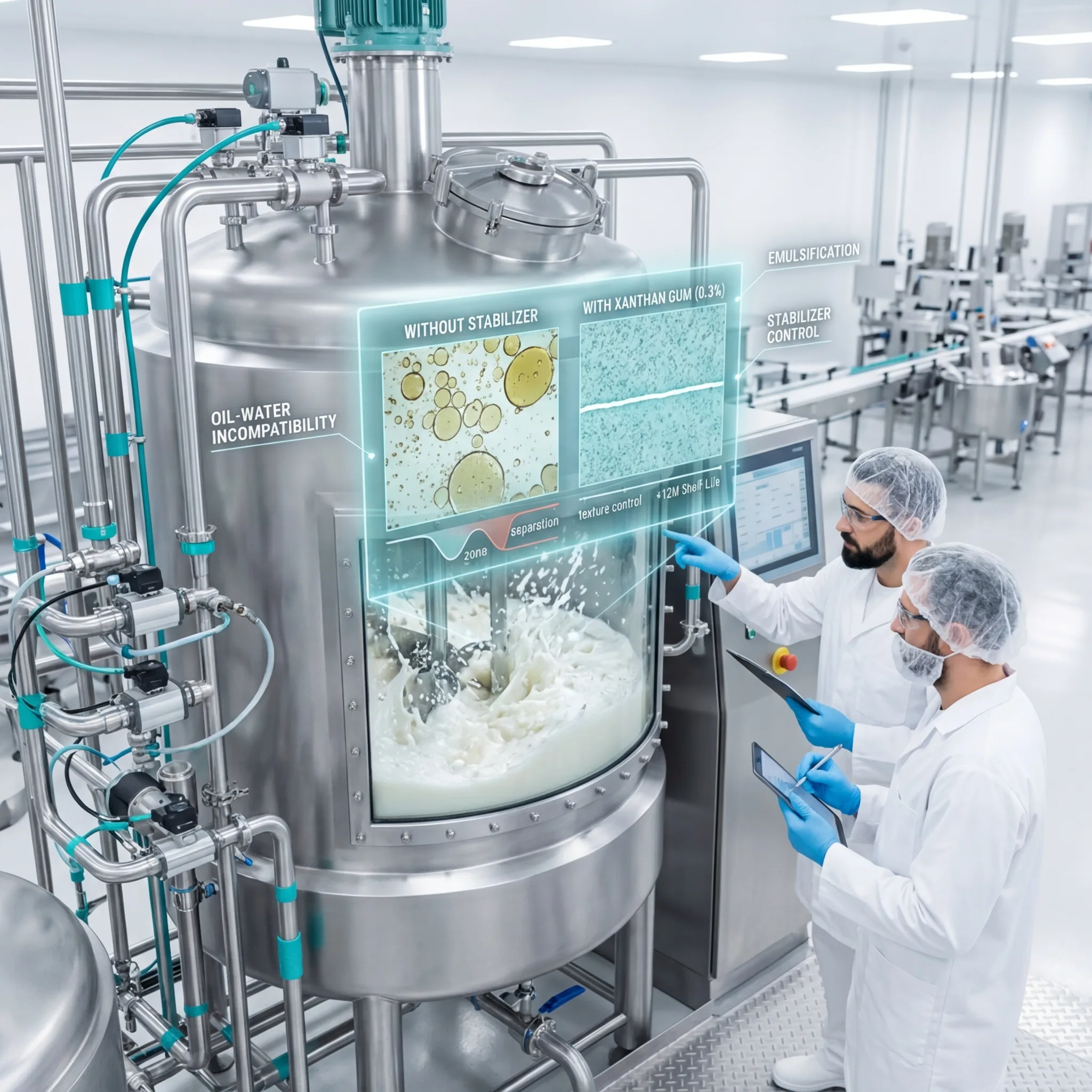
A salad dressing manufacturer makes vinaigrettes without stabilizers. Result: Oil and vinegar separate within 24 hours. Bottle requires shaking. Consumer annoyance. Shelf appeal lost.
A reformulated dressing uses xanthan gum (0.3%). Result: Oil and vinegar stay mixed for over 12 months. No separation visible. Premium shelf appeal. Premium pricing justified (+$0.50/bottle).
Emulsification control directly impacts product stability and consumer experience.
The Emulsification Framework
Oil-Water Incompatibility:
Oil and water don't mix (immiscible):
- Polarity: Oil nonpolar, water polar
- Result: Natural separation over time
- Challenge: Keep separated phases mixed
Emulsion Types:
| Type | Continuous | Dispersed | Examples |
|---|---|---|---|
| O/W | Water | Oil droplets | Salad dressing, sauce |
| W/O | Oil | Water droplets | Mayonnaise, butter |
| Multiple | Complex | Both phases | Cream, lotion |
Emulsifiers and Stabilizers
Emulsifiers (Reduce Surface Tension):
Function: Reduce energy needed to disperse oil in water
Common Emulsifiers:
-
Lecithin (phospholipid)
- Source: Egg yolk, soy
- Level: 1-3%
- Function: Reduces interfacial tension
-
Mono-diglycerides
- Type: Ester
- Level: 0.5-2%
- Function: HLB (hydrophile-lipophile balance)
-
Polysorbates (Tween)
- Type: Synthetic surfactant
- Level: 0.1-0.5%
- Function: Strong emulsifying power
Stabilizers (Increase Viscosity, Prevent Separation):
Function: Thicken continuous phase, slow separation
Common Stabilizers (Hydrocolloids):
| Stabilizer | Source | Level | Function |
|---|---|---|---|
| Xanthan gum | Fermentation | 0.1-0.5% | High viscosity, stability |
| Guar gum | Legume seed | 0.1-0.3% | Moderate viscosity |
| Carrageenan | Red seaweed | 0.1-0.3% | Gel formation |
| CMC | Cellulose derivative | 0.1-0.3% | Thickening |
| Gelatin | Collagen protein | 1-5% | Gel + stability |
Stabilization Mechanisms
Mechanism 1: Viscosity Increase
Process: Thickener raises continuous phase viscosity
- Effect: Oil droplets move slower (separation slowed)
- Example: Oil droplet sinking takes 1 year instead of 1 day
- Result: Shelf-stable (practical shelf-life extended)
Sedimentation Rate (Stokes Law):
Speed of separation is proportional to 1/viscosity
- Low viscosity (water): Fast separation
- High viscosity (xanthan): Slow separation
- 10x viscosity increase = 10x longer shelf-life
Mechanism 2: Droplet Size Control
Process: Homogenization creates smaller oil droplets
- Droplet size: under 5 micrometers (very small)
- Effect: Slower settling (Stokes law)
- Result: Colloid stability (stays mixed)
Mechanism 3: Electrostatic Stabilization
Process: Charged particles repel each other
- Mechanism: Particles have same charge (repel)
- Result: Stay suspended (don't coalesce)
- Example: Proteins (negatively charged at pH 7)
Emulsion Stability Testing
Test 1: Centrifugation
Method: Spin sample at high speed
- Speed: 3,000-10,000 rpm
- Time: 5-10 minutes
- Result: Acceleration simulates storage (fast test)
- Measure: Any separation visible?
Test 2: Storage Stability
Method: Store at ambient temperature
- Temperature: 20-25 degrees C
- Time: 3-6 months typical
- Observation: Monthly check for separation
- Pass: No visible separation after 6 months
Formulation Optimization
Example: Vinaigrette Formulation
Without Stabilizer:
- Oil: 70%
- Vinegar: 30%
- Result: Separates 24-48 hours
With Stabilizer:
- Oil: 70%
- Vinegar: 28%
- Xanthan gum: 0.3%
- Emulsifier (lecithin): 0.7%
- Result: Stable over 12 months
Cost Addition: +$0.03-0.10/bottle Price Premium: +$0.50/bottle possible
Cost-Benefit
| Factor | Impact |
|---|---|
| Homogenizer | $50-200K |
| Stabilizer (xanthan) | $0.05-0.15/lb |
| Emulsifier | $0.10-0.30/lb |
| Shelf-life | 24-48 hrs to over 12 months |
| Consumer satisfaction | +85% (no separation) |
| Price premium | +$0.50/bottle possible |
| Volume increase | +40-60% (better shelf appeal) |
| ROI | Immediate (margin gain) |
For manufacturers, proper emulsification and stabilization ensures long shelf-life and premium consumer experience.