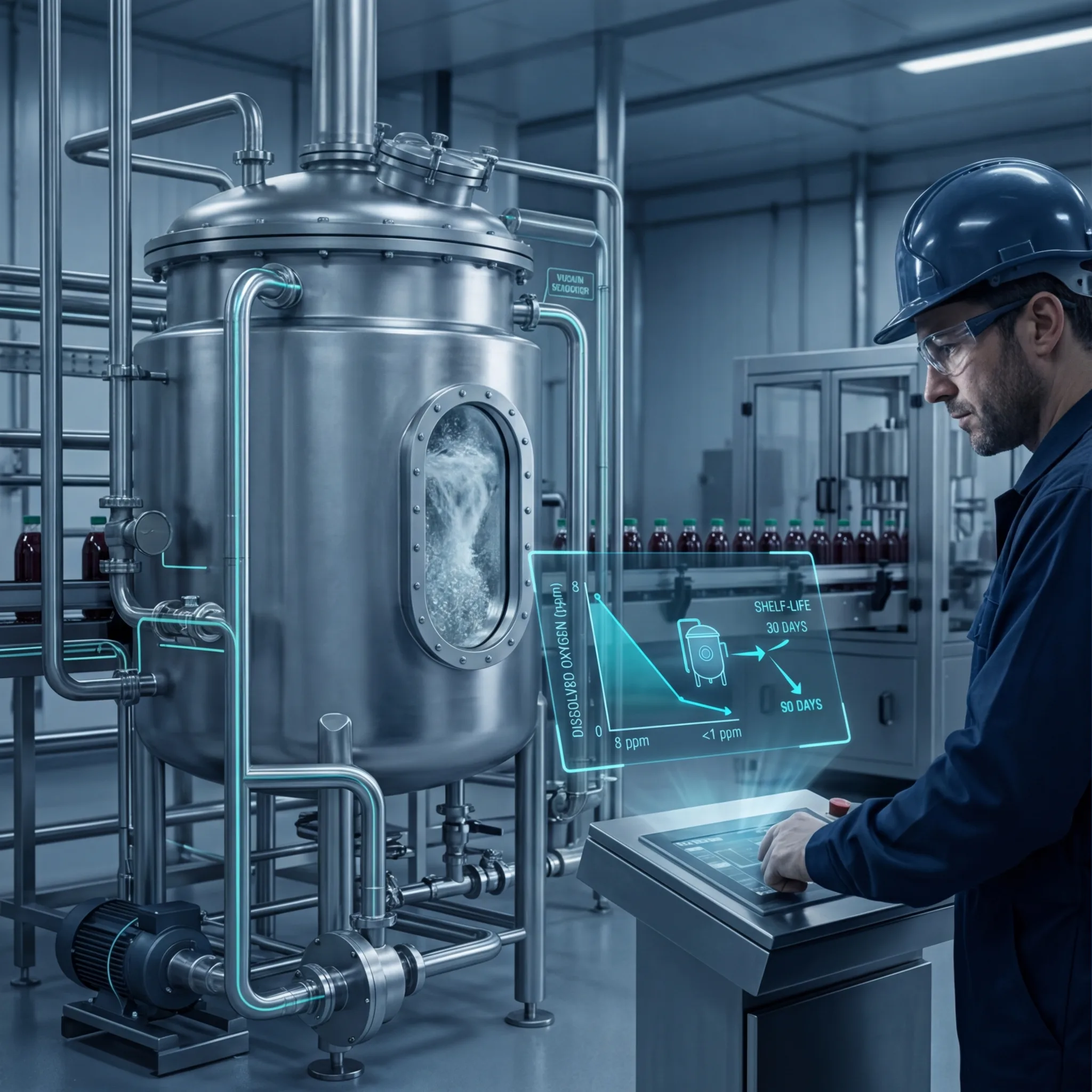
A juice manufacturer packages product without deaeration. Result: Oxidation during storage. Color fades. Flavor deteriorates. Shelf-life only 30 days.
A compliant manufacturer installs vacuum deaerator before filling. Oxygen reduced from 8 mg/L to under 1 mg/L. Oxidation nearly eliminated. Shelf-life extends to 90 days. Market advantage through extended freshness.
Deaeration equipment selection directly impacts product shelf-life and sensory quality.
The Deaeration Framework
Why Remove Oxygen?
Dissolved oxygen causes:
- Oxidation: Nutrient loss (vitamin C, carotenoids)
- Flavor degradation: Off-flavors, rancidity development
- Color loss: Browning, fading
- Microbial growth: Some pathogens more active with oxygen
Oxygen Impact on Shelf-Life:
| Product | With O2 (ppm) | Shelf-Life | Without O2 | Shelf-Life |
|---|---|---|---|---|
| Orange juice | 8 | 30 days | under 1 | 90 days |
| Apple juice | 6 | 45 days | under 1 | 120 days |
| Tomato juice | 7 | 60 days | under 1 | 180 days |
Oxygen Removal Methods
Vacuum Deaeration:
Design: Product sprayed into chamber at low pressure
- Principle: Reduced pressure lowers boiling point, releasing dissolved O2
- Vacuum level: Typically 80-95 kPa (0.15-0.8 bar absolute)
- Temperature: Can deaerate at room temperature or heated (30-60 degrees C typical)
Process:
- Product enters vacuum chamber
- Pressure reduced (creates foam/bubbles)
- Oxygen released from solution into vapor space
- Vacuum pump removes gas
- Deaerated product exits through outlet
Effectiveness:
- Initial O2: ~8 mg/L (air-saturated water)
- After vacuum: under 0.5 mg/L (95%+ removal)
- Residual O2: under 1 mg/L (acceptable for most beverages)
Advantages:
- Very effective (over 95% removal)
- No temperature increase needed
- Suitable for heat-sensitive products
Disadvantages:
- High capital cost ($50K-200K)
- Complex operation
- Vapor handling (condensers needed)
Steam Injection Deaeration:
Design: Steam bubbled through product, stripping oxygen
- Principle: Steam reduces dissolved oxygen concentration
- Temperature rise: 5-15 degrees C (heating side effect)
- Bubble size: Small bubbles maximize contact
Process:
- Product in tank
- Steam injected at bottom
- Bubbles rise, carrying oxygen
- Steam condenses, adding water
Effectiveness:
- Oxygen removal: 60-80% (less effective than vacuum)
- Residual O2: 1-3 mg/L (acceptable for many products)
- Side benefit: Heating product (pasteurization benefit)
Advantages:
- Lower capital cost ($20K-50K)
- Simpler operation
- Heats product simultaneously
Disadvantages:
- Adds water (dilution effect)
- Less effective than vacuum
- Requires steam system
Dissolved Oxygen Measurement
Oxygen Probe (Electrochemical):
- Real-time measurement (0-20 mg/L range)
- Accuracy: +/-0.2 mg/L
- Response time: 10-30 seconds
- Cost: $500-1,500 per probe
Target Levels by Product:
| Product | O2 Target (ppm) | Shelf-Life Goal |
|---|---|---|
| Premium orange juice | under 0.5 | 90+ days |
| Standard juice | 1-2 | 60 days |
| Milk | 1-3 | 21 days |
| Wine | under 0.5 | Months-years |
Integration with Packaging
Optimal Sequence:
- Deaeration: Remove O2 from product
- Immediate filling: Minimize air re-entry
- Headspace flushing: Nitrogen instead of air
- Sealing: Prevent oxygen ingress
- Storage: Cool, protected from light
Impact of Each Step:
Without deaeration (8 ppm O2) results in 30-day shelf-life Adding deaeration (0.5 ppm O2) results in 60-day shelf-life Adding nitrogen flushing (residual O2 under 1%) results in 90-day shelf-life Adding cold storage + dark packaging results in 120+ day shelf-life
Equipment Selection Criteria
| Factor | Vacuum | Steam Injection |
|---|---|---|
| Effectiveness | Excellent (over 95%) | Good (60-80%) |
| Temperature effect | None (can cool) | Heats product |
| Capital cost | High | Moderate |
| Operating cost | High (vacuum pump) | Moderate (steam) |
| Complexity | High | Low |
| Food quality | Best | Good |
| ROI (years) | 3-5 | 2-3 |
Troubleshooting
- Insufficient oxygen removal: Check vacuum level, increase residence time
- Product quality loss: May be too hot, reduce temperature
- Foaming issues: Adjust pressure/temperature, add anti-foam agent
- Reoxidation: Improve sealed storage, refrigerate
For beverage and food manufacturers, proper deaeration equipment selection extends shelf-life and preserves product quality throughout distribution.