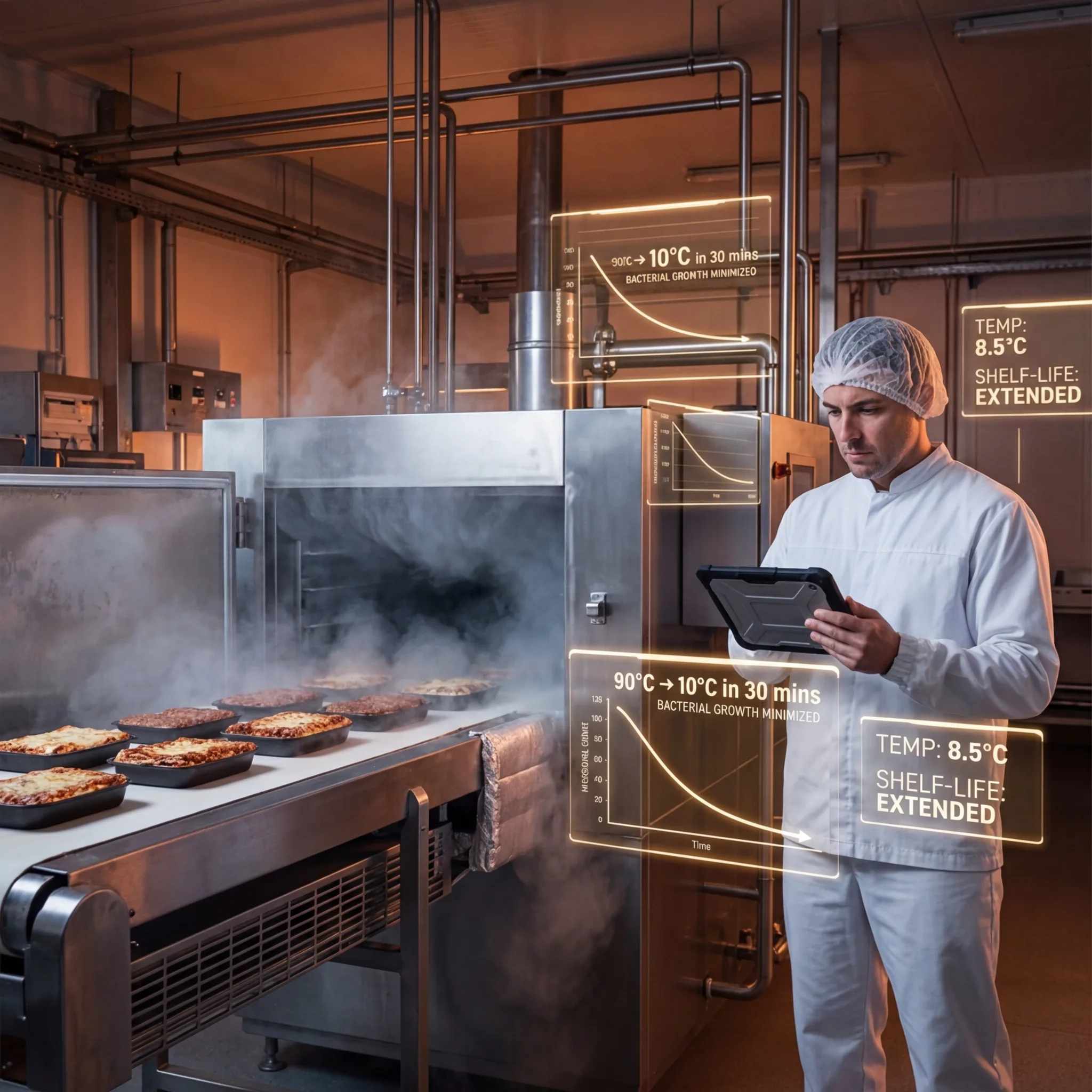
A prepared food manufacturer cools cooked products slowly (3-4 hours from 90C to 10C). Result: Pathogenic growth window extended. Food safety risk (Clostridium perfringens). Product shelf-life uncertain.
A compliant facility installs blast chiller. Cooling completes in 30 minutes (90C to 10C). Pathogenic growth minimized. Food safety assured. Shelf-life predictable and extended.
Cooling equipment selection directly impacts food safety, shelf-life, and product quality.
The Cooling Framework
Temperature Danger Zone:
Rapid bacterial growth occurs between 10-65C (40-149F)
- Optimal growth: 37C (98.6F, body temperature)
- Doubling time: 20-30 minutes (can multiply dramatically)
Food Safety Requirement:
FDA guideline: Cool from 65C to 21C in 2 hours, then 21C to 4C in 4 hours
- Total maximum: 6 hours from 65C to 4C
- Better practice: Cool to 4C in under 2 hours (minimize bacterial growth)
Rapid cooling reduces:
- Bacterial multiplication (limits pathogenic growth)
- Sensory quality loss (shorter exposure to high temp)
- Nutritional loss (vitamin degradation slows at lower temps)
Cooling Methods
Slow Cooling (Room Temperature):
Process:
- Hot product placed on shelf in cooler
- Passive cooling by ambient air circulation
- Time: 3-4 hours typical (90C to 10C)
Risk: Long danger zone exposure (bacterial growth) Cost: Low (gravity-driven, no equipment) Quality: Nutrient loss possible
Blast Chilling (Rapid Cooling):
Design: High-velocity cold air circulation around product
- Temperature: -10 to -40C air blast
- Air velocity: 3-5 m/s (rapid heat transfer)
- Cooling time: 30 minutes to 2 hours (90C to 4C typical)
- Capacity: 50-200 kg per cycle
Process:
- Hot product loaded into chamber
- Fans activate (rapid air circulation)
- Cold air rapidly cools product
- Compressor cycles maintain temperature
- Product removed when target temp reached
Cooling Rate Example:
Time to cool 50 kg cooked chicken from 85C to 5C:
- Slow method (ambient): 180 minutes (3 hours)
- Blast chiller: 30 minutes
- Improvement: 6x faster
Advantage: Very rapid, food-safe, minimal sensory loss Disadvantage: High capital cost ($30K-100K), energy-intensive
Heat Transfer Principles
Newton's Law of Cooling:
Rate of cooling is proportional to (delta-T / Thermal resistance)
Where:
- delta-T = Temperature difference (product vs. environment)
- Thermal resistance = Material properties, size, air contact
Optimization Strategies:
- Larger delta-T (colder air): Faster cooling
- Reduce thermal resistance: Thinner products, more air contact
- Increase air velocity: Better convection
Blast Chiller Design
Critical Parameters:
| Parameter | Impact |
|---|---|
| Air temperature | Lower = faster cooling (but energy cost) |
| Air velocity | Higher = faster cooling (convection) |
| Product arrangement | Spread out = faster (vs. stacked) |
| Product thickness | Thinner = faster (heat diffusion) |
| Humidity | Moderate (prevents desiccation) |
Typical Specifications:
- Cabinet size: 0.5-2 m3 internal volume
- Product load: 20-100 kg typical
- Cooling time: 30 min - 2 hours (depending on load)
- Evaporator capacity: 5-15 kW cooling
- Temperature range: -18C to 0C (adjustable)
Food Safety Validation
Time-Temperature Study:
- Load product at measured temperature (e.g., 80C)
- Place thermocouples in thermal center (thickest point)
- Record temperature at 5-minute intervals
- Stop when core reaches target (4C typical)
- Document total time
Acceptance Criteria:
- Core reaches 4C within 2 hours (FDA compliant)
- Better: Within 1 hour (margin of safety)
Microbial Testing:
- Pre-blast: Baseline microbial count
- Post-blast: Confirm no growth during cooling
- Shelf-life: Extended validation study
Cost-Benefit Analysis
| Factor | Slow Cooling | Blast Chiller |
|---|---|---|
| Equipment cost | Low | $30-100K |
| Energy/cycle | Minimal | High (compressor) |
| Time/cycle | 3-4 hours | 30 min - 2 hours |
| Food safety | Risky | Excellent |
| Shelf-life | Uncertain | Predictable |
| Labor | Minimal | Minimal |
| Payback | -- | 2-3 years |
ROI Calculation:
Annual throughput: 100,000 kg products Labor cost savings: 500 hours/year @ $20/hr = $10,000 Improved shelf-life: 2-3 extra days (10% sales increase) = $50K Energy cost: $5,000/year Net annual benefit: $55,000 Payback: 1 year (for $50K equipment)
Operational Considerations
Blast Chiller Maintenance:
- Clean filters weekly (airflow maintenance)
- Defrost cycles (frost buildup reduces efficiency)
- Compressor service (annual or per schedule)
Safety:
- Auto shutoff if door opened
- Adequate drainage for condensation
- Proper ventilation for heat rejection
For prepared food and cook-chill operations, proper cooling equipment selection ensures food safety and extends product shelf-life significantly.