
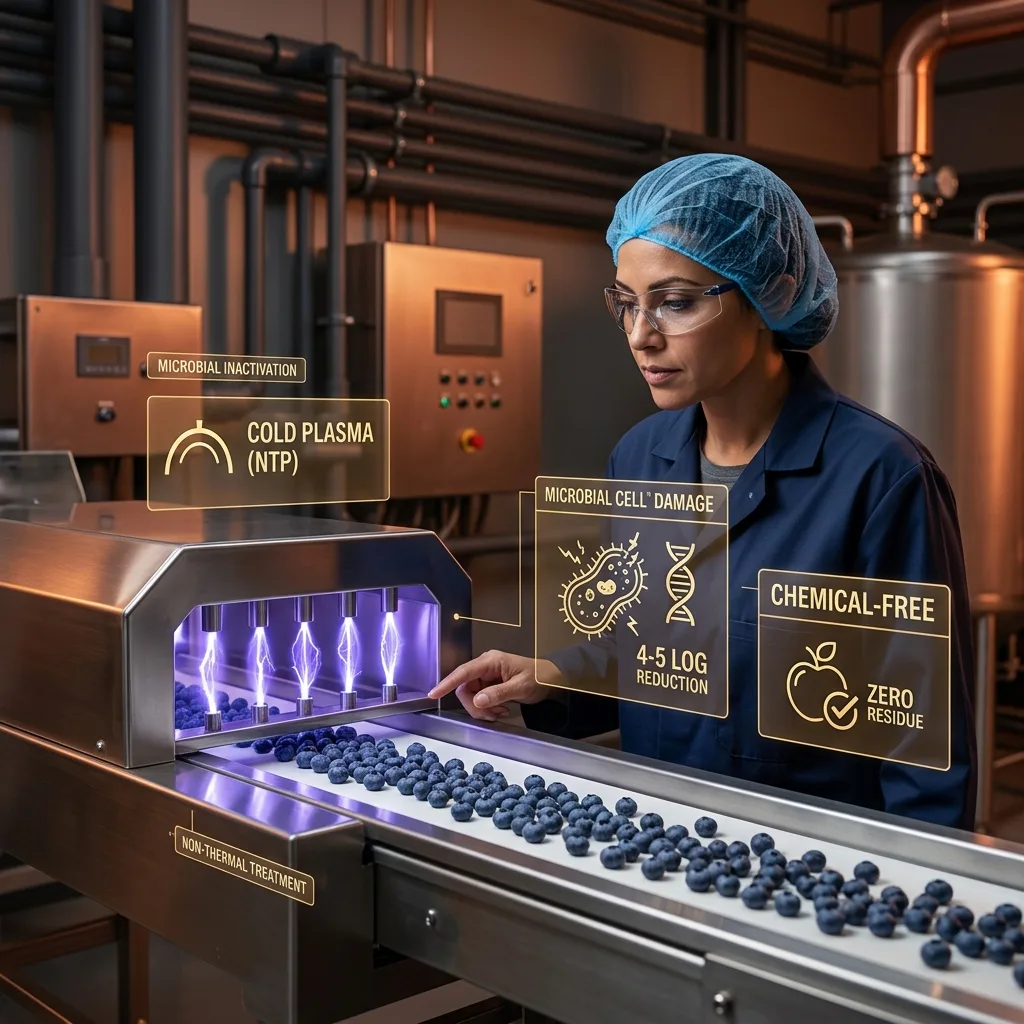
A fresh produce packer uses chemical sanitizers (chlorine wash) for surface decontamination. Result: Chemical residues, environmental concern, inconsistent microbial reduction (2-3 log reduction).
An innovative facility installs cold plasma system: Non-thermal gas ionization, chemical-free. Result: 4-5 log microbial reduction, zero chemical residues, no texture/flavor damage. Premium clean-label positioning achieved. Regulatory approval strong.
Cold plasma enables chemical-free sterilization with superior microbial reduction.
The Cold Plasma Framework
What is Cold Plasma?
Ionized gas at near-room temperature:
- Generation: Electrical discharge ionizes gas (air, N2, O2, Ar)
- Active species: Free radicals, UV photons, charged particles
- Temperature: 30-60 degrees C (non-thermal, no cooking)
- Effect: Destroys microorganisms on surfaces
Mechanism:
Active species attack microbial cells:
- Cell membrane damage: Lipid oxidation
- DNA damage: Breaks genetic material
- Protein denaturation: Enzyme inactivation
- Result: Cell death (4-5 log reduction typical)
Applications
Application 1: Fresh Produce Surface
Target: E. coli, Salmonella, Listeria (surface contamination)
- Treatment time: 30 seconds - 5 minutes
- Log reduction: 3-5 log (99.9-99.999% kill)
- Advantage: No water, no chemicals, no heat damage
Application 2: Packaging Sterilization
Target: Sterilize film, containers before filling
- Treatment: Inline plasma before product contact
- Speed: Continuous (production line compatible)
- Advantage: Reduces preservative needs
Application 3: Meat/Poultry Surface
Target: Pathogen reduction post-processing
- Treatment: 1-3 minutes plasma exposure
- Result: Extended shelf-life (3-5 days additional)
- Advantage: No texture change vs. heat
Technology Types
Type 1: Atmospheric Pressure Plasma
Operation: Ambient pressure, air gap
- Advantages: Simple, scalable, low cost
- Limitations: Uneven coverage (surface irregularities)
Type 2: Low-Pressure Plasma
Operation: Vacuum chamber
- Advantages: Uniform treatment, deeper penetration
- Limitations: Batch process (slower), equipment cost
Type 3: Plasma Jet
Operation: Targeted plasma stream
- Advantages: Precise application, inline processing
- Limitations: Requires close proximity
Microbial Reduction Data
| Organism | Untreated | After Plasma (3 min) | Log Reduction |
|---|---|---|---|
| E. coli | 10^6 CFU/cm2 | 10^2 CFU/cm2 | 4-log |
| Salmonella | 10^6 CFU/cm2 | 10^2 CFU/cm2 | 4-log |
| Listeria | 10^5 CFU/cm2 | 10^1 CFU/cm2 | 4-log |
| Mold spores | 10^4 CFU/cm2 | 10^1 CFU/cm2 | 3-log |
Cost-Benefit Analysis
| Factor | Impact |
|---|---|
| Equipment | $100-500K (scale-dependent) |
| Operating cost | $0.01-0.05/unit (electricity only) |
| Chemical cost eliminated | $50-150K/year savings |
| Shelf-life extension | +3-5 days (fresh produce) |
| Clean-label | Premium positioning possible |
| ROI | 2-4 years typical |
For food manufacturers, cold plasma enables chemical-free sterilization with superior safety.