
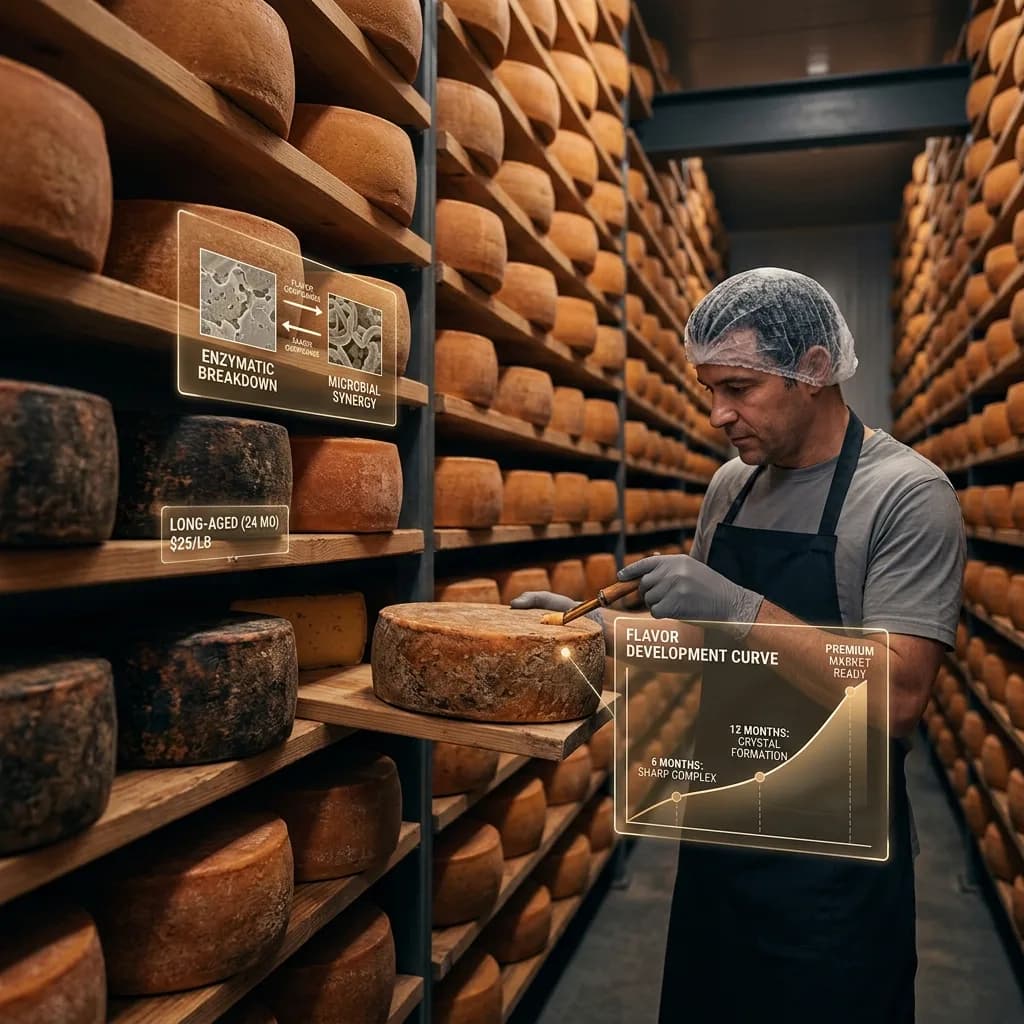
A cheese maker produces young cheddar immediately after production. Result: Mild flavor, rubbery texture, commodity pricing ($8-12/lb). Limited market appeal.
A sophisticated producer ages cheddar 12-18 months in controlled conditions (12-15 degrees C, 85-90% humidity). Result: Complex sharp flavor, crystalline texture, premium market ($18-25/lb). Repeat buyers established. Flavor profile legendary.
Cheese aging directly impacts flavor complexity and premium market positioning.
The Cheese Maturation Framework
Aging Purpose:
Cheese changes during storage through:
- Enzymatic breakdown: Proteins to amino acids (flavor)
- Microbial growth: Surface molds/bacteria develop (secondary flavors)
- Moisture loss: Concentration of flavors, texture firming
- Crystal formation: Calcium lactate crystals (pleasant crunch)
Aging Timeline Effects:
| Age | Flavor | Texture | Price |
|---|---|---|---|
| Fresh (1-3 days) | Mild, milky | Soft, rubbery | $8-12/lb |
| Young (1-3 months) | Moderate | Creamy, firm | $12-15/lb |
| Aged (6-12 months) | Complex, sharp | Crystalline | $15-20/lb |
| Long-aged (12-24 months) | Very complex | Hard, granular | $20-30/lb |
Aging Environment Control
Temperature (Critical):
Target: 12-15 degrees C (52-59 degrees F)
- Too warm (over 18 degrees C): Fermentation continues, excess acid development
- Too cool (under 8 degrees C): Slow maturation, incomplete flavor development
- Optimal: 13 degrees C enables slow enzyme activity
Humidity (Critical):
Target: 85-90% relative humidity
- Too dry (under 70%): Excessive moisture loss, hard exterior, cracking
- Too moist (over 95%): Mold overgrowth, surface degradation
- Optimal: 85-90% allows controlled moisture loss
Air Flow:
- Purpose: Prevent mold buildup, distribute microbes
- Method: Passive air circulation (cave-like conditions)
- Result: Even surface development, reduced defects
Microbial Environment:
- Native microbes: Natural cheese cave microbes (Penicillium, Brevibacterium)
- Benefit: Unique flavor profile per location (terroir)
- Challenge: Must control pathogenic species (Listeria, E. coli control)
Flavor Development Mechanisms
Mechanism 1: Proteolysis (Protein Breakdown)
Enzymes (from rennet, culture, cell enzymes) break casein proteins:
- Casein (big, bland) to amino acids (small, flavorful)
- Key amino acids: Glutamate (umami), aspartate (sour)
- Result: Complex flavor develops
Mechanism 2: Lipolysis (Fat Breakdown)
Lipases break milk fats into fatty acids:
- Short-chain fatty acids: Sharp, pungent flavors
- Long-chain fatty acids: Mild, buttery notes
- Balance: 6-12 month aging optimal (not too sharp)
Mechanism 3: Microbial Growth
Secondary microbes produce volatile compounds:
- Blue mold: Penicillium roqueforti (peppery, sharp)
- Surface bacteria: Brevibacterium (pungent, earthy)
- Yeasts: Complex fruity notes
Texture Evolution
Moisture Loss (Gradual):
Fresh cheddar: 38% moisture
- 3 months: 35% moisture (slight firming)
- 12 months: 32% moisture (firm texture)
- 24 months: 28% moisture (hard, brittle)
Crystal Formation:
Calcium lactate crystals form during aging:
- Appearance: White dots/specks in cheese
- Texture: Pleasant crunch (desirable)
- Indicator: Sign of proper aging
Texture Profile (Preferred):
Aged cheddar (12+ months):
- Smooth, not grainy
- Slight crystalline crunch
- Firm, not hard
- Mouthfeel: Rich, complex
Aging Room Monitoring
Daily Checklist:
- Temperature: Verify 12-15 degrees C (+/-1 degree C tolerance)
- Humidity: Check 85-90% (+/-2% tolerance)
- Air circulation: Verify passive flow present
- Surface inspection: Look for unwanted mold (green, black)
- Cheese turning: Rotate wheels monthly
Monthly Testing:
- Sample pH: Target 5.0-5.2 (stable)
- Taste: Flavor profile documentation
- Texture: Firmness assessment
- Defects: Mold type, crack location
Cost-Benefit Analysis
| Factor | Impact |
|---|---|
| Aging room | $50-150K (construction/equipment) |
| Temperature/humidity control | $10-30K |
| Capital investment | $60-180K |
| Aging time | 12-18 months (storage cost) |
| Yield loss | 8-12% (moisture loss) |
| Price increase | $8/lb to $20/lb (+150%) |
| Payback | 2-4 years |
For cheese makers, controlled aging enables premium market positioning with 150%+ price increase.