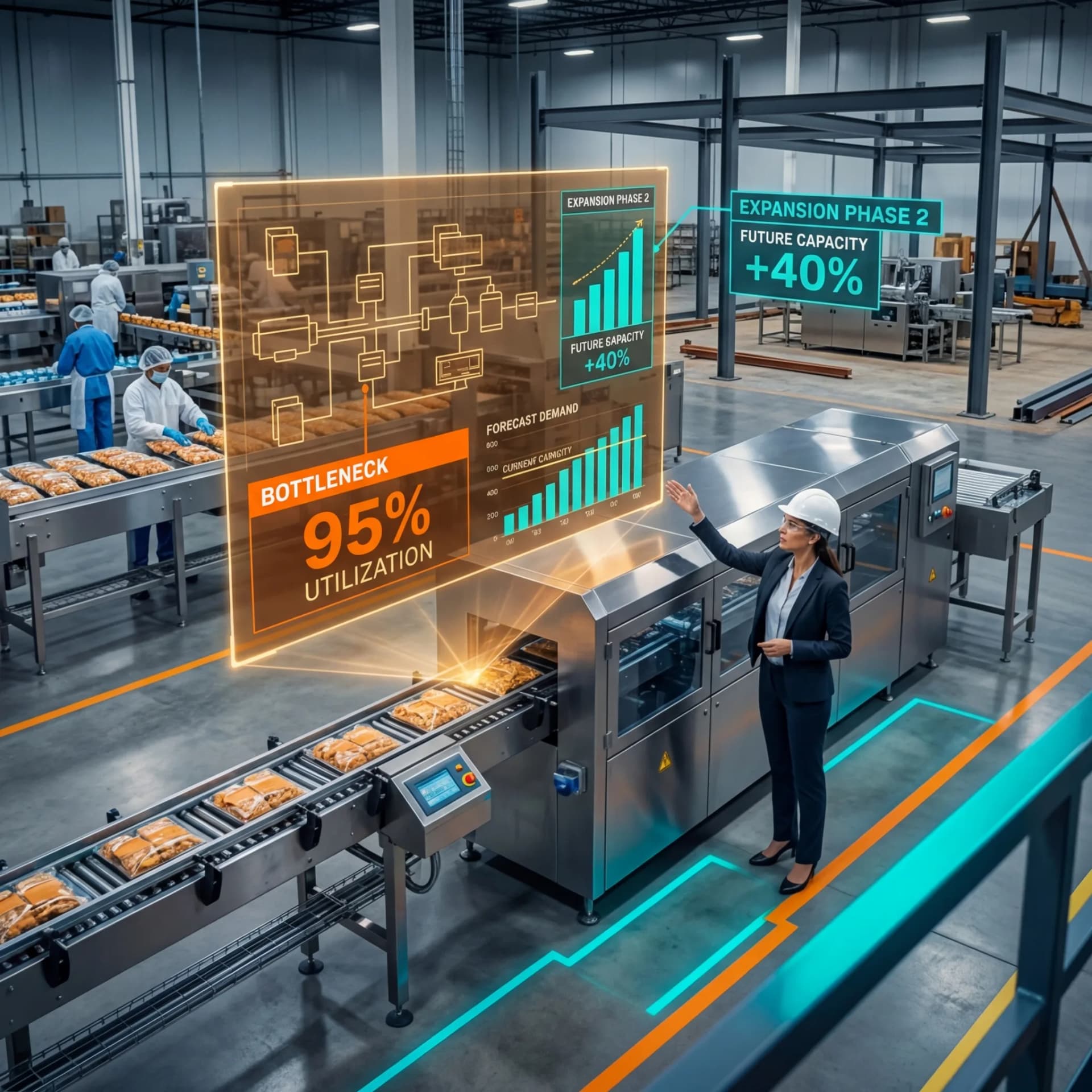
A food manufacturer growing 20% annually quickly hits capacity constraints. Current facility designed for $50M volume now struggling at planned $60M volume. Equipment running at 95%+ utilization -- no buffer for downtime or variability.
Capacity expansion requires planning 18-24 months in advance to avoid production bottlenecks delaying customer orders.
The Capacity Expansion Framework
Step 1: Capacity Assessment (Months 1-3)
Analyze current state:
- Equipment utilization by line (identify bottlenecks)
- Current throughput (units/day, hours/day)
- Downtime analysis (maintenance, changeovers)
- Facility constraints (space, utilities)
- Labor availability
Example findings:
- Line 1: 85% utilized (capacity available)
- Line 2: 95% utilized (bottleneck)
- Line 3: 70% utilized (capacity available)
- Identified constraint: Line 2 production speed
Step 2: Demand Forecast (Months 1-3)
Project future demand:
- Current volume: $50M
- Year 1 growth: 15% = $57.5M
- Year 2 growth: 18% = $68M
- Year 3 growth: 20% = $82M
Equipment capacity required by year.
Step 3: Expansion Options Assessment (Months 3-6)
| Option | Investment | Capacity | Timeline | Benefits | Risks |
|---|---|---|---|---|---|
| Add Shift | $1M (labor) | +30% | 2 months | Fast, flexible | Labor cost, complexity |
| Optimize Line 2 | $2M | +15% | 6 months | Moderate cost | Modest improvement |
| Add Equipment | $8M | +50% | 12 months | Significant capacity | Capital intensive |
| New Facility | $30M+ | +100% | 18-24 mo | Strategic | Major investment |
Step 4: Expansion Decision (Months 6-9)
For $50M manufacturer growing 20% annually:
-
Years 1-2 (growth to $68M): Add shift + optimize Line 2
-
Investment: $3M
-
Capacity: $65M (adequate for Years 1-2)
-
Years 2-3 (growth to $82M): Add new production line
-
Investment: $8M
-
Capacity: $90M (adequate through Year 3-4)
Step 5: Expansion Implementation (Months 9-24)
For $8M production line addition:
- Equipment procurement: 3-4 months
- Installation: 2-3 months
- Testing/validation: 1-2 months
- Ramp-up: 1-2 months
- Total: 9-12 months from decision to production
Optimizing Existing Capacity First
Before expanding, maximize current capacity:
Efficiency Improvements (typical lift: 10-15%):
- Reduce changeover time (quick changeover techniques)
- Improve OEE (reduce downtime through preventive maintenance)
- Optimize scheduling (better production sequencing)
- Cross-train labor (flexible staffing model)
These improvements can add $5-8M capacity for $2M investment (vs. $8M for new equipment).
Return on Investment (ROI):
Add Shift Approach:
- Investment: $1M (additional labor, minimal capex)
- Capacity benefit: $5M annual revenue (Year 1-2)
- Annual operating profit lift: $750K (15% margin on new revenue)
- ROI: 75% annually (very attractive)
New Equipment Approach:
- Investment: $8M
- Capacity benefit: $20M annual revenue (incremental over time)
- Annual operating profit lift: $3M (15% margin)
- ROI: 37.5% annually (attractive but capital intensive)
Capacity Planning Cadence
- Quarterly: Assess current utilization vs. forecast
- Semi-annually: Reforecast demand, assess expansion needs
- Annually: Approve 18-month expansion roadmap
For food manufacturing companies, proactive capacity planning ensures infrastructure matches growth trajectory while minimizing investment waste or production bottlenecks.