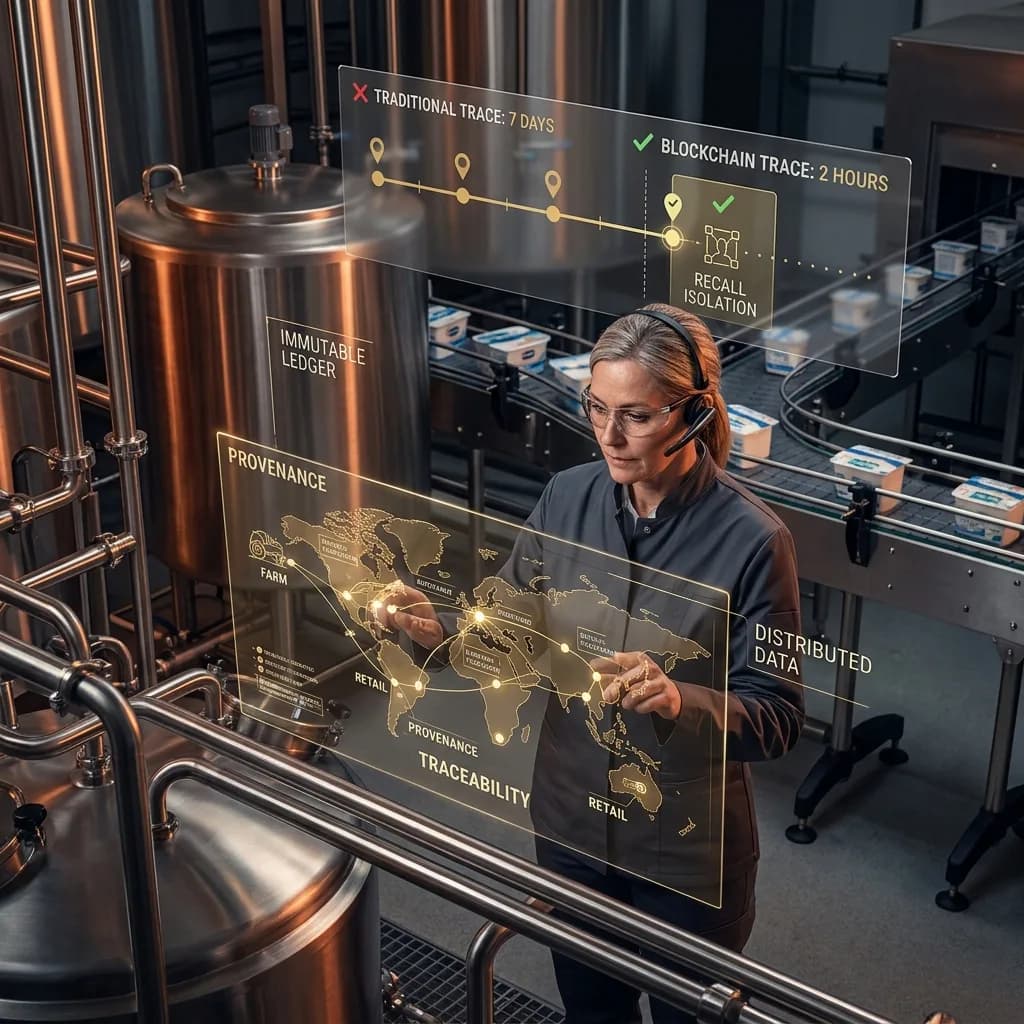
A contamination outbreak occurs in dairy supply. Regulators must trace product manually. Result: 5-7 days to identify all affected lots. Millions dollars in waste, massive brand damage. Consumer confidence destroyed.
A blockchain-enabled supply chain records each transaction. Result: Complete supply chain visible in hours. Affected product identified, isolated immediately. Waste reduced 90%, brand trust maintained. Competitive advantage established.
Blockchain traceability directly impacts recall efficiency and brand protection.
The Traceability Framework
Traditional Traceability Gap:
Manual trace process:
- Day 1: Contamination reported, investigation begins
- Day 2-3: Manufacturer contacted, batch identified
- Day 3-4: Distributor records searched, transportation tracked
- Day 5-7: Retail locations identified
- Day 7: Media notification (damage done)
- Result: Massive waste, brand damage, regulatory penalties
Blockchain Solution:
Immutable digital ledger:
- Immediate: All parties access complete history
- Real-time: Transaction timestamp recorded
- Encrypted: Cryptographic proof prevents tampering
- Result: Hours to trace vs. 5-7 days
Blockchain Technology Basics
What is Blockchain?
Distributed ledger technology:
- Records: Each transaction immutable (cannot alter)
- Distributed: Copies maintained on multiple computers
- Transparent: All authorized parties see complete history
- Secure: Cryptographic validation ensures authenticity
Key Properties:
- Immutability: Once recorded, cannot change
- Transparency: All transactions visible (to authorized users)
- Decentralization: No single entity controls data
- Security: Cryptographic signatures prevent fraud
Supply Chain Implementation
Participants in Chain:
- Producer (Farm/Factory): Input initial data
- Processor: Processing information logged
- Distributor: Distribution and transportation
- Retailer: Final retail location
- Consumer: QR code access for verification
Data Points Recorded:
| Step | Data Recorded | Timestamp | Verified By |
|---|---|---|---|
| Production | Product, lot, ingredients | Farm timestamp | Producer |
| Processing | Processing method, conditions | Facility timestamp | Processor |
| Distribution | Route, temperature, time | Transport timestamp | Distributor |
| Retail | Location, receipt | Retail timestamp | Retailer |
Example: Dairy Traceability
Producer (Farm):
- Farm location: Specific GPS coordinates
- Cow identification: Herd health status
- Milk collection date/time: 6AM
- Quality parameters: 3.8% protein, 4.5% lactose
- QR code generated: Farm_001_March15_Lot_001
Processor (Dairy Facility):
- Milk received: 8AM confirmation
- Pasteurization: 72 degrees C x 15 seconds
- Cooling: 4 degrees C verified
- Packaging: UHT carton, lot number assigned
- Quality test: Passed microbiology, chemistry
- QR code updated: Added processing data
Distributor:
- Transportation: Refrigerated truck verified
- Temperature log: 0-4 degrees C throughout
- Route: Farm to Processor to Distribution center
- Time: 24-hour delivery window
- QR code updated: Added transportation history
Retailer:
- Received: 3/16/2024 10AM
- Storage: Dairy case 4 degrees C
- Location: Store #527, Aisle B-3
- QR code updated: Added retail information
Consumer Access:
- Scans QR code on package
- Views: Complete supply chain history
- Sees: Farm origin, processing details, transportation
- Verifies: Authenticity, quality compliance
- Confidence: Product trust established
Recall Management Efficiency
Traditional Recall (Manual):
Contamination detected in distributor:
- Day 1: Alert issued
- Days 1-3: Determine affected lots (manual search)
- Days 3-5: Contact retailers (phone calls)
- Days 5-7: Identify stores with product
- Result: Millions of units potentially affected before trace complete
Blockchain Recall (Automated):
Contamination detected:
- Hour 0: Data entered into blockchain
- Hour 1: Smart contract triggers
- Hour 2: All retailers auto-notified (immediate)
- Hour 3: Affected stores identified precisely
- Hour 4: Specific shelf locations identified
- Result: Only affected lot isolated, minimal waste
Example Numbers:
| Metric | Traditional | Blockchain |
|---|---|---|
| Time to identify affected product | 5-7 days | 2-4 hours |
| Units potentially affected | 50M+ | 100K (specific lot) |
| Waste | $10M+ | $500K (specific lot) |
| Cost to company | $20-50M | $2-5M |
| Brand damage | Severe | Minimal |
Regulatory Compliance
FDA Requirements (21 CFR Part 11):
Blockchain addresses:
- Electronic record authenticity (cryptographic signature)
- Record integrity (immutable ledger)
- Audit trail (complete transaction history)
- Security (encryption, access control)
EU Regulations:
- GDPR compliance: Possible with private blockchain
- Food Traceability: Full compliance possible
- Documentation: Automatic via blockchain
Cost-Benefit Analysis
| Factor | Impact |
|---|---|
| Implementation | $100-300K initial |
| Per-transaction cost | $0.10-0.50 |
| Monthly volume | 1M transactions (typical) |
| Ongoing monthly | $1-5K |
| Recall prevention | One incident = $20-50M savings |
| Brand protection | Premium maintained |
| ROI | Very high (single recall justifies) |
For supply chain managers, blockchain enables rapid traceability and precision recalls.