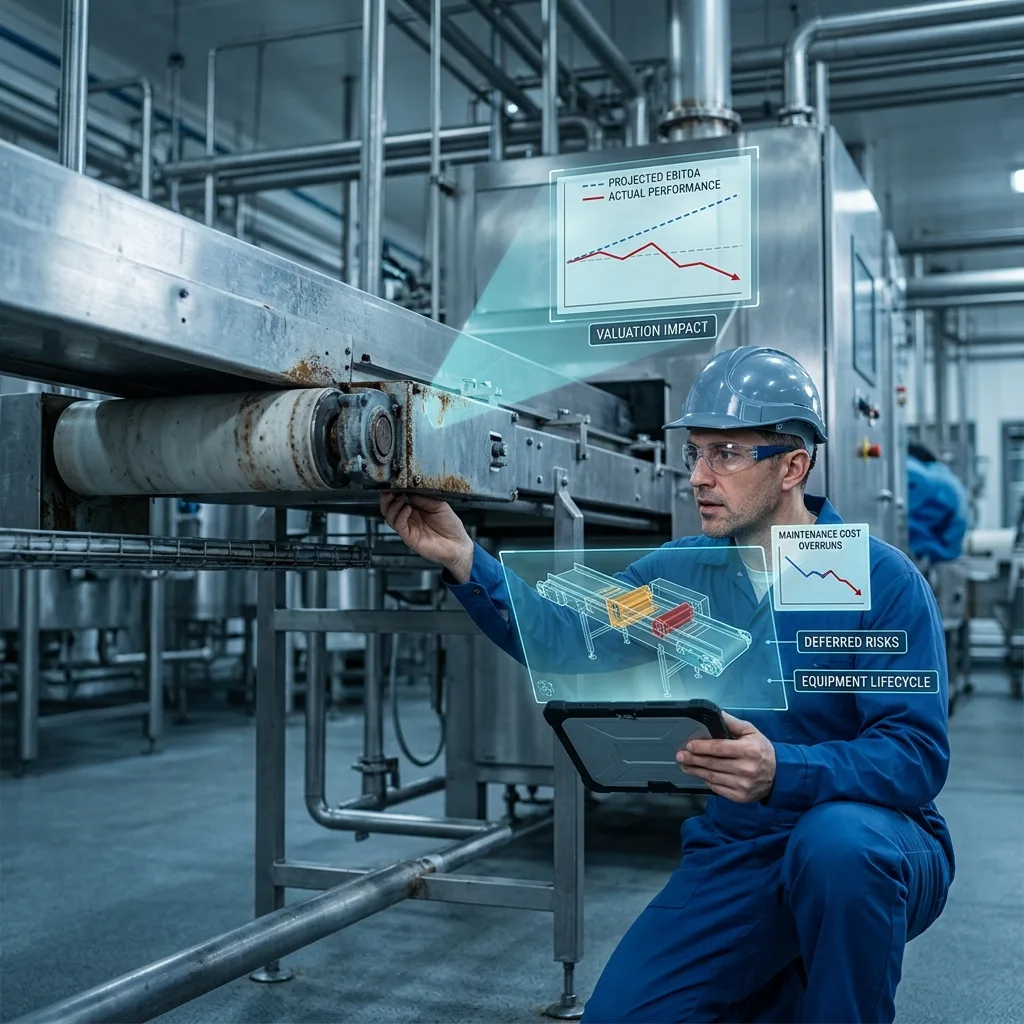
A PE firm acquires a food manufacturing facility for $40M based on $8M EBITDA at a 5x multiple. The financial due diligence looks clean. The operational DD identifies some aging equipment but nothing alarming.
Eighteen months post-close, the reality emerges: $1.2M in emergency repairs, a production line down for 6 weeks, and EBITDA running $1.5M below plan. The root cause wasn't a sudden failure — it was deferred maintenance that accumulated over years, invisible during a 2-week due diligence sprint.
This scenario plays out repeatedly in food manufacturing M&A. Understanding why deferred maintenance matters — and how to identify, quantify, and address it — separates successful acquisitions from costly surprises.
What Deferred Maintenance Actually Is
Deferred maintenance is equipment work that was postponed — not because it wasn't necessary, but because it wasn't urgent. A pump bearing showing early wear. A heat exchanger losing 5% efficiency each quarter. A control system running on an unsupported operating system. A boiler that hasn't been retubed in 8 years despite a 5-year recommended cycle.
In food manufacturing, deferred maintenance accumulates for predictable reasons:
Production pressure. Facilities run 16-20 hours daily. Taking a line down for preventive maintenance means lost production. Operators defer work until the next planned shutdown — then defer again because the shutdown window is too short.
Budget constraints. Maintenance competes with growth CapEx for limited capital. A new production line that generates revenue wins over a compressor rebuild that merely prevents future failure.
Invisible degradation. Equipment doesn't fail suddenly. It degrades gradually — 2% efficiency loss this quarter, another 3% next quarter. By the time performance is noticeably impaired, the cumulative degradation represents significant hidden cost.
Knowledge gaps. Many food facilities lack formal maintenance tracking systems. Equipment history lives in the maintenance manager's memory. When that person leaves, institutional knowledge of what needs attention disappears.
Why Deferred Maintenance Matters in M&A
For PE firms and strategic acquirers, deferred maintenance creates three distinct risks:
Purchase Price Risk
Every dollar of deferred maintenance that surfaces post-close is a dollar that wasn't modeled in the acquisition price. A facility with $800K in identified deferred maintenance and $400K in hidden deferred maintenance has $1.2M in total exposure — potentially reducing enterprise value by $1.2M or more depending on the valuation methodology.
PE firms model deferred maintenance as "deferred CapEx" — an adjustment to enterprise value. But due diligence teams typically identify only 40-60% of total deferred maintenance during a standard operational review. The remaining 40-60% emerges over 12-24 months post-close.
EBITDA Erosion Risk
Deferred maintenance doesn't just represent future repair cost. It actively erodes current EBITDA through:
- Energy waste. A fouled heat exchanger consumes 10-15% more energy. A compressed air system with 25% leakage wastes $30K-$60K annually. Aging refrigeration runs 20-30% less efficiently than rated capacity.
- Throughput loss. Equipment running below rated speed due to wear produces fewer units per hour. A separator processing at 85% of rated capacity on a $50K/hour production line costs $7,500/hour in lost throughput.
- Downtime cost. Unplanned breakdowns on deferred-maintenance equipment average 3-5x the cost of planned maintenance interventions. Emergency repairs require expedited parts, overtime labor, and lost production.
- Quality yield loss. Worn equipment produces inconsistent product — wider temperature ranges, variable fill weights, surface defects — driving rework and scrap.
For a $50M revenue facility, these hidden costs typically total $500K-$1.5M annually in suppressed EBITDA.
Regulatory and Safety Risk
Food manufacturing facilities operate under FDA, USDA, and OSHA oversight. Deferred maintenance on safety-critical systems creates compliance exposure:
- Aging electrical systems with outdated arc flash protection
- Ammonia refrigeration systems past inspection intervals
- Boiler systems with deferred pressure vessel certifications
- CIP systems with worn gaskets creating potential contamination pathways
- Emergency shutdown systems that haven't been tested
A single regulatory finding can trigger mandatory shutdowns, fines, or — in the worst case — product recalls that cost $10M-$50M+.
How to Identify Deferred Maintenance During Due Diligence
Effective identification requires looking beyond the maintenance manager's assurances. Here's what experienced operational DD teams evaluate:
Plant Tour Indicators
Walk the facility with engineering eyes:
- Corrosion and leaks. Visible corrosion on piping, tanks, or structural steel indicates deferred coating and repair. Active leaks (compressed air, steam, water) indicate deferred sealing work.
- Jury-rigged repairs. Hose clamps on piping, zip-tied wiring, temporary supports that became permanent — all indicate deferred proper repairs.
- Noise and vibration. Equipment producing abnormal noise or excessive vibration signals bearing wear, misalignment, or structural degradation.
- Floor conditions. Cracked concrete, standing water, damaged drains indicate deferred facility maintenance that affects sanitation and safety.
- Electrical panels. Open panel doors, visible wire splices, absence of labeling indicate deferred electrical maintenance.
Document Review
Request and analyze:
- Maintenance work order history (3-5 years). Declining work order count + aging equipment = deferred maintenance, not improved reliability.
- Equipment downtime logs. Increasing unplanned downtime on specific assets reveals degradation patterns.
- Capital expenditure history. Facilities spending less than 2-3% of replacement asset value annually on maintenance are likely deferring work.
- Inspection reports. Boiler inspections, electrical assessments, refrigeration system reviews — look for outstanding recommendations.
- Spare parts inventory. Minimal spare parts inventory for critical equipment means the facility relies on emergency procurement during failures.
Operator Interviews
Maintenance managers may minimize issues. Operators live with them daily:
- "Which equipment gives you the most trouble?"
- "What would you fix first if you had unlimited budget?"
- "How often does unplanned downtime occur, and on which equipment?"
- "Are there any workarounds you use regularly because equipment doesn't function as designed?"
Operators will tell you the truth that maintenance reports may obscure.
Quantification Framework
Categorize findings into three tiers:
| Tier | Description | Typical Cost | Timeline |
|---|---|---|---|
| Critical | Safety/regulatory risk, imminent failure | $200K-$500K | 0-6 months |
| Significant | Performance degradation, reliability risk | $300K-$800K | 6-12 months |
| Routine | Cosmetic, minor efficiency, preventive | $100K-$300K | 12-24 months |
Total deferred maintenance for a mid-size food facility ($50M revenue) typically ranges from $600K to $1.6M — representing 8-20% of annual EBITDA.
Practical Strategies to Extend Equipment Lifespan and Reduce Risk
Preventive Maintenance Programs
The foundation: shift from reactive (fix when broken) to preventive (service before failure).
- Asset criticality ranking. Identify the 10-15 assets where failure has the highest production and safety impact. Focus preventive programs here first.
- OEM-based schedules. Follow manufacturer-recommended service intervals as minimum baseline. Adjust based on actual operating conditions (food facilities often run harder than OEM assumptions).
- Planned shutdown windows. Schedule quarterly maintenance windows aligned with production slowdowns. Resist the temptation to cancel them when orders increase.
Cost: $100K-$200K annually for a mid-size facility. ROI: 3-5x through avoided downtime and extended equipment life.
Condition Monitoring and Predictive Technology
Move beyond calendar-based maintenance to condition-based decisions:
- Vibration analysis on rotating equipment (motors, pumps, compressors) detects bearing wear 2-6 months before failure.
- Thermal imaging on electrical systems and heat exchangers identifies hot spots indicating degradation.
- Oil analysis on gearboxes and hydraulic systems reveals metal contamination from internal wear.
- IoT sensors on critical equipment provide continuous monitoring of temperature, pressure, vibration, and energy consumption — triggering alerts when parameters drift from baseline.
Investment: $50K-$150K for sensor deployment + monitoring platform. Payback: 6-12 months through avoided emergency repairs.
Equipment Lifecycle Planning
Every piece of equipment has a useful life. Food manufacturing equipment typically operates on these cycles:
- Pumps and motors: 10-15 years (with regular rebuild at 5-7 years)
- Heat exchangers: 15-20 years (with retubing at 7-10 years)
- Control systems/PLCs: 10-15 years (software support typically ends at 10 years)
- Refrigeration compressors: 15-25 years (with major overhaul at 10-12 years)
- Boilers: 20-30 years (with retubing at 10-15 years)
Mapping equipment age against expected lifecycle reveals where deferred maintenance is accumulating and where capital replacement planning is needed.
The Post-Close Catch-Up Program
For PE firms that have already acquired a facility with deferred maintenance, the proven approach is a concentrated 6-12 month catch-up program rather than spreading fixes across the entire hold period.
The catch-up program prioritizes Tier 1 (critical) items in months 1-6, Tier 2 (significant) items in months 6-12, and folds Tier 3 (routine) items into the ongoing preventive maintenance program.
Why concentrate early? Because deferred maintenance actively suppresses EBITDA. Every month of delay is another month of excess energy cost, lost throughput, and unplanned downtime. Facilities that execute catch-up programs in Year 1 typically recover $500K-$1.5M in annual EBITDA — delivering 3-5x return on the maintenance investment.
How Addressing Deferred Maintenance Creates Value
The value creation math is compelling:
EBITDA Recovery. Resolving $1M in deferred maintenance typically recovers $300K-$500K in annual EBITDA through reduced energy waste, improved throughput, and lower emergency repair costs.
Valuation Multiple Expansion. A facility with a documented preventive maintenance program, condition monitoring, and equipment lifecycle plan commands a premium valuation. Buyers see lower risk, which translates to higher multiples — potentially moving from 4.5x to 5.5x EBITDA.
Reduced Post-Close Surprises. For sellers, addressing deferred maintenance before going to market eliminates the largest source of purchase price adjustments and due diligence findings.
Combined Impact Example:
- Pre-improvement: $8M EBITDA at 5x = $40M enterprise value
- Post-improvement: $9M EBITDA (recovery) at 5.5x (multiple expansion) = $49.5M enterprise value
- Value created: $9.5M from a $1M-$1.5M maintenance investment
For PE firms, sellers preparing for exit, and operators managing food manufacturing facilities, deferred maintenance is not a maintenance problem — it's a value creation opportunity. The facilities that systematically identify, quantify, and address deferred maintenance outperform those that defer it, both operationally and at the point of transaction.