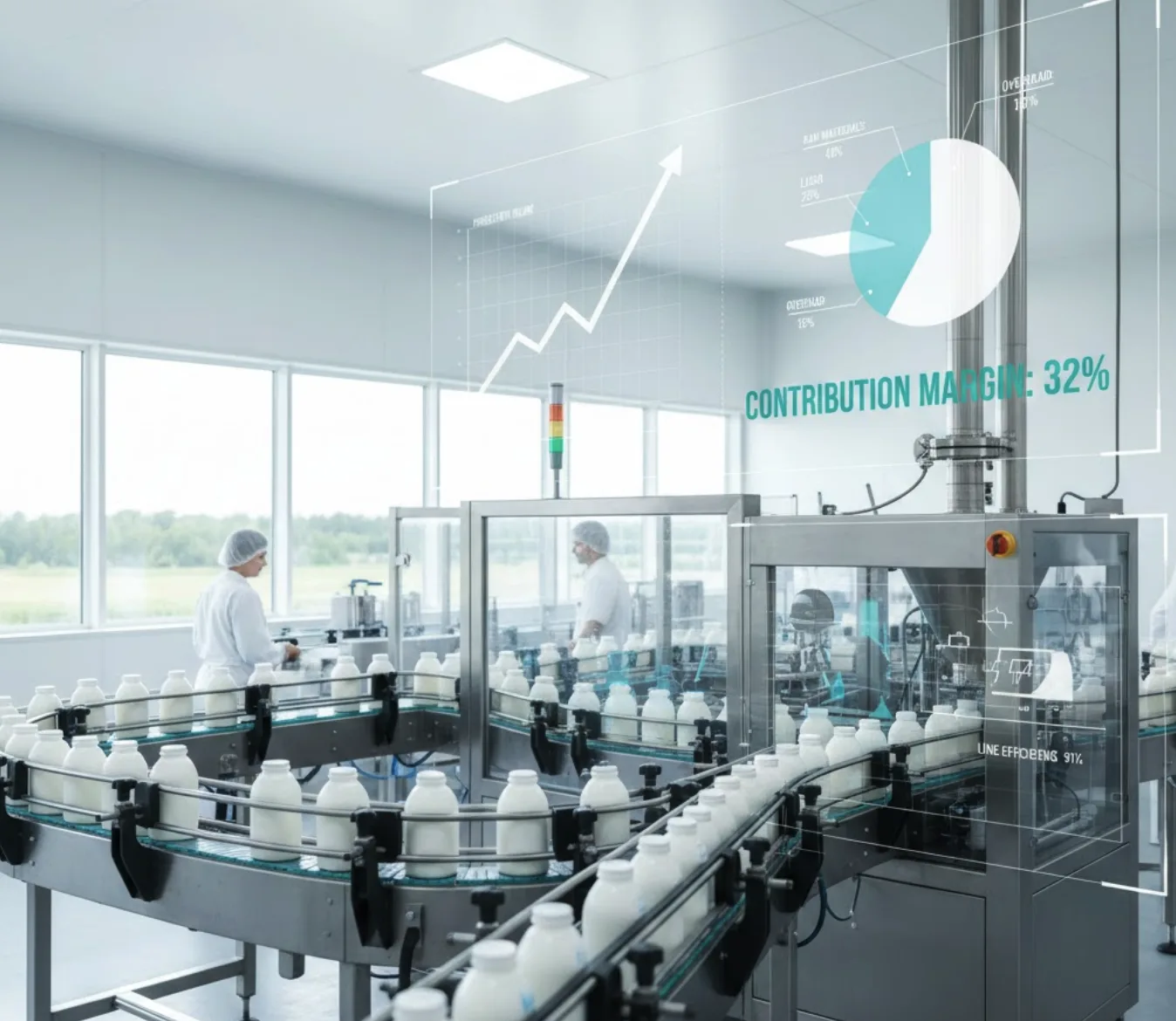
A dairy plant operates three milk processing lines. Line A: steady profitability, 85% utilization, positive contribution margin. Line B: declining volume, 40% utilization, covers variable costs but not allocated overhead. Line C: old equipment, high downtime, variable margins oscillating.
Should the facility expand production or consolidate to fewer lines? The answer requires analyzing contribution margin, fixed cost allocation, and strategic positioning—not just revenue volume.
The Contribution Margin Analysis
Contribution margin (price minus variable cost) tells you whether a line generates incremental value. A line with 65% contribution margin generating $2M in sales contributes $1.3M to cover fixed costs and profit.
A line with 35% contribution margin generating $2M contributes only $700K.
When utilization drops (Line B at 40%), volume falls but variable costs drop proportionally. If Line B generates $800K revenue at 35% margin, contribution is $280K—still positive. But once overhead allocation is considered ($200K assigned to Line B), the "profit" disappears.
This creates confusion. Line B appears unprofitable on the P&L. But eliminating it only saves $200K in allocated overhead while losing $280K contribution. Net impact: -$80K.
The Fixed Cost Absorption Question
Facility fixed costs (plant management, utilities, maintenance, depreciation on building) continue whether a line runs or not. If a facility spends $500K annually on fixed costs and operates three lines, each line "should" cover $167K.
Line B at $280K contribution exceeds its fair share of fixed costs. Eliminating it increases per-line fixed cost allocation for remaining lines—potentially making them appear less profitable.
The correct decision framework:
Decision to Eliminate = (Contribution margin from line) < (Specific fixed costs eliminated)
Line B's $280K contribution EXCEEDS shutdown savings of ~$50K (dedicated staffing reduction), so Line B stays operational.
The Expansion vs. Consolidation Framework
When should you expand vs. consolidate?
Expand if:
- Remaining lines can absorb higher volumes at similar contribution margin
- Customers demand consolidated production (reduces changeover complexity)
- Expansion CapEx < NPV of consolidated operations
Consolidate if:
- Expansion requires significant facility investment (new equipment, utilities upgrade)
- Market demands decline, reducing need for three-line flexibility
- Single, larger-scale line operates at superior efficiency (lower labor per unit)
The Real Decision: What to Spend Capital On
Often the choice isn't "shut down line C" but rather "should we invest $400K upgrading Line C vs. $600K expanding Line A?"
Using contribution margin analysis:
- Line C: $300K contribution with $800K revenue at 37.5% margin
- Upgrade cost: $400K
- Payback: upgrade costs + 1.3 year payback
- Expansion opportunity lost: Can't expand Line A during Line C upgrade
vs.
- Line A: $1.3M contribution with $2M revenue at 65% margin
- Expansion cost: $600K
- Payback: 0.46 year payback
- Line A capacity improves from 85% to 100% utilization
The capital clearly goes to Line A expansion.
For food manufacturing companies, shutdown vs. expansion decisions should prioritize contribution margin analysis over allocated profitability. Lines generating positive contribution margin often justify continued operation despite appearing unprofitable on standard P&Ls. Capital investment should flow to highest-return opportunities identified through contribution margin and payback analysis.