A food manufacturer's sales team is compensated on revenue generation. Result: Sales team pursues every opportunity, discounts aggressively to close deals, acquires many low-margin customers.
Problem: Profitability suffers despite revenue growth.
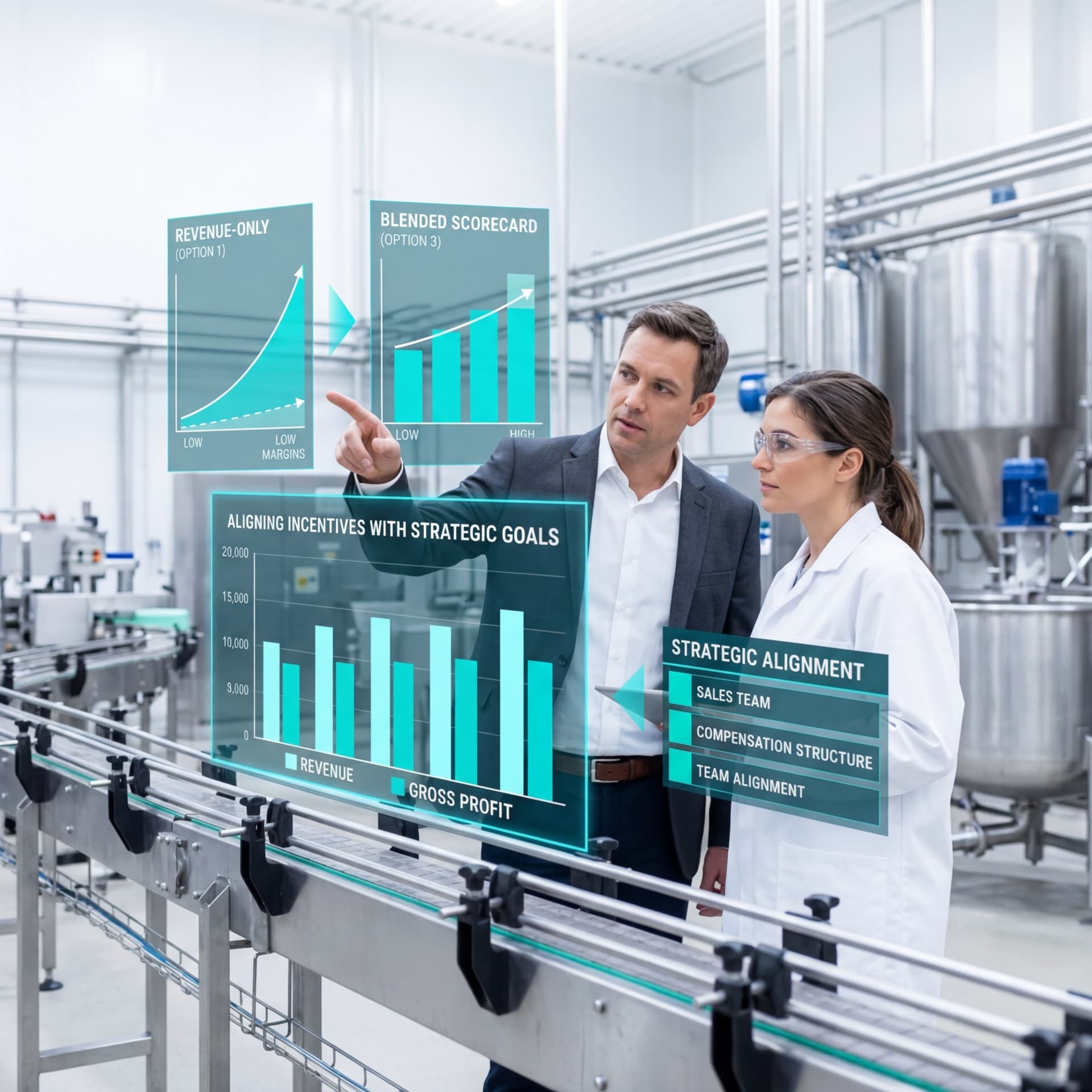
Better approach: Align compensation with strategic goals—revenue AND profitability, retention AND growth.
The Compensation Framework
Option 1: Revenue-Only Commission (Traditional)
- Structure: 5-8% commission on revenue
- Behavior incentive: Maximize volume
- Outcome: Growth, but margin compression through discounting
- Best for: Early-stage companies needing market penetration
Option 2: Gross Profit Commission
- Structure: 8-10% commission on gross profit (revenue minus COGS)
- Behavior incentive: Maximize profitable sales
- Outcome: Better margin focus, reduced aggressive discounting
- Best for: Mature companies with margin pressure
Option 3: Blended Scorecard
- Structure: 60% revenue + 30% profitability + 10% customer retention
- Behavior incentive: Balanced (growth, margin, loyalty)
- Outcome: Holistic behavior—grow profit, not just revenue
- Best for: Most food manufacturers
Example Compensation Impact
Sales Rep A: Revenue-only, 6% commission
- Target: $2M annual revenue
- Commission: $120K base comp
Closes deals:
- $1.5M at 40% margin = $600K gross profit
- $0.5M at 10% margin (to reach revenue target) = $50K gross profit
- Total: $2M revenue, $650K gross profit
Sales Rep B: Gross profit commission, 10% on profit
- Target: $1.5M gross profit
- Commission: 10% x $1.5M = $150K
Closes deals:
- $1.8M at 40% margin = $720K gross profit
- $0.3M at 15% margin (selective) = $45K gross profit
- Total: $2.1M revenue, $765K gross profit
Key insight: Same commission spend ($120K vs. $150K) generates $115K more gross profit with Rep B's model.
The Retention Component
Add customer retention metric to compensation:
- Revenue growth: 50% of commission
- Gross profit: 30% of commission
- Customer retention: 20% of commission
Retention calculation:
- Base commission: $120K
- Retention bonus: If over 80% customer retention (vs. 60% baseline), +$12K
This incentivizes:
- Upselling existing customers (better margin than new acquisition)
- Service quality (reduces churn)
- Long-term relationship focus
Sales Team Structure
| Role | Comp Structure | Focus |
|---|---|---|
| Senior Account Manager | Base $80K + gross profit bonus | Strategic customers, relationship, upselling |
| Sales Representative | Base $60K + revenue commission + retention bonus | New customer acquisition, pipeline building |
| Inside Sales (SDR) | Base $50K + activity metrics (meetings booked) | Prospecting, lead generation |
The Strategic Alignment
For growth phase: Revenue focus (50-60% weight) For mature phase: Profitability focus (40-50% weight) For platform consolidation: Retention focus (30-40% weight)
For food manufacturing companies, sales compensation structure should evolve with business maturity—prioritizing growth early, shifting to profitability and retention as company matures to optimize overall value creation.