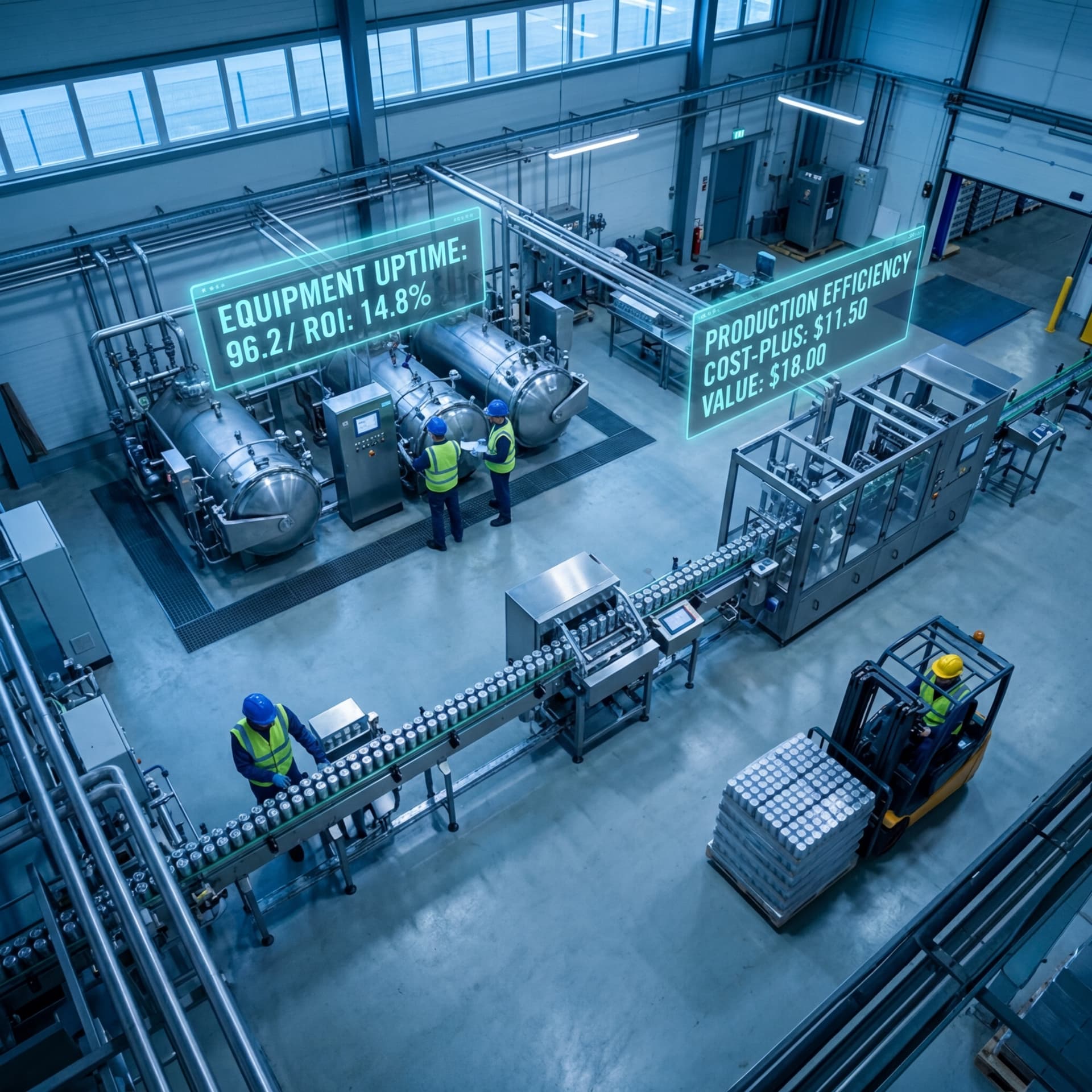
Most food manufacturers use cost-plus pricing: Calculate production cost, add fixed markup (typically 30-40%), set price.
Cost-plus is simple, but it often leaves money on the table. A premium-positioned dairy separator might command 50% markup while a commodity product only supports 20%. Cost-plus pricing ignores these differences.
Value-based pricing sets price based on customer willingness to pay—capturing more of the value created.
The Pricing Framework Comparison
Cost-Plus Approach:
- Production cost: $10/unit
- Fixed markup: 35%
- Sale price: $13.50/unit
- Margin: $3.50/unit (35%)
Advantage: Simple, fair, easy to justify Disadvantage: Ignores customer value perception, leaves margin on table
Value-Based Approach:
Same product, different customer segments:
| Segment | Value Proposition | Willingness to Pay | Optimal Price |
|---|---|---|---|
| Premium organic | Natural, premium brand | $18/unit | $17.50 |
| Foodservice | Reliability, consistency | $15/unit | $14.50 |
| Retail store brand | Cost competitive | $12/unit | $11.50 |
| Ingredient supplier | Volume, consistency | $11/unit | $10.75 |
Using value-based pricing vs. cost-plus on the same product:
- Organic segment: +$4/unit above cost-plus
- Foodservice: +$1/unit above cost-plus
- Retail: -$2/unit below cost-plus (price-sensitive)
- Ingredient: -$2.75/unit below cost-plus (commodity)
The Market Research Foundation
Value-based pricing requires understanding customer value perception:
1. Qualitative Research:
- Customer interviews exploring what they value
- What problems does your product solve?
- How does your product compare to alternatives?
- What would cause them to switch?
2. Quantitative Research:
- Conjoint analysis: Test price elasticity at different price points
- Willingness to pay studies: What would you pay for this product?
- Competitive benchmarking: What do similar products cost?
3. Segmentation:
- Identify distinct customer segments with different value perceptions
- Price each segment based on their willingness to pay
Implementing Value-Based Pricing
Step 1: Identify Segments
- Premium positioned (organic, local, specialty)
- Mainstream (quality, consistent supply)
- Value (lowest cost)
Step 2: Quantify Value Drivers For each segment, identify what creates value:
- Premium: Sustainability, transparency, quality
- Mainstream: Reliability, consistent product, good service
- Value: Lowest cost, acceptable quality
Step 3: Set Prices
- Premium segment: Price at 80-90% of customer willingness to pay
- Mainstream: Price at 75-85% of willingness to pay
- Value: Price at 70-80% of willingness to pay
Step 4: Monitor and Adjust
- Track sales volume and margin by segment
- Adjust pricing if volume drops too much or margins insufficient
- Annually reassess market willingness to pay
The Financial Impact
A facility selling $50M revenue at 35% cost-plus margin generates $8.75M gross profit.
Implementing value-based pricing improves margin by 2-3 percentage points (from 35% to 37-38%) through:
- Premium pricing where value justifies it
- Better alignment of price to customer value perception
- Reduced discounting (because prices reflect value)
2% margin improvement on $50M = $1M additional gross profit.
The Risks to Manage
- Pricing too high: Lose volume to lower-cost competitors
- Differentiation credibility: Can you actually deliver the value you're claiming?
- Customer communication: Justify premium pricing based on value delivered
For food manufacturing companies, transitioning from cost-plus to value-based pricing requires market research but delivers significant margin improvement while better aligning price to customer value perception.