A food manufacturer executes growth strategy: Acquires competitor, launches new product line, enters new market. All good initiatives.
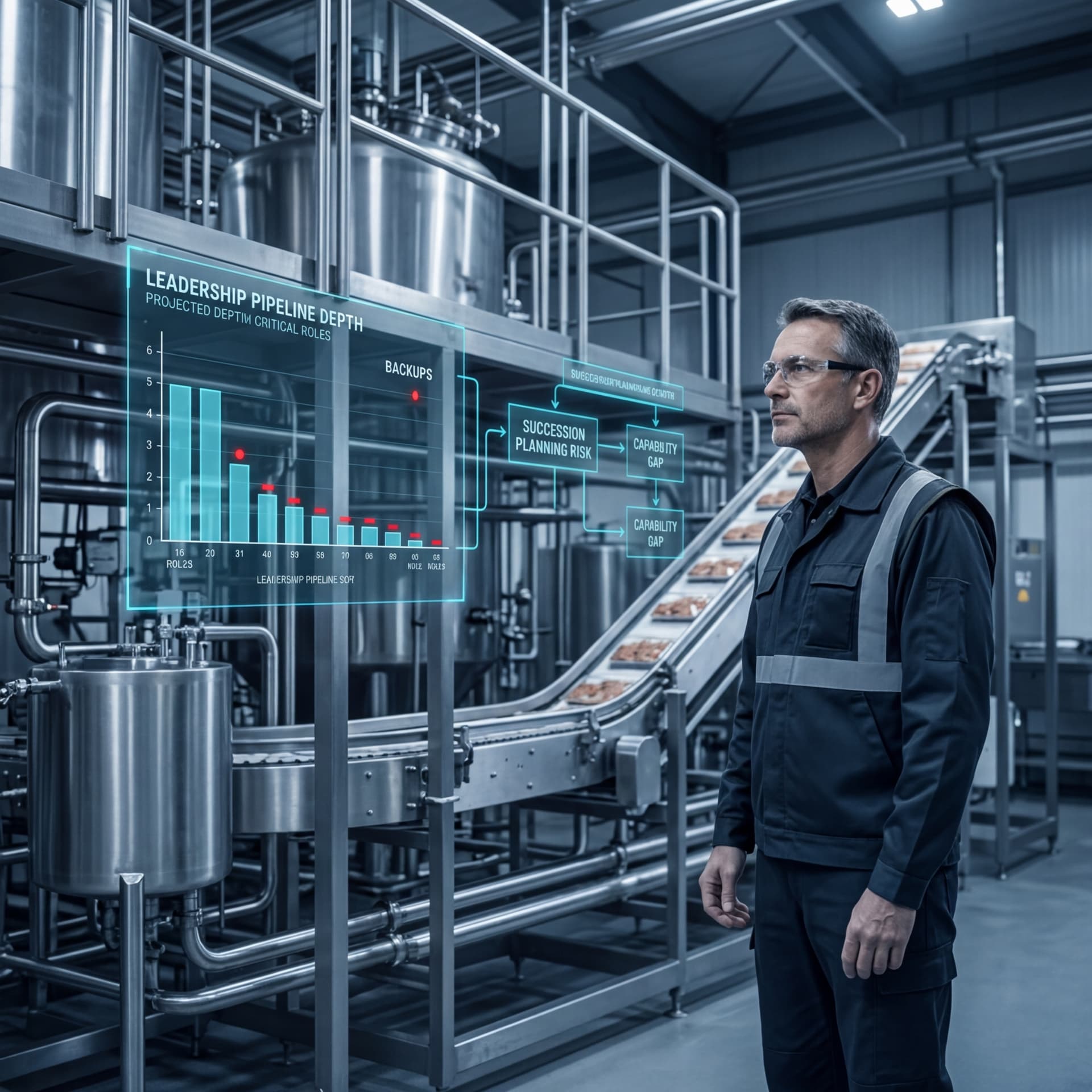
But the organization lacks management depth. Plant manager stretched across 2 facilities. No functional heads with P&L responsibility. Succession plan empty.
Strategic initiatives fail not due to strategy -- but due to organizational capability to execute.
The Capability Building Framework
Assessment Phase (Months 1-3):
Evaluate current state:
| Role | Critical? | Current Depth | Bench Strength |
|---|---|---|---|
| Plant Manager | Yes | 1 person | 0 backups |
| Operations Manager | Yes | 1 person | 1 backup |
| Sales Manager | Yes | 2 people | 0 backups |
| Quality Manager | Yes | 1 person | 0 backups |
| Finance Manager | Yes | 1 person | 0 backups |
Assessment findings: 4 of 5 critical roles have no backup. Organization at risk.
Talent Development Strategy
Tier 1: Immediate Bench Strength (9-12 Months)
- Identify high-potential individual contributors
- Assign mentorship from current leader
- Provide formal training in management/functional area
- Rotate through experiences building depth
- Cost: $20K-$50K per person
Example:
- Operations Coordinator to Mentored by Operations Manager
- Sales Rep to Mentored by Sales Manager
- Quality Tech to Mentored by Quality Manager
Tier 2: Leadership Development (2-3 Years)
- External executive education programs (MBA, executive development)
- Cross-functional assignments
- P&L responsibility for product line or region
- Cost: $30K-$80K per person + opportunity cost
Example:
- High-potential operational manager to Lead new product launch (P&L ownership)
- Sales manager to Attend leadership development program
Tier 3: Succession Planning (3-5 Years)
- Formal succession plans for all critical roles
- Multi-candidate pipeline for each role
- Phased handoffs (current leader mentors successor)
- Documentation of institutional knowledge
Talent Retention
Key drivers of retention:
-
Career Growth: Clear path to advancement
- Define roles/competencies for progression
- Regular feedback and development planning
- Internal mobility opportunities
-
Compensation: Competitive pay and benefits
- Benchmark against industry
- Performance-based bonus tied to company goals
- Equity or profit sharing for leadership
-
Work Environment: Supportive culture
- Clear roles and expectations
- Support for continuous learning
- Recognition of contributions
-
Purpose: Mission alignment
- Employees understand company vision
- Role clarity in achieving objectives
- Sense of impact
Development Investment ROI
Investment (3-Year):
- Development programs: $200K (10 employees x $20K)
- Backfill/opportunity cost: $300K
- External recruiting (when replacements don't work): $150K
- Total: $650K
Benefit:
- Reduced turnover (save 2 key retentions x $80K replacement cost): $160K
- Faster decision-making (strong bench = better decisions): $300K annually
- Successful execution of growth strategy (due to capable team): $1M+ value creation
3-Year ROI: Positive (benefits $800K+ vs. $650K investment)
Implementation Roadmap
Q1: Assess current organizational capability gaps Q2: Define development plans for high-potential individuals Q3: Launch formal mentorship and development programs Q4: Quarterly talent review assessing progress
Year 2-3:
- Leadership development programs
- Cross-functional assignments
- Succession planning formalization
- External hires for specialized expertise (if needed)
The Growth Enabler
Most growth strategies fail not due to strategy -- but due to organizational capability. Strong talent development programs enable execution of ambitious plans while retaining institutional knowledge.
For food manufacturing companies, investing in talent development and succession planning builds organizational capability supporting strategic ambitions while reducing execution risk.