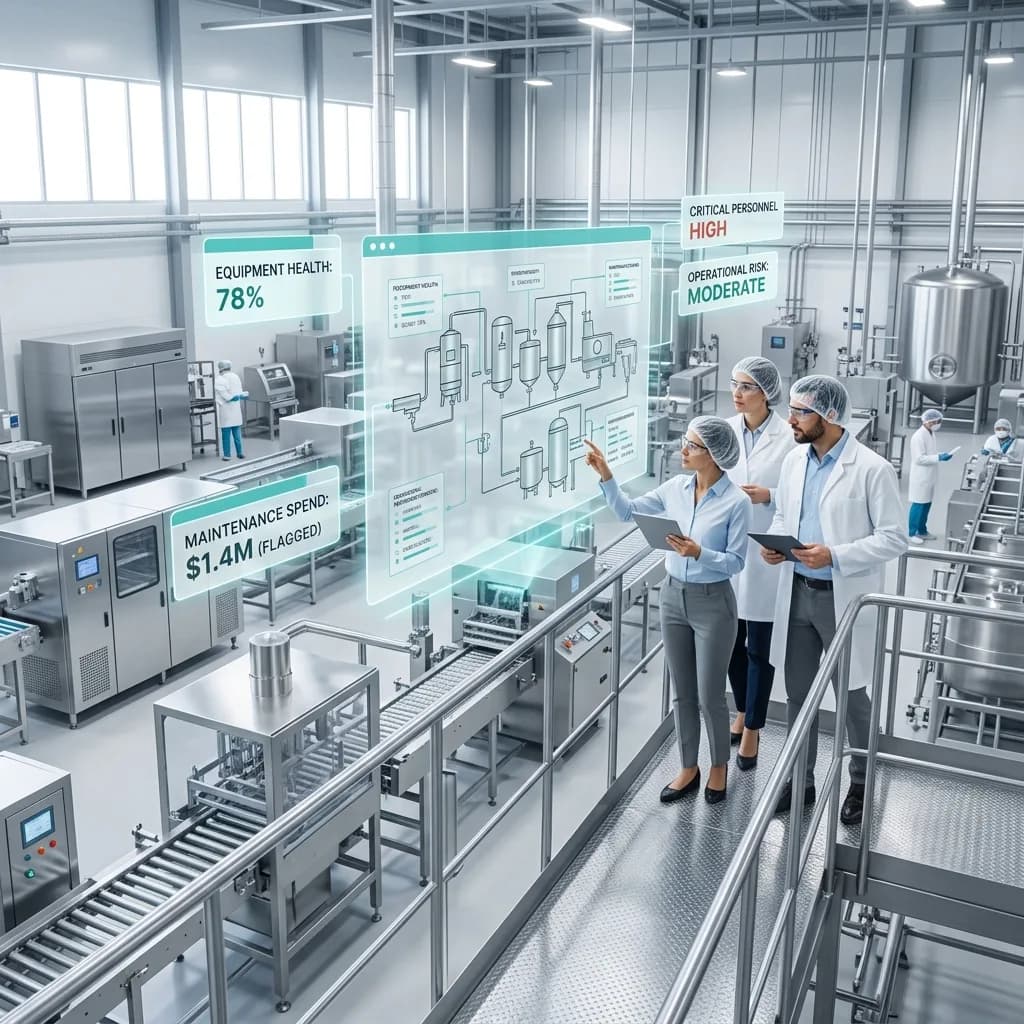
A mid-market PE firm signs an LOI on a $55M meat processing facility. The deal team has 3 weeks to complete operational due diligence before exclusivity expires. The CFO hands over a clean CIM with $9.2M adjusted EBITDA. Financial DD confirms the numbers. But the investment committee wants answers to questions that don't live in spreadsheets: What's the real condition of the refrigeration system? How dependent is the operation on three key employees? Is $1.4M in annual maintenance spend adequate or a sign of chronic underinvestment?
This is the operational DD challenge — and most deal teams either skip it, outsource it to a generalist firm that produces a 200-page report nobody reads, or conduct a surface-level walkthrough that misses the findings that actually move valuations.
This guide provides a step-by-step operational DD process specifically designed for food processing acquisitions. A junior analyst can follow this framework and deliver findings that directly inform the investment committee's go/no-go decision.
Phase 1: Pre-Visit Preparation (Days 1-5)
The quality of your site visit is determined by the work you do before you arrive. Five days of focused preparation transforms a plant tour from a guided walkthrough into a forensic investigation.
Document Request List
Submit your document request within 24 hours of LOI execution. Every day of delay compresses your analysis window. Request the following:
Financial and operational data:
- 36 months of P&L by production line (not just facility-level)
- Maintenance spend detail: labor, parts, contractors, by month
- CapEx history — last 5 years, actuals vs. budget
- Utility bills — electricity, gas, water, sewer — last 24 months
- Production volume by SKU, by month, last 24 months
- Yield data: input lbs vs. finished goods lbs, by line
- Downtime logs: planned and unplanned, by line, last 12 months
Equipment and facility:
- Fixed asset register with original install dates and purchase prices
- Equipment list with make, model, year, and replacement cost estimates
- Maintenance work order history (CMMS export if available)
- Capital project backlog — approved but not yet executed
- Building condition reports, roof inspection reports
- Fire suppression system inspection records
Regulatory and compliance:
- FDA/USDA inspection reports — last 3 years
- OSHA citations or inspection reports — last 3 years
- Environmental permits: air, water discharge, stormwater
- Discharge monitoring reports (DMRs) — last 24 months
- Third-party audit scores (SQF, BRC, FSSC 22000) — last 3 audits
- Workers' compensation claims history — 3 years
Workforce:
- Organizational chart with tenure for each management position
- Headcount by department, shift, and employment type
- Turnover rates by department — last 3 years
- Wage rate benchmarking data (if available)
- Training records and certification tracking
Pre-Visit Analysis
Before stepping foot in the facility, your analyst should complete these calculations:
| Analysis | Formula | What It Reveals |
|---|---|---|
| Maintenance spend as % of RAV | Annual maintenance / Replacement asset value | under 1.5% = chronic underinvestment; 2-3% = healthy; over 4% = reactive mode |
| CapEx as % of revenue | Annual CapEx / Revenue | under 2% for 3+ years = deferred investment |
| Energy cost per lb | Total energy spend / Total lbs produced | Benchmark against industry; over $0.04/lb protein = efficiency opportunity |
| OEE estimate | (Uptime % x Performance % x Quality %) | under 65% = significant improvement opportunity |
| Maintenance labor ratio | Maintenance FTEs / Total production FTEs | under 5% = understaffed maintenance team |
| Yield loss cost | (Input lbs - Output lbs) x Raw material cost/lb | Quantifies the dollar value of waste |
Flag anomalies. If the target reports $1.4M in maintenance spend on $18M in replacement assets, that's 7.8% of RAV — far above the 2-3% benchmark. Either the equipment is in poor condition requiring excessive repair, or maintenance is being miscategorized. Both findings matter.
Pre-Visit Hypotheses
Based on document analysis, develop 5-7 hypotheses to test during the site visit. Examples:
- "Maintenance spend dropped 30% in Year 3 while production volume increased 15% — we expect to find deferred maintenance on high-utilization equipment."
- "Three key operators have 20+ years of tenure with no documented succession plan — critical key-person risk."
- "Wastewater discharge permit expires in 14 months — current treatment system may not meet anticipated tighter limits."
These hypotheses focus your site visit. Instead of wandering the plant, you're investigating specific questions.
Phase 2: The 2-Day Site Visit (Days 6-7)
Two days is the minimum for a thorough operational DD of a food processing facility. One day is a plant tour. Two days is due diligence.
Day 1: Facility Assessment and Operations Review
6:00-7:00 AM — Shift Change Observation Arrive before the day shift starts. Watch the shift changeover. Look for structured handoff procedures, pre-shift meetings, visual management boards. Chaotic shift changes signal weak operational discipline. Note staffing levels — are positions unfilled? Are operators covering multiple stations?
7:00-10:00 AM — Production Floor Walkthrough Walk every production line, every utility room, every storage area. Use this checklist:
Structural and facility:
- Roof condition — staining, active leaks, patch repairs
- Floor condition — cracks, standing water, slope to drains
- Wall and ceiling panels — damage, missing sections, mold
- Dock doors and seals — condition, pest entry points
- Lighting adequacy — dark areas, non-functional fixtures
Equipment condition:
- Visible corrosion on piping, tanks, conveyors
- Leaks — compressed air, steam, refrigerant, product
- Abnormal noise or vibration on rotating equipment
- Jury-rigged repairs — hose clamps, zip ties, temporary supports
- Guard conditions — missing, modified, bypassed safety guards
- Control panel condition — clean, labeled, closed, organized
Sanitation and food safety:
- CIP system condition and coverage
- Condensation control — especially over open product zones
- Allergen segregation practices (if applicable)
- Employee hygiene practices — handwashing, GMP compliance
- Pest control device placement and monitoring logs
Utilities:
- Boiler room — age, condition, redundancy, water treatment
- Refrigeration — compressor age, condenser condition, ammonia detection
- Compressed air — dryer condition, leak audibility, oil-free if required
- Electrical — panel age, capacity utilization, backup generation
- Wastewater — treatment system type, capacity, condition
10:00 AM-12:00 PM — Management Interviews Interview the plant manager, maintenance manager, quality manager, and production manager individually. Key questions:
- "What keeps you up at night about this facility?"
- "If you had $500K in unbudgeted CapEx, what would you fix first?"
- "What equipment would you replace tomorrow if you could?"
- "What's your biggest constraint to increasing throughput by 20%?"
- "How many unplanned breakdowns did you have last month?"
- "What's the average age of your maintenance team? Who's retiring in the next 3 years?"
These open-ended questions reveal what the data doesn't show. The maintenance manager who immediately lists 8 critical needs is telling you the deferred maintenance backlog is real and well-understood.
12:00-1:00 PM — Working Lunch with Line Supervisors Informal conversations with supervisors and lead operators often surface the most valuable operational intelligence. Ask about workarounds, recurring problems, equipment they've "learned to live with."
1:00-4:00 PM — Document Deep-Dive On-Site Review maintenance logs, production records, and quality data on-site where you can ask questions in real time. Pull the last 6 months of work orders. Calculate planned vs. unplanned maintenance ratio. Review the top 10 equipment failures by frequency and cost.
4:00-5:00 PM — Second Shift Observation Stay for the second shift start. Staffing adequacy often differs between shifts. Note whether second shift supervision matches first shift quality.
Day 2: Focused Investigation and Validation
7:00-10:00 AM — Follow-Up Inspections Return to areas where Day 1 findings raised questions. Bring the maintenance manager. Ask them to open electrical panels, show you the inside of tanks, demonstrate control systems. Test your pre-visit hypotheses with direct evidence.
10:00 AM-12:00 PM — Workforce and HR Review Meet with HR. Review turnover data, wage competitiveness, training program structure, workers' comp history. Interview 2-3 hourly employees (with management's permission) about working conditions, training adequacy, and job satisfaction.
12:00-2:00 PM — Regulatory and Compliance Review Review all permits, inspection reports, and audit findings on-site. Walk the wastewater treatment system with the environmental compliance person. Review the corrective action log from the most recent third-party food safety audit.
2:00-4:00 PM — Capital Planning and Growth Capacity Assess the facility's capacity for growth. Is there physical space for additional lines? Is the utility infrastructure (power, water, refrigeration, wastewater) sized to support 20-30% production increases? What would a capacity expansion cost?
4:00-5:00 PM — Exit Meeting with Plant Manager Share preliminary observations (high-level only). Ask for clarification on any outstanding items. Confirm timeline for receiving any outstanding documents.
Phase 3: Post-Visit Analysis (Days 8-14)
Synthesizing Findings
Organize findings into four categories with direct valuation impact:
| Category | Finding Type | Valuation Treatment |
|---|---|---|
| Immediate CapEx | Equipment at or past end of life, safety hazards, compliance gaps | Deduct from enterprise value |
| Deferred CapEx (0-12 months) | Equipment approaching failure, permit renewals requiring upgrades | Deduct from enterprise value or model as Year 1 CapEx |
| Value Creation Opportunities | OEE improvement, yield improvement, energy savings, maintenance optimization | Model as EBITDA upside in operating plan |
| Risk Factors | Key-person dependency, regulatory exposure, workforce instability, supply chain concentration | Adjust risk premium or require escrow/holdback |
The Findings-to-Valuation-Impact Framework
Every operational finding must translate to dollars. Use this framework:
Equipment condition findings:
- Remaining useful life estimate (years)
- Replacement cost (get quotes if over $100K)
- Annual maintenance cost trend (increasing = approaching failure)
- Production impact if equipment fails ($/day of lost production)
Operational efficiency findings:
- Current OEE vs. benchmark OEE for the category
- Gap in percentage points x production hours x throughput value = annual opportunity
- Example: 68% OEE vs. 80% benchmark = 12 points x 6,000 hours x $5,000/hr = $360K annual EBITDA opportunity
Workforce findings:
- Current turnover cost (turnover rate x headcount x $8K-$12K per replacement)
- Key-person risk quantification (cost to recruit + 6-month productivity loss)
- Training investment needed to reduce turnover to benchmark levels
Phase 4: DD Report and IC Presentation (Days 15-21)
DD Report Structure
- Executive Summary (1 page) — Go/no-go recommendation with top 3 findings and total valuation impact
- Facility Overview (1-2 pages) — Age, size, capacity, utilization, major equipment
- Critical Findings (3-5 pages) — Findings that affect purchase price or deal structure
- Value Creation Opportunities (2-3 pages) — EBITDA improvement roadmap with timeline and investment required
- Risk Register (1-2 pages) — Ranked risks with probability, impact, and mitigation cost
- 100-Day Plan (1-2 pages) — Priority actions for the first 100 days post-close
- Capital Plan (1 page) — 3-year CapEx forecast: maintenance, compliance, growth
- Appendices — Photos, equipment lists, supporting calculations
Typical DD Timeline
| Week | Phase | Key Activities | Deliverable |
|---|---|---|---|
| Week 1 | Pre-visit preparation | Document request, financial analysis, hypothesis development | Pre-visit briefing memo |
| Week 2 | Site visit | 2-day facility assessment, interviews, document review | Raw findings and photo documentation |
| Week 3 | Analysis and synthesis | Findings quantification, valuation impact modeling, report drafting | Draft DD report |
| Week 4 | Final report and IC prep | Report finalization, IC presentation preparation, Q&A prep | Final DD report + IC presentation |
Tying It All Together
Operational DD in food processing isn't about producing a comprehensive catalog of every equipment deficiency. It's about answering three questions for the investment committee:
-
What's the real CapEx requirement? Not the seller's sanitized capital plan, but the actual capital needed to run this facility reliably for the next 5-7 years. On a $55M deal, the gap between the seller's $500K annual CapEx estimate and the actual $1.2M requirement represents $3.5M in net present value — enough to change the deal math.
-
Where's the EBITDA upside? Every food processing facility has operational improvement potential. The DD should quantify it: $360K from OEE improvement, $180K from yield optimization, $120K from energy efficiency, $200K from maintenance program maturity. That's $860K in annual EBITDA improvement — at a 7x exit multiple, that's $6M in value creation.
-
What could go wrong? Key-person departures, regulatory actions, equipment failures, customer losses from compliance gaps. Price these risks into the deal structure through holdbacks, escrows, representations, or purchase price adjustments.
The deal teams that run this process systematically — preparation, investigation, quantification, presentation — consistently make better investment decisions. They avoid the $2M surprise 18 months post-close. They identify the $860K EBITDA improvement that funds the value creation plan. And they walk into the investment committee with the confidence that comes from having actually understood what they're buying.