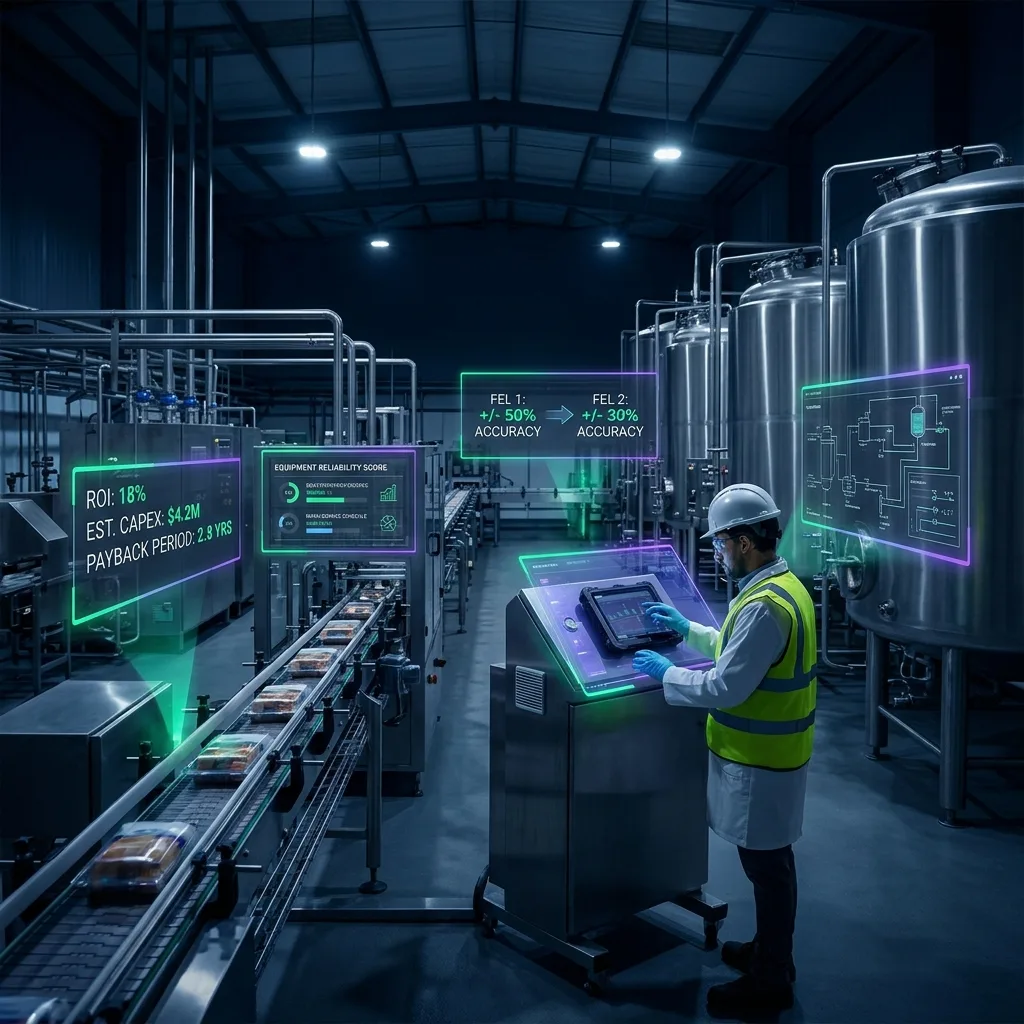
Most food manufacturing facilities skip feasibility studies. Project ideas go directly to design and bidding. This approach creates surprises: equipment doesn't fit, utilities are inadequate, site conditions require modifications, scope creeps.
The alternative: Front-End Loading (FEL)—a three-phase approach that resolves uncertainties before expensive execution begins.
FEL-1: Exploration Phase (1-3 Months)
Goal: Determine if the project is viable and worth pursuing.
FEL-1 activities:
- Situation analysis (current facility assessment)
- Problem statement definition
- Multiple design concepts evaluated
- Preliminary process flow diagrams
- High-level equipment list
- Infrastructure review (electrical, water, drainage, utilities)
- Cost estimate accuracy: +/- 50% ($250K project could be $125K-$375K)
- Risk identification (technology, execution, regulatory)
Cost: Less than 1% of total project investment
Outcome: Go/no-go decision. If viable, fund FEL-2.
FEL-2: Conceptual Engineering Phase (2-4 Months)
Goal: Lock in design approach and refine cost estimates.
FEL-2 activities:
- Detailed process design basis
- Refined equipment selection with vendor quotes
- P&IDs (Process & Instrument Diagrams)
- Utility load calculations (electrical, water, steam requirements)
- Civil/structural layout planning
- Preliminary electrical and controls design
- Hazard analysis and safety review
- Cost estimate accuracy: +/- 30% ($250K project now $175K-$325K)
- Risk mitigation strategies identified
- Permitting pathway defined
Cost: 1-3% of total project investment
Outcome: Refined scope definition and capital authorization.
FEL-3: Detailed Engineering Phase (3-6 Months)
Goal: Develop complete design for construction and procurement.
FEL-3 activities:
- Detailed equipment specifications
- Complete P&IDs with instrument details
- 3D plant layout models
- Electrical single-line diagrams and wiring plans
- Structural engineering and foundation design
- Constructability reviews identifying schedule risks
- Cost estimate accuracy: +/- 10-15% ($250K project now $212K-$287K)
- Final construction schedule (critical path analysis)
- Detailed execution plan including procurement strategy
- Regulatory approvals and permits filed
Cost: 10-20% of total project investment
Outcome: Bid-ready design. Construction can proceed with high confidence.
Why FEL Works for Food Manufacturing
Food facilities have unique complexities: sanitation requirements, utility loads (high water volume, steam, compressed air), drainage infrastructure, and regulatory compliance. These don't become apparent until detailed engineering.
A $500K project that skips FEL might encounter $100K in unexpected site modifications. A $500K project completing FEL-1-2-3 spends $25K but avoids surprises.
The ROI
FEL-1 typically shows immediate ROI by eliminating marginal projects. FEL-2-3 prevents cost overruns and schedule delays that typically exceed 20% of project cost.
For food manufacturing companies, investing in FEL frameworks converts capital project uncertainty into calculated risks and accurate budgets.