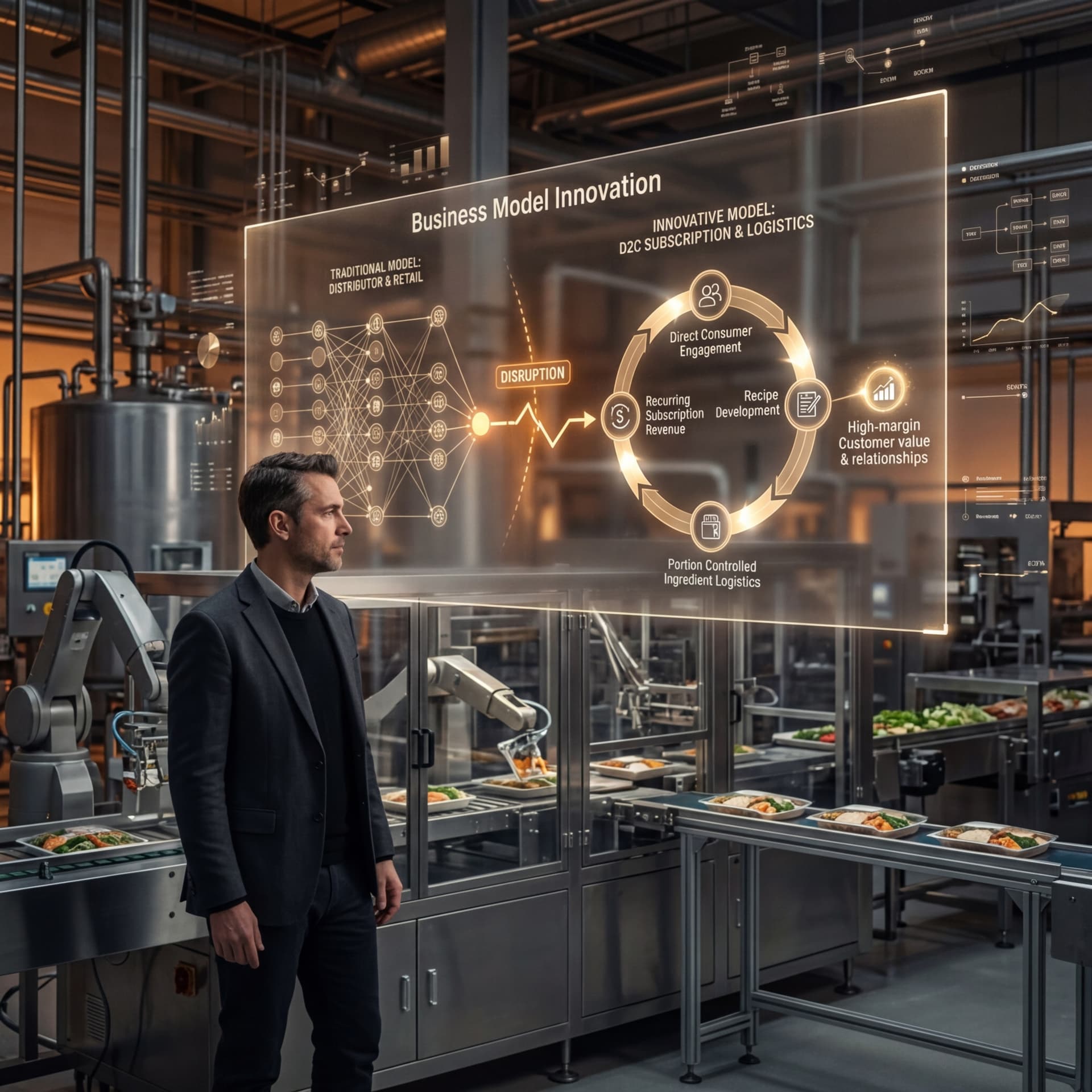
Traditional food manufacturer: Sell products to distributors, who sell to retailers, who sell to consumers. Fragmented, low-margin channel.
Direct-to-consumer food company (e.g., HelloFresh): Ship meal kits directly to homes. Proprietary recipes, portion-controlled ingredients, easy cooking. Build customer relationships and recurring subscription revenue. Higher margins, customer data, loyalty.
Same products (food), radically different business model and profitability.
The Business Model Framework
Core Components:
-
Value Proposition: What problem do we solve? What value do customers receive?
- Traditional: "Affordable dairy products" (commodity)
- Direct-to-consumer: "Easy home meals delivered weekly" (convenience + customization)
-
Value Creation: How do we create the value?
- Traditional: Efficient production, volume
- Direct-to-consumer: Recipe development, ingredient sourcing, logistics
-
Value Delivery: How do customers access the value?
- Traditional: Wholesale to retail distribution
- Direct-to-consumer: Direct shipping to home
-
Revenue Model: How do we capture value?
- Traditional: Per-unit revenue
- Direct-to-consumer: Subscription revenue (recurring, predictable)
-
Customer Segments: Who do we serve?
- Traditional: Anyone who eats dairy
- Direct-to-consumer: Health-conscious, busy professionals, subscription users
Business Model Innovation Types
Type 1: Value Proposition Innovation
- Solve different customer problem
- Example: From "nutritious food" to "convenient home meals"
- Investment: Product development, customer research
- Impact: New customer segment, premium pricing
Type 2: Value Creation Innovation
- New capabilities or partnerships
- Example: Add meal kits + recipe development capability
- Investment: New operations, skills, technology
- Impact: Better unit economics, competitive advantage
Type 3: Value Delivery Innovation
- New channels or logistics
- Example: Direct-to-consumer vs. wholesale
- Investment: Logistics, customer service, marketing
- Impact: Direct customer relationships, subscription revenue
Type 4: Revenue Model Innovation
- New pricing or revenue structure
- Example: Subscription vs. per-unit
- Investment: Technology, billing systems, customer service
- Impact: Recurring revenue, customer lifetime value improvement
Digital Business Model Examples
Subscription Model:
- HelloFresh, Purple Carrot (meal delivery)
- Recurring revenue, customer lock-in
- Higher margins vs. retail
Platform Model:
- Instacart, Uber Eats (marketplace)
- Connect customers, restaurants, drivers
- Extract value from facilitating transactions
Direct-to-Consumer:
- Bonafide Provisions, Ritual (brand direct)
- Own customer relationship
- Premium positioning, higher margin
Hybrid:
- Combine traditional + innovation
- Sell through retail + build DTC subscription
- Diversify revenue, build brand
Business Model Innovation Process
Step 1: Assess Current Model
- What is current value proposition?
- How is value created?
- How is value delivered?
- Revenue model and margins?
- Customer satisfaction?
Step 2: Identify Gaps
- Unmet customer needs
- Inefficiencies in value creation
- Distribution channel gaps
- Revenue optimization opportunities
Step 3: Explore Innovations
- What customer problems could we solve differently?
- What new delivery channels exist?
- What revenue models could improve margins?
- What digital capabilities enable new model?
Step 4: Test and Validate
- Pilot new model with subset of customers
- Measure economics, customer feedback
- Iterate based on learning
- Scale if validated
Step 5: Transition Strategy
- Decide: Canary, hybrid, or full transition
- Manage: Risk of existing model cannibalization
- Invest: Required capabilities and infrastructure
- Timeline: Phased rollout
Examples of Successful Innovation
| Company | Traditional | Innovation | Result |
|---|---|---|---|
| Rebel Foods | Restaurant chain | Cloud kitchens + multi-brand | 3x growth, asset-light model |
| HelloFresh | Retail distribution | Meal kit subscription | Direct customer relationships, premium margins |
| Bonafide | Restaurant | Direct-to-consumer | DTC brand, higher margins |
Risk and Reward
Innovation Potential: 3-5x margin improvement, new customer segments, recurring revenue
Investment Required: $5-20M depending on scope
Timeframe: 2-3 years to profitability
Risk: Cannibalization of existing business, execution complexity, market acceptance
For food manufacturing companies, strategic business model innovation transforms value proposition, delivery, or revenue model enabling competitive differentiation and margin improvement.